



It’s been a while since premium OTT platforms offered consumers a very clean pitch: pay more money, get rid of the ads.
Across India and global markets, streaming companies from Netflix to Disney+ Hotstar, Amazon Prime Video and Sony Liv steadily pushed higher-priced “Ad-Free” tiers while quietly increasing subscription prices underneath them. For some streamers like Netflix, the Ad-free narrative is embedded in all of their plans.
For movies and binge-watch television, the arrangement mostly works. Pay the premium, skip the interruptions. Then live sports enter the equation and the entire promise suddenly becomes negotiable.
Open an IPL game, a Champions League match or an ICC knockout fixture on a premium account and the experience immediately changes. Commercial breaks return. Sponsor graphics flood the screen. Strategic timeout branding appears every few minutes. L-band ads creep across the broadcast. QR-code integrations flash during pauses in play.
To a subscriber paying specifically to avoid advertising, it feels contradictory. But inside the sports streaming business, this has never really been viewed as a contradiction at all.
Because live sports are not built on the same economics or even the same infrastructure as regular entertainment streaming.
The first thing most viewers underestimate is how brutally expensive sports rights have become. Platforms are trying to balance the ledger on monumental investments, like the BCCI’s current ₹48,390 crore ($6.2 billion) IPL media cycle or the NFL’s staggering $110 billion domestic broadcast portfolio within hyper-compressed broadcast windows.
Streaming companies are spending billions globally on premium leagues and tournaments because live sports remain one of the few forms of content audiences still watch in real time. That matters enormously to advertisers.
A Netflix series can sit on a platform for years and slowly accumulate value. An IPL match has a monetisation window of roughly three-and-a-half hours. Once the match ends, most of the commercial value disappears with it.
That changes the financial logic completely.
Subscription revenue helps platforms recover some of the cost. But it does not come close to balancing the ledger on its own, not at current pricing levels.
Advertising is still doing an enormous amount of the heavy lifting behind the scenes, especially during premium live events where brands are willing to pay huge rates for concentrated audiences. Which is why “ad-free sports” has always been a much fuzzier promise than consumers realised.
Careful wording used by platforms
Netflix on its website says, “Live events are included with any Netflix plan and contain ads.” That means every live event, including sport, will contain ads.
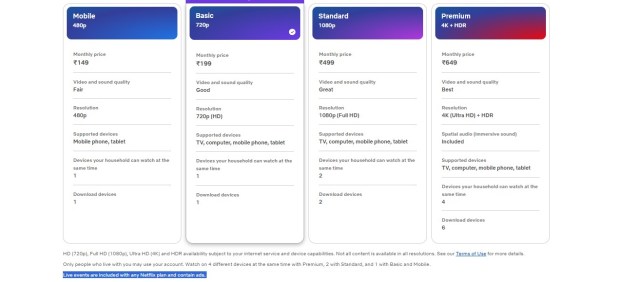
Amazon Prime Video says users can watch “most” content without advertising interruptions. The JioStar subscription plan explicitly excludes sports from ad-free content.
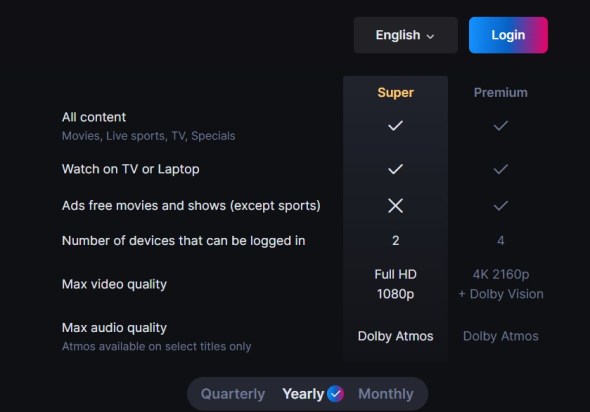
Most major streaming platforms quietly carve out live sports, live television and special events from their broader ad-free guarantees inside subscription terms or help pages. The promise usually applies to on-demand entertainment content, not necessarily to the entire platform ecosystem. And that distinction becomes very important once live sports traffic starts hitting infrastructure at scale.
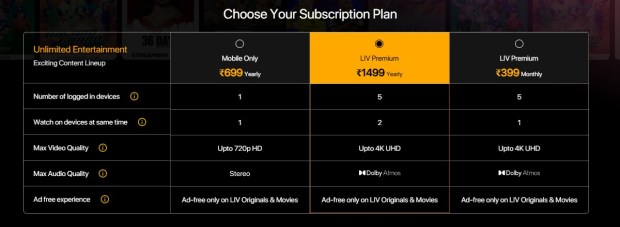
Financialexpress.com reached out to JioStar, which operates JioHotstar, with questions seeking clarification on how advertising is handled for premium subscribers during live sports broadcasts, whether separate ad-free feeds are technically feasible and how the company interprets its advertising commitments across different subscription tiers. JioStar did not respond before publication.
IPL-scale traffic turns sports streaming into an engineering nightmare
Consumers often assume OTT apps fully control the sports feeds they stream. They don’t. Large sporting events run through centralised broadcast systems controlled by host broadcasters, governing bodies or production partners. In cricket, organisations such as the Board of Control for Cricket in India (BCCI) and the International Cricket Council (CC) oversee much of the broader production workflow around the world feed.
By the time a live match reaches a streaming platform, sponsor graphics, commercial break structures and broadcast overlays are already embedded deep into the production pipeline.
And live sports contain constant stoppages. Drinks breaks. Strategic timeouts. Replay windows. VAR checks. Innings transitions. Traditional television fills those pauses with advertising inventory. Streaming platforms usually mirror the same structure because the alternative gets ugly very quickly.
Live sports completely break the back of staggered internet traffic. When an IPL playoff match hits a timeout window, platforms are no longer managing viewers watching independently across different timelines. They are suddenly dealing with 35 to 50 million concurrent users slamming the exact same infrastructure at the exact same millisecond. That creates a serious engineering problem.
Under normal Video-on-Demand conditions, platforms use systems like Dynamic Ad Insertion (DAI) to personalise commercials for individual users. The process works because demand is spread out. People watch different episodes at different times. Servers get breathing room. Live sports remove that breathing room entirely.
Trying to run hyper-personalised ad decisions across millions of free-tier users while simultaneously generating completely separate clean feeds for premium subscribers during an IPL final is dangerously resource-intensive. The infrastructure overhead becomes enormous. If synchronization drifts even slightly, streams buffer, feeds fall out of sync and social media explodes within minutes. And sports audiences are unforgiving when streams fail.
Faced with that risk, engineers usually prioritise stability over subscription segmentation. Instead of maintaining multiple customised workflows during peak traffic spikes, platforms simplify aggressively and push one stable broadcast-grade commercial stream to everyone. Cheaper. Safer. Far less likely to collapse under load.
The sponsorship ecosystem is now baked directly into the broadcast
Then there is the sponsorship layer, which has become even harder to separate from the broadcast itself. Modern sports sponsorship is no longer limited to old-fashioned television commercials. Brands now buy directly into the production environment: sponsored scorecards, branded replay systems, title-sponsored statistics, strategic timeout integrations and persistent on-screen graphics.
The “Strategic Timeout presented by CEAT” or “Orange Cap powered by Saudi Aramco” are not lightweight digital overlays added separately for streaming viewers. They are embedded directly into the live graphics stack powering the world feed itself.
Removing those elements for premium subscribers would mean maintaining parallel production systems, separate graphics pipelines and entirely different sponsor agreements. At tournament scale, that quickly turns into an operational nightmare.
So premium users are not just watching ads. In many cases, they are watching sponsor-funded broadcast infrastructure.
Even outside sports, the “Ad-Free” ecosystem is not quite as clean as platforms imply. Premium subscribers on services like Amazon Prime Video, Apple TV+ and Max still regularly encounter trailers and promotional splash screens for upcoming originals before content begins.
Platforms typically avoid classifying these as advertisements because they promote in-house content rather than third-party brands. Consumers, of course, usually do not make that distinction.
Could truly ad-free sports eventually exist?
Some international broadcasters are experimenting with alternate camera feeds, ambient stadium audio, Picture-in-Picture continuity during commercial windows and premium second-screen experiences designed to soften the interruption layer.
But the broader economics still point in the opposite direction. Sports rights keep getting more expensive. Infrastructure costs remain massive. Advertisers continue paying premium rates for live audiences because live sports still deliver real-time collective attention.
This is especially true as traditional television faces a steep structural decline, with BARC data showing a sharp 26% drop in linear TV ratings for live sports as prime-time audiences migrate permanently to Connected TV (CTV) and digital streams. And as long as that remains true, live sports will continue operating under a different set of rules than the rest of the streaming business.
The premium subscription mostly buys cleaner entertainment streaming, better access and more stable video quality. It does not buy immunity from the commercial machinery funding the sport itself.