



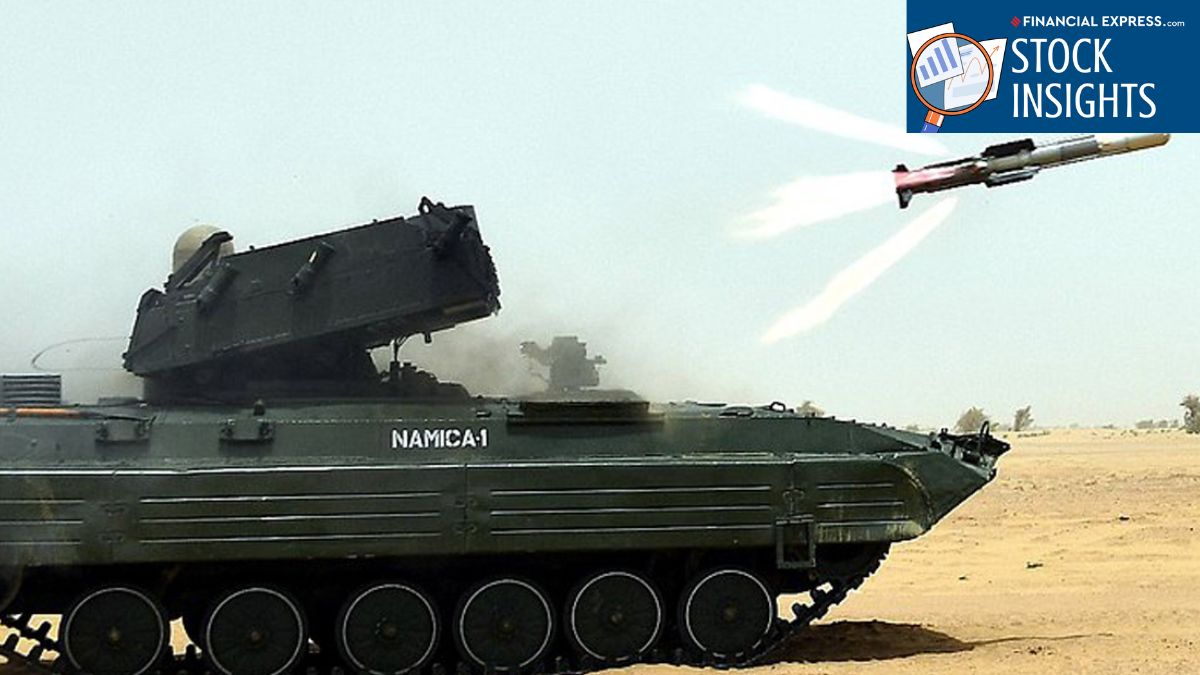
If India’s defence story had a spine, Bharat Dynamics (BDL) would be one of its toughest ribs. Fighter jets and war vessels dominate headlines, but BDL develops the deeper systems, the thrust blocks, seeker systems, control brains, and segmental subsystems that transform an armament into a precision tool of modern warfare.
For years, people thought of BDL as a solid public sector unit that supplied missiles when asked. But the Indian rocket environment has changed, and BDL has silently changed with it.
Today, it stands as something far more tactical: the engineering and production platform that converts missile concepts into repeatable, scalable, export-ready systems.
If you ever get a chance to walk into a facility, you likely won’t hear the roar of enormous engines. Instead, you’ll hear the systematic hum of precision engineering, instruments attuning propellant units, technicians putting together guidance electronics, vibration and heat labs where each subsystem is stress-tested before it is ever used.
It is in these low-key corners that BDL is scripting a new chapter in India’s missile manufacturing story.
When BDL Was Just a Missile Builder
For most of its history, BDL operated like an established defence PSU: it built what it was told to build, followed DRDO designs, and supplied missiles on long, predictable schedules.
The work was important, but it was just a small part of the whole. BDL was engaged in assembly and production, while design, guidance logic, and subsystem engineering were handled somewhere else.
Revenue moved in a straight, steady line, tied closely to a few big programmes like Akash, Konkurs, and MILAN. There was little talk of exports, modularity, or subsystem ownership.
And when global supply chains fumbled, or imported parts were delayed, BDL had few levers it could pull.
But, like everything else, change is constant, and India’s new stance on missile ecosystems was the first step. BDL had to change if it wanted to meet the increasing missile demand, India’s push for self-reliance.
Another reason for change was the understanding that modern guided weapons needed a domestic engine, not just a national assembly line. BDL saw that if it did not change, it would remain a supporter in a missile ecosystem that was expanding faster than its expertise.
So, it chose reinvention.
Change Rooted in Strategy, Not Hype
BDL’s evolution wasn’t a sudden pivot. It was a series of tactical choices that increased its role from merely creating DRDO missiles to owning significant parts of the value chain, control systems, seeker logic, propulsion, integration, testing, and subsystem design.
In the early part of FY26, this revolution took on a new urgency. The company’s Q2 FY26 results showed how accelerated implementation and improved utilization of production capacity can affect the fundamentals.
The revenue from operations soared over 111% YoY to ₹1,147 crore, and net profit rose ~76% to ₹216 crore excluding exceptional items.
The share price grew at a compounded annual rate of 44% over the last three years, while the return on equity during the same period was 15%. It has a zero debt-to-equity ratio, making the company debt-free.
BDL 3-Year Share Price Trend
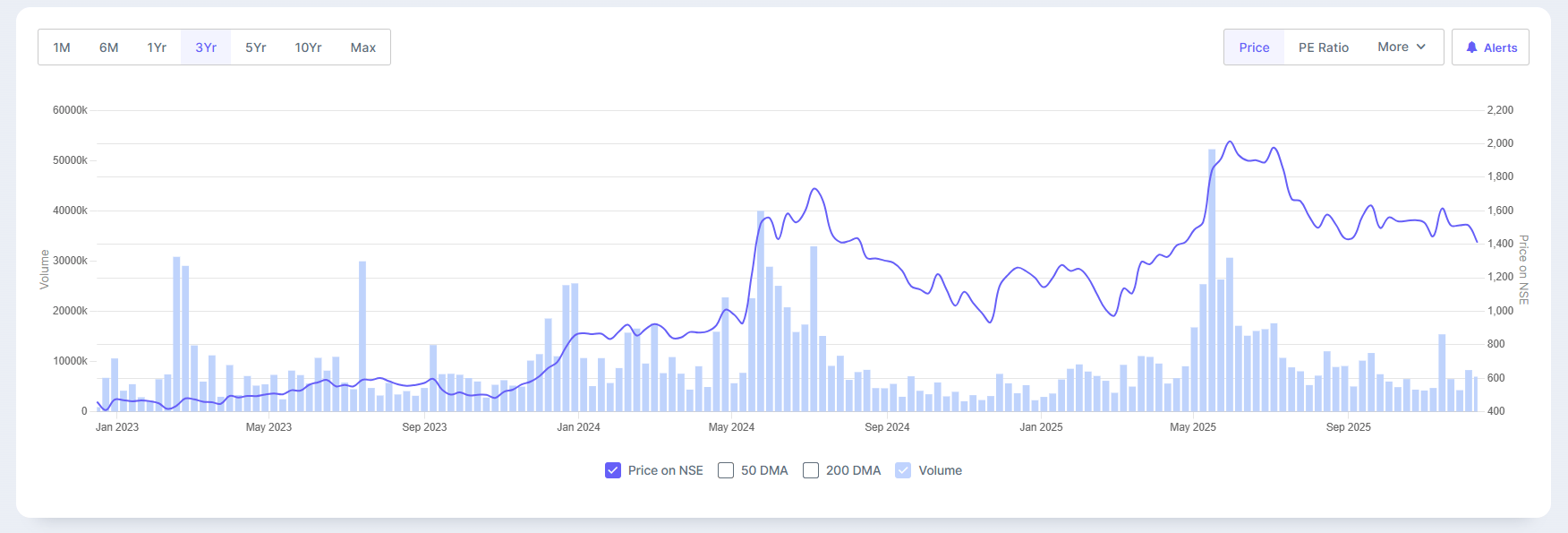
These quarterly numbers paint a picture of impetus, not one-off achievements. They show that BDL is advancing beyond cyclic PSU behaviour to steady execution, even as defence sector spending grows across the board.
Moreover, it trades at a premium with a P/E multiple of ~79x compared to the sector median of ~60x. The enterprise value/ earnings before interest, tax, depreciation and amortisation (EVEBITDA) at 49.5x is higher than its median of ~32.8x.
A Future Pipeline Locked In
BDL’s order book remains one of its most valuable assets. Its order book was at around ₹23,029 crore as of August 31, 2025. The company added fresh orders to its book, including a ₹2,461-crore Indian army contract announced on the first of December.
This strong and growing backlog gives BDL long-term visibility on performance, a rare quality in defence manufacturing where order flows can be uneven and random.
This strong and growing backlog gives BDL long-term visibility on performance, a rare quality in defence manufacturing where order flows can be uneven and random.
The Real Deep-Tech Game
Many still believe missile power lies in nuclear warheads or range. In reality, BDL’s engineering depth sits in something subtler: the operational logic that directs, feeds, navigates, and performs a missile’s mission.
BDL doesn’t just construct metal tubes with explosives. It builds propulsion units adjusted for consistency and performance. It builds guidance and control segments that adjust flight paths in real time and modular electronic subsystems that can be reused across missile families.
The company’s prefabricated design idea means that a propulsion module for one class of missiles can be modified for another; the same guidance block can be retuned for air, sea, or land platforms.
This scalable engineering approach is what gives the company a competitive edge, and it’s why complicated subsystems increasingly define its portfolio.
Modular Approach To Growth
BDL’s big shift came when it embraced modular missile manufacturing. It built subsystems used as building blocks that could be shared, recalibrated, updated, or expanded.
Just like building with Lego blocks: one module that could serve several purposes.
This prefabricated approach decreased the engineering risk, sped up production ramp-ups, and improved predictability, which is crucial in defence manufacturing where breaks and custom reworks can prove to be costly and disruptive.
This framework helped BDL land large contracts in FY25 and early FY26, including continued production orders for Akash, Astra, and anti-tank guided missiles, and follow-on agreements for next-generation systems.
Combined with evolving work in seeker assemblies, the integrated model is becoming the company’s foundational growth engine.
The Armenia Effect: How Exports Went From Zero to Hero
One of BDL’s most interesting shifts has been in exports. While earlier years saw modest export numbers, FY25 saw a dramatic surge, with export turnover reaching ₹1,270 crores, rising an incredible 689% from a modest ₹161 crore in FY24. This was largely driven by the breakthrough order from Armenia for the Akash Weapon System, marking India’s arrival as a credible supplier of complex air defence technology.
This indicated two things: the global demand for economically effective, indigenous Indian missile hardware is real.
Moreover, BDL’s modular, subsystem-focused exports offer flexibility in international supply chains, an important differentiator from legacy export standards that focus only on complete systems.
Beyond direct revenue, exports are building strategic links; countries that implement BDL subsystems may work together on future upgrades, co-development, and regional defence alignments.
The Economics Behind the Missile Business
Defence manufacturing is capital-intensive, and the jumps in implementation come with risks. Large missile contracts have long production cycles, parts can be sourced globally, and accuracy is challenging.
Yet between FY25 and FY26, BDL has progressively addressed these structural issues. It has worked on expanding its production capacity utilisation, set up alternative vendor ecosystems to allay import bottlenecks, shortened testing and integration cycles, and aligned its plant expansion strategies with government defence industrial corridors
Market analysts have taken note, with some forecasting strong medium-term growth as capacity and execution improve. BDL’s long order book, export push, and deepening engineering base position it for unbroken scale rather than unpredictable bursts.
The Bigger Picture
BDL’s evolution is more than a corporate story; it’s evidence of India’s defence ambitions.
Three key shifts stand out. Indigenisation of critical weapon systems that reduce dependence on imports and enhance sovereign capability.
Adoption of a modular engineering philosophy that allows faster reiterations, upgrades, and cross-platform reuse. And export-led credibility, which is slowly turning defence trade into a political and financial asset.
This transformation is happening against a backdrop of broader defence sector growth. Defence revenues across India are expected to rise by 16–18% in FY26 as self-reliance and order implementation improve.
Against this broader backdrop, BDL isn’t just building products. It is building capability.
Building India’s Missile Mind
BDL’s story is no longer about assembling missiles. It is about shaping the intelligence that makes them smart, adaptive, and scalable.
The company now stands at the node of propulsion engineering, guidance logic, modular design, and export outreach.
As India expands its missile portfolio, from area defence SAMs to anti-tank systems and beyond, BDL’s subsystem approach is quickly turning central, not secondary.
For investors, BDL offers something rare: a blend of sovereign strategic relevance, deep-tech engineering, multi-year order visibility, and emerging export footprint.
BDL isn’t just making weapons.
It’s building the structural design India will use, and potentially export in the decades ahead.
Disclaimer:
Note: We have relied on data from www.Screener.in throughout this article. Only in cases where the data was not available have we used an alternate, but widely used and accepted source of information.
The purpose of this article is only to share interesting charts, data points, and thought-provoking opinions. It is NOT a recommendation. If you wish to consider an investment, you are strongly advised to consult your advisor. This article is strictly for educative purposes only.
Archana Chettiar is a writer with over a decade of experience in storytelling and, in particular, investor education. In a previous assignment, at Equentis Wealth Advisory, she led innovation and communication initiatives. Here she focused her writing on stocks and other investment avenues that could empower her readers to make potentially better investment decisions.
Disclosure: The writer and her dependents do not hold the stocks discussed in this article.
The website managers, its employee(s), and contributors/writers/authors of articles have or may have an outstanding buy or sell position or holding in the securities, options on securities or other related investments of issuers and/or companies discussed therein. The content of the articles and the interpretation of data are solely the personal views of the contributors/ writers/authors. Investors must make their own investment decisions based on their specific objectives, resources and only after consulting such independent advisors as may be necessary.