



In September 2023, the best single malt whisky in the world was not distilled in Scotland, in the glens of Speyside or Islay, nor in the highlands of Japan. It was made in Indri, a small town in Haryana. At the Whiskies of the World Awards, an Indian single malt called Indri beat every Scotch, bourbon and Japanese malt on the table to be named Best in Show, Double Gold.
Piccadily Agro Industries Ltd (PAIL), the company behind it, was an unlikely candidate for this award. It did not start life as a distiller at all. In 1994 it was a sugar mill in Karnal, Haryana. The branded-spirits business came only in 2017, and Indri itself only in 2022.
The market noticed. Over the last five years Piccadily’s stock has compounded at well over 100% a year, turning a share that changed hands in the mid-teens into one trading near Rs 730, close to a 35-bagger, almost entirely on the strength of one whisky brand.
This Award-winning spirits business has spent its entire life sharing a balance sheet, and a share price, with the sleepy sugar operation it was born from. In April 2026, Piccadily decided to end the arrangement. It is demerging its sugar business into a separate listed company and keeping the distillery in PAIL.
For a special-situations investor, that is exactly the kind of moment worth stopping for.
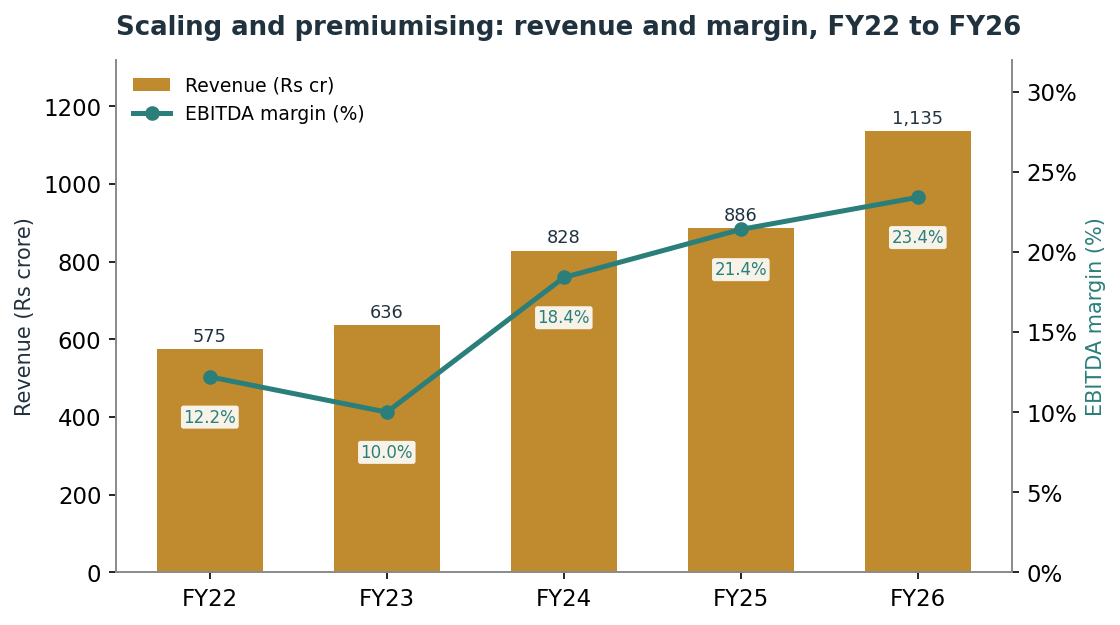
Piccadily Revenue and margin trajectory
Why Demergers Create Value
When one listed company houses two very different businesses, a fast-growing branded franchise sitting next to a cyclical commodity, the market rarely values it well. The investors who want the branded business do not want the commodity attached to it, and the analysts who cover the commodity have no framework for the brand. So the whole trades at a blended, compromise multiple that flatters the weaker half and penalises the better one. That is the conglomerate discount.
A demerger breaks it. Each business starts trading on its own, attracts its own investors and analysts, gets its own management focus and capital allocation, and is freed from the other’s cycle. The discount evaporates, usually. It works best when the two halves are genuinely different in growth, margins, capital needs and investor base.
Bajaj Auto‘s 2008 split into Bajaj Auto and Bajaj Finserv created two giants worth many times the original whole. Triveni Engineering carved out Triveni Turbine in 2011 – the spun-off child is now worth more than double its parent. Greenply demerged Greenpanel in 2019 and the MDF business ran up more than 5x in two years.
More recently: Reliance‘s Jio Financial (2023), Piramal Pharma (2022), Raymond‘s lifestyle-and-realty split (2024), Arvind Fashions, and ITC‘s hotels demerger in early 2025, which listed ITC Hotels at roughly Rs 42,000 crore while leaving ITC a cleaner, higher-return FMCG play. Different sectors, same result: separated, the parts were usually worth more than the whole.
Give a good business its own identity, its own management attention and its own investor base, and value surfaces sooner or later.
Which brings us to a company that has spent three decades building exactly this mismatch under one roof. On one side, a low-margin, policy-bound sugar business at the mercy of the monsoon and government pricing. On the other, a globally awarded single-malt franchise, home to Indri, growing IMFL volumes over 40% a year at luxury pricing. The market values the whole as a sugar-and-ethanol company with a spirits kicker. Piccadily Agro now wants to separate the two.
Why Demerging the Sugar Business Makes Sense
Piccadily’s restructuring is, in one line, a separation of the old from the new. The company will demerge its Sugar Business into a separate listed company, Piccadily Food & Essential Limited (PFEL), and keep the distillery and branded-spirits business, the part that has done all the heavy lifting, inside the listed parent, Piccadily Agro (PAIL). If you own PAIL on the record date, you keep your PAIL shares, now a near pure-play spirits company, and receive 1 PFEL share for every 9 PAIL shares you hold. We will get to the mechanics in Section 3. First, why the split makes sense.
Three reasons to let the sugar business go
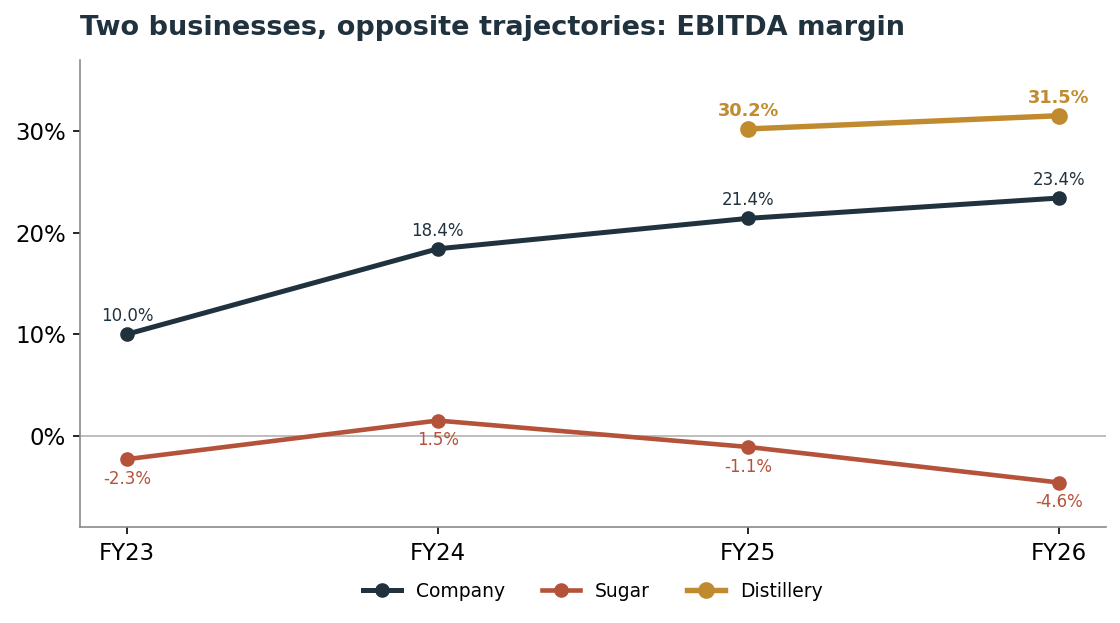
1. Sugar is dragging the margins, and the valuation, down. In FY26 the distillery business earned an EBITDA margin of 31.5%. The sugar business earned -4.6%. This is not a one-off: sugar’s segment margin has been negative or near-zero for four straight years. Sugar is now barely a fifth of revenue and shrinking, but it pulls down the blended margin and, worse, it forces the market to value a globally awarded single-malt franchise as if it were a sugar-and-ethanol company. Every poor cane season and every policy wobble on sugar MSP or ethanol pricing clouds a story that has nothing to do with whisky.
Segment wise EBITDA margins
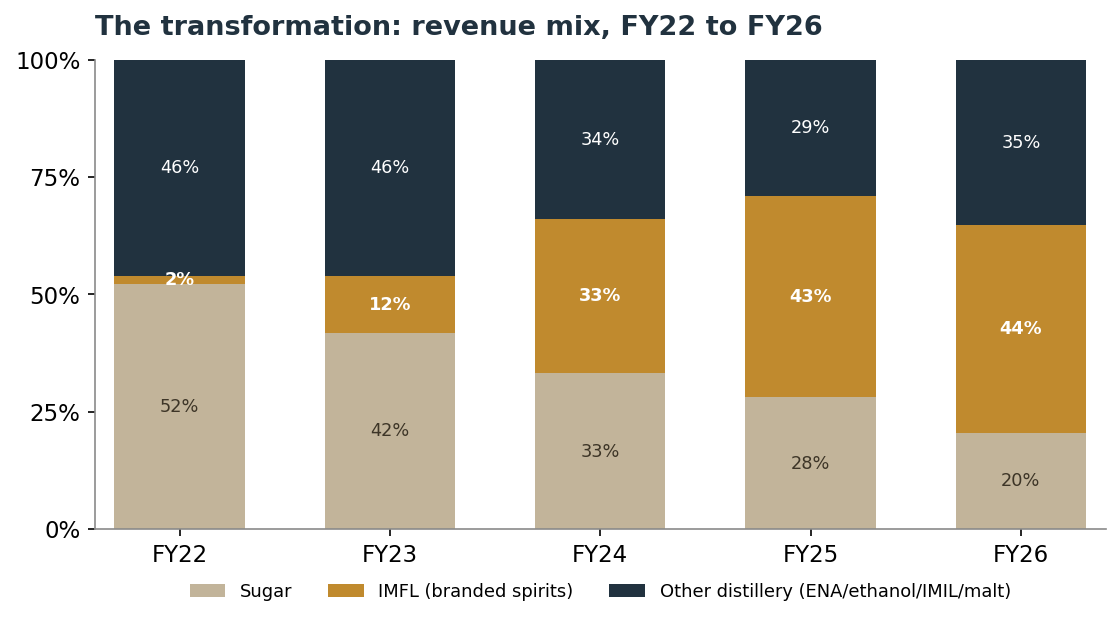
2. The spirits business has reached escape velocity. Five years ago sugar was more than half of Piccadily’s revenue and IMFL was under 2%. Today IMFL is the single largest segment, at over 40% of revenue. Distillery revenue grew 42% in FY26 to Rs 902 crore and Indri has gone from launch to more than 100,000 cases and 50-plus international awards in barely three years. This is no longer a side project that needs the sugar cash flows. It is a business that needs its own identity, its own capital allocation and its own investor base to be valued for what it is.
Piccadily Agro – Segment wise Revenue mix change (FY22-FY26)
3. Two different businesses attract two different investors. A branded, premiumising, high-margin consumer franchise and a cyclical, policy-bound commodity processor do not belong in the same wrapper. The consumer and spirits investors who would pay up for Indri do not want a sugar mill attached. Kept together, both are mispriced. Split apart, each can be valued on its own terms, and the conglomerate discount from Section 1 starts to unwind.
Piccadily Agro: key financials (Rs crore unless stated)
| Metric | FY24 | FY25 | FY26 |
| Revenue from operations | 828 | 886 | 1,135 |
| EBITDA | 153 | 191 | 243 |
| EBITDA margin | 18.4% | 21.4% | 23.4% |
| Profit before tax | 148 | 144 | 193 |
| Profit after tax | 86 | 105 | 140 |
| EPS (Rs) | 9.09 | 11.08 | 14.42 |
| Distillery revenue | 553 | 637 | 902 |
| Sugar revenue | 275 | 250 | 233 |
| Distillery EBITDA margin | n/a | 30.2% | 31.5% |
| Sugar EBITDA margin | 1.5% | -1.1% | -4.6% |
Zooming in on the crown jewel that stays behind
Here is the twist that makes this demerger unusual. In most demergers the exciting business is the one being spun out. Here it is the opposite: the jewel stays with you in PAIL, and it is the commodity that leaves. Either way the net results are similar.
That jewel is one of the more remarkable stories in Indian consumer branding. Piccadily began making malt spirit at Indri, in Haryana, and by 2015 was good enough to sell matured malt to well-known distilleries. In 2022 it launched its own single malt, Indri. Within a year it was named the best whisky in the world; within two it had crossed 100,000 cases; today it carries more than 50 international awards and ranks among the most decorated Indian single malts globally.
What makes it hard to copy is the same thing that makes Scotch hard to copy: time and place. Indri’s distillery sits in a climate that swings from near zero to 50 degrees Celsius, which accelerates the interaction between spirit and wood, and the company matures its whisky in hand-selected imported oak casks tended by in-house coopers. The maturing stock is itself a moat you cannot buy overnight: Piccadily is sitting on roughly 83,800 barrels and scaling towards 100,000 by March 2027. Whisky laid down today is revenue three, five, ten years out, a bank of future premium sales a new entrant simply does not have.
Around Indri sits a widening portfolio: Camikara, a pure cane-juice rum; Whistler, the original blended whisky; and Cashmir, a luxury vodka launched in 2025. IMFL volumes grew 48% in FY26, led by Whistler (+98%), Indri (+16%) and Camikara (+11%), and the portfolio now reaches 29 states, over 25,000 retail outlets and 29 countries. The tailwind is real: India’s premium alco-beverage market is growing at a projected 16% CAGR, and premiumisation in whisky is structural, not cyclical.
The financials say the same thing. In FY26 the distillery business did Rs 902 crore of revenue and Rs 254 crore of EBITDA at a 31.5% margin, and it is midway through a large capacity build: ENA/ethanol at Indri expanding from 78 to 220 KLPD, malt from 12 to 30 KLPD, a new 210 KLPD distillery in Chhattisgarh, and an international malt distillery at Portavadie in Scotland. This is the business shareholders are left holding once the sugar is gone.
Management expects this to accelerate, not fade. On the Q4 FY26 earnings call it called FY27 an exceptional year and guided the Alco-Bev (distillery) business to grow 60% to 70% in value, with absolute EBITDA growing at a similar pace and the margin flat to modestly higher.
Over the next three to four years it is targeting three to four times the current revenue. The supply constraints that held Indri’s volume growth to 16% in FY26 are easing as the new Indri and Chhattisgarh capacity comes on stream; management expects those two plants alone to add roughly Rs 250 to 300 crore and Rs 300 to 400 crore of revenue respectively in FY27.
The Mechanics of How the Demerger Works
Piccadily’s demerger is refreshingly simple, especially next to the multi-step schemes you often see. There is really only one moving part. The company carves its Sugar Business out of the listed parent, Piccadily Agro (PAIL), and transfers it into a separate company, Piccadily Food & Essential Limited (PFEL), which today is a wholly owned subsidiary of PAIL. Once it is done, you have two listed companies: PAIL, now housing only the distillery and branded-spirits business, and PFEL, housing sugar.
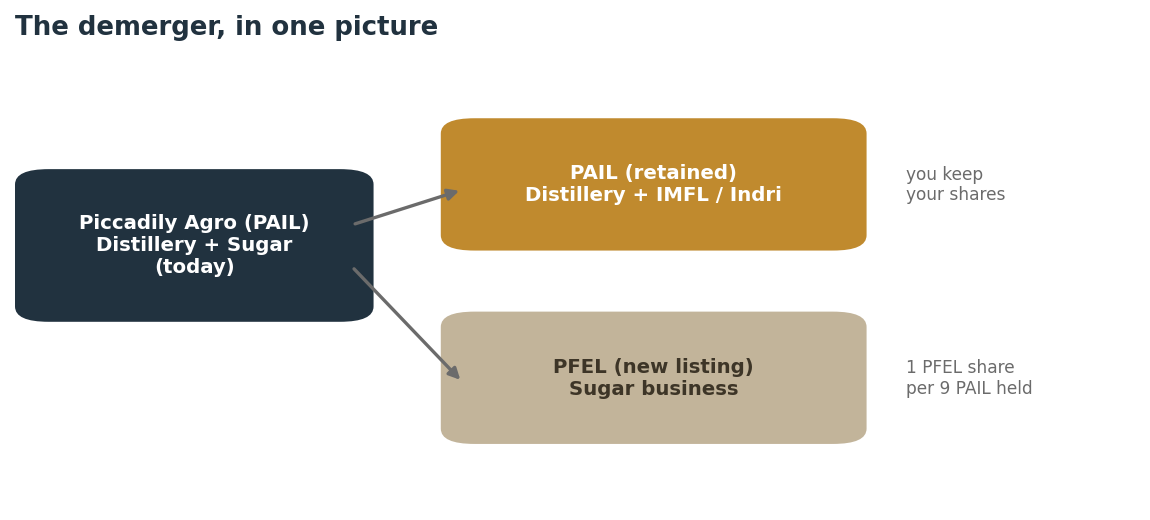
What you receive. For every 9 equity shares of PAIL (face value Rs 10) you hold on the record date, you will be credited 1 equity share of PFEL (face value Rs 10), fully paid. No cash changes hands. So if you hold 900 PAIL shares, you keep all 900 and receive 100 PFEL shares. The ratio was fixed with reference to the turnover and assets of the sugar business.
Why no independent valuation was needed. Ordinarily a demerger ratio is set by a registered valuer. But because every PAIL shareholder receives PFEL shares in the same 9:1 proportion, this is a mirror demerger in which no shareholder is advantaged over another. Under the SEBI Master Circular, a valuation report is not required where there is no change in the shareholding pattern of the resulting company, so the ratio simply sets how many shares PFEL will have. Whatever valuation or fairness-opinion material was obtained will sit in the full scheme document.
A clean structural detail. Because PFEL is a wholly owned subsidiary, its existing capital (all held by PAIL) is cancelled when the scheme takes effect, and PFEL issues fresh shares only to PAIL’s shareholders. The result is that PFEL’s shareholding mirrors PAIL’s exactly: same promoters, same public shareholders, same proportions. There is no shareholding compression and no dilution of public holders, which is not always the case in demergers.
How big is the piece leaving? Small, by design. The sugar business had a turnover of about Rs 233 crore in FY26, roughly 20.5% of total revenue, at a negative EBITDA margin. PFEL is listed as a small, standalone sugar company. The interesting value sits with what stays behind in PAIL.
The scheme at a glance
| Item | Detail |
| Demerged undertaking | Sugar Business (white crystal sugar and allied products) |
| Demerged company | Piccadily Agro Industries Ltd (PAIL) |
| Resulting company | Piccadily Food & Essential Ltd (PFEL), currently a wholly owned subsidiary |
| Retained by PAIL | Distillery and branded spirits (Indri, Camikara, Whistler, Cashmir) |
| Share entitlement ratio | 1 PFEL share (Rs 10) for every 9 PAIL shares (Rs 10) |
| Consideration | Nil cash; PFEL’s pre-scheme capital cancelled |
| Shareholding | Proportionate; PFEL mirrors PAIL, no compression |
| Sugar turnover (FY26) | ~Rs 233 crore, ~20.5% of total revenue |
| Board approval | 28 April 2026 |
| Appointed / Record / Effective dates | Not yet set (in the full scheme, pending NCLT) |
| Listing | PFEL to list on BSE and NSE |
Where we are today. The board approved the scheme on 28 April 2026, on the recommendation of the audit committee and independent directors. That is the starting gun. From here the scheme must clear, in sequence:
The stock exchanges and SEBI (a No-Objection / Observation Letter, which comes before the tribunal); the National Company Law Tribunal (a first-motion order convening meetings, then a second-motion sanction); the shareholders and creditors, including a mandatory public-shareholder e-vote where votes in favour must exceed votes against; and finally the listing of PFEL.
A listed-company demerger of this kind typically takes nine to fifteen months. The Appointed, Record and Effective dates have not been set yet; they will be fixed as the scheme moves through the tribunal.
The Valuation Math, Is There Value?
DISCLAIMER: What follows is an illustrative if-then framework using peer multiples and trailing numbers. It is not a target price and not a recommendation and not a prediction. It is an if-then exercise to help readers think about how the market might value these two businesses once they trade independently.
The idea of a sum-of-the-parts is simple. Today the market values Piccadily as one company. After the demerger the distillery and the sugar business will be valued separately, on their own multiples. Almost all the value sits in the distillery, so we value that on EV/EBITDA and treat sugar as a small stub.
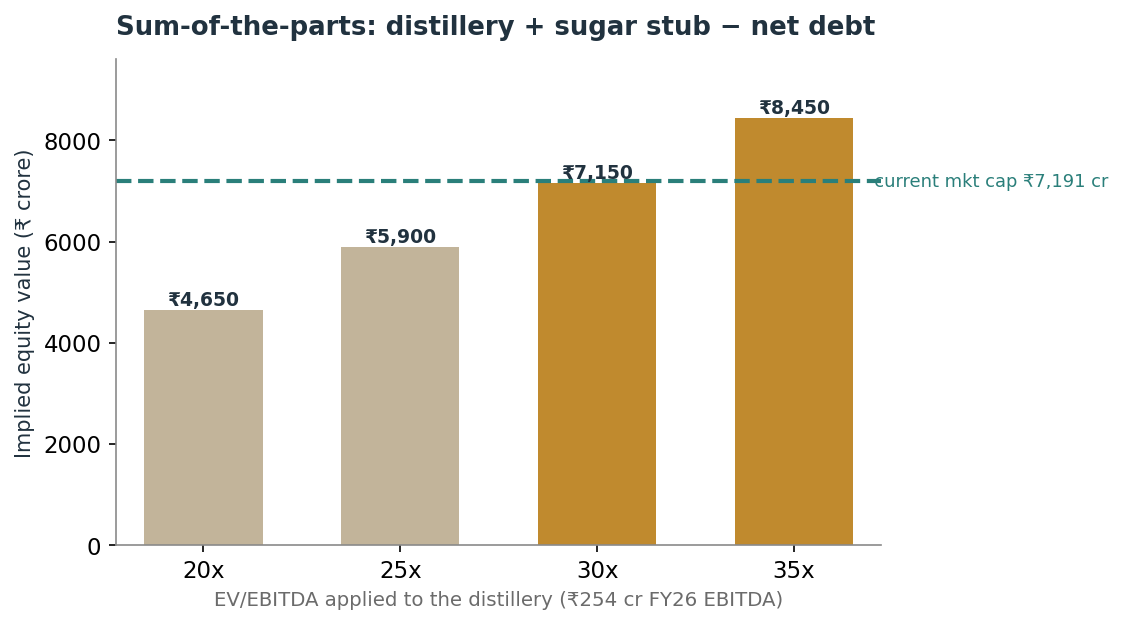
The distillery (retained in PAIL). In FY26 it recorded Rs 254 crore of EBITDA at a 31.5% margin, which continues to grow fast. Branded-spirits peers trade richly: Radico Khaitan is at about 52 times EV/EBITDA. Piccadily’s distillery carries a commodity ENA, ethanol and IMIL base underneath the Indri brand and is smaller, so it should sit at a discount to that. The table below applies a range to its Rs 254 crore of EBITDA, adds a nominal Rs 100 crore for the loss-making sugar business, and subtracts about Rs 530 crore of net debt to reach an equity value.
| EV/EBITDA on distillery | Distillery enterprise value | Implied equity value |
| 20x | ~Rs 5,100 cr | ~Rs 4,650 cr |
| 25x | ~Rs 6,350 cr | ~Rs 5,900 cr |
| 30x | ~Rs 7,600 cr | ~Rs 7,150 cr |
| 35x | ~Rs 8,900 cr | ~Rs 8,450 cr |
Source: Implied equity value across distillery EV/EBITDA multiples, against the current market cap.
Against today’s Rs 7,191 crore market cap, the market is already paying about 30 times EV/EBITDA for the distillery. That is a discount to Radico’s ~52 times, but not a deep one, and the stock has already re-rated most of the way there. On trailing numbers, this is not a screaming mispricing.
Sum-of-the-Parts – EV/EBITDA estimates
So where is the value? Two levers, both pointing up.
Re-rating: as a pure-play spirits company, freed from a loss-making commodity and a conglomerate label, the distillery can close more of the gap to branded peers. Move it from 30 to 35 times and the equity is worth about Rs 8,450 crore, roughly 18% above today, before any growth at all.
Growth: The Rs 254 crore of EBITDA does not yet reflect Indri’s malt capacity rising 2.5 times, the new Chhattisgarh distillery ramping through FY27, the Scotland project, or the whisky bank compounding from 83,800 barrels toward 100,000. Whisky laid down today is premium revenue years out. If distillery EBITDA grows toward Rs 380 to Rs 420 crore over the next two to three years, even a steady 30 times implies enterprise value north of Rs 11,000 crore on a forward basis.
The downside is anchored by real assets, a globally awarded Whisky brand and a hard-to-replicate barrel bank. The upside is a high-margin, premiumising franchise that, once it trades on its own, can be valued like one. The demerger does not create that value on day one – it removes the thing that has been stopping the market from seeing it.
Data note: we have relied on data from Screener.in and Tijorifinance.com, supplemented by the company’s investor presentations, annual report and the 28 April 2026 scheme filing. Distillery-only figures are estimates (reported segment data adjusted for the sugar business). Market cap and peer multiples move daily and should be refreshed at publication.
Disclaimer: The purpose of this article is only to share interesting charts, data points and thought-provoking opinions. It is NOT a recommendation. If you wish to consider an investment, you are strongly advised to consult your advisor. This article is strictly for educational purposes only.
Rahul Rao has been investing since 2014. He has helped conduct financial literacy programs for over 1,50,000 investors. He helped start a family office for a 50-year-old conglomerate and worked at an AIF, focusing on small and mid-cap opportunities. He evaluates stocks using an evidence-based, first-principles approach as opposed to comforting narratives.
Disclosure: The writer or his dependents do NOT hold shares in the securities/stocks/bonds discussed in this article. The content and interpretation of data are solely the personal views of the author. Investors must make their own investment decisions based on their specific objectives and resources, and only after consulting such independent advisors as may be necessary.