




When one of India’s most respected fund managers writes a ₹650 crore cheque, it signals conviction, not curiosity.
Over the past few months, Pulak Prasad’s Nalanda Capital has done exactly that. He has silently built up a ~5% stake in IndiaMART InterMESH. To say that this surprised many would be an understatement.
IndiaMART is not a breakout expansion story today. If anything, it rests in an uneasy middle: lucrative and leading but no longer growing at the speed it once did.
Which makes the timing of this investment exciting. Because investors like Nalanda don’t pursue short-term growth spurts.
They look for mispriced strength, businesses where the market is underrating how long the cash flows can last, or how deep the moat really is.
IndiaMART fits that description disturbingly well.
It is India’s largest B2B discovery platform, with 219 million buyers, over 8.7 million suppliers, and a high-margin subscription model per its latest investor presentation.
But it is also a company where growth has slackened, narratives have cooled, and the next leg of value creation is up in the air.
So, the question is not why someone invested ₹650 crore. The real question is:
What is the market missing about IndiaMART, a slowing directory, or a still-undervalued digital communications play?
The Business That Lies Between Buyers and Chaos
At its core, IndiaMART is not an e-commerce company. It does not maintain inventory, oversee logistics, or track fulfilment metrics.
Its role is straightforward and more scalable. It connects buyers and suppliers.
A small manufacturer in Rajkot looking for industrial valves, a retailer in Coimbatore locating packaging material, or a contractor in Nagpur searching for electrical components, all begin with supplier discovery.
In an offline world, that discovery is unproductive, constrained by local networks and intermediaries. Online, IndiaMART endeavors to structure that chaos.
Suppliers list themselves on the platform. Buyers search, enquire, and connect. IndiaMART monetises this interaction primarily through subscription fees, charging suppliers for prominence, leads, and prioritised position.
The scale is significant, but the monetisation layer beneath it is far more revealing.
The platform today hosts over 8.7 million suppliers and 42 million active buyers, with more than 128 million product listings. But only about 2,21,000 suppliers actually pay for the service.
That gap is not a weakness. It is the business model.
Out of nearly 9 million suppliers, barely 2–3% are paying users, making monetisation highly focused and progressively dependent on getting more value from a narrow base.
This structure gives IndiaMART both strengths and limitations.
On one hand, it establishes high-margin economics. On the other hand, it places a top limit on how far growth can be driven by simply adding more suppliers.
The revenue engine: Growth vs. Realization
Financially, this shows up clearly.
This translates into revenue of ₹402 crore, up 11% YoY, and collections of ₹426 crores growing 15% YoY in Q3 FY26.
This is why IndiaMART has quietly become one of the few steadily profitable internet platforms in India.
IndiaMART is, fundamentally, a high-margin discovery platform built on selective monetisation.
Riding a structural shift without owning it
IndiaMART’s rise is attached to the steady formalisation of India’s SME economy.
India has 7.47 crore MSMEs, contributing ~31% of GDP and ~48.58% of exports per the latest Union Budget press release on 15th February 2026.
Yet for most of these businesses, digitisation remains superficial, often limited to listings or payments rather than full integration into software-driven workflows.
IndiaMART operates in digital visibility without deep integration. However, policy changes have accelerated this transition.
As businesses become searchable, more discovery platforms are needed. IndiaMART positioned itself as a default access point in this emerging ecosystem.
It expanded much before competitors like TradeIndia and Justdial, gaining from early adoption and category depth.
But the structure of this tailwind is changing.
The first phase of digitisation rewarded visibility, being present and discoverable.
But that advantage, by itself, is no longer adequate to drive the next phase of growth.
The evolving competitive landscape
The change IndiaMART is undergoing is not happening singly. The competitors around it are evolving in ways that directly affect its core model.
At one level, competition remains familiar.
Platforms like TradeIndia and Justdial continue to operate in adjacent discovery layers. But these are not new threats — and IndiaMART’s scale has historically been enough to stay ahead.
The more meaningful change is structural.
The emergence of ONDC introduces the possibility of unbundled discovery, where buyers and sellers are no longer tied to a single platform for visibility.
If this model expands, discovery itself will become more open, interoperable, and less dependent on any one marketplace.
At the same time, SME-focused software platforms are moving closer to the hub of business operations.
These platforms don’t compete for listings. They battle for workflow ownership.
Discovery platforms compete for attention while software platforms vie for dependence.
IndiaMART’s current model is anchored in the first. Its future ambitions point toward the second.
Margins are strong — but what are they pricing in?
One of the reasons IndiaMART continues to attract investor interest, despite slowing growth, is the strength of its financial profile.
The business remains highly profitable.
The third-quarter collections were ₹426 crore. While the deferred revenue, a proxy for future subscription income, was ₹1,775 crore, marking a growth of 17% YoY, reinforcing the model’s upfront, subscription-led nature.
The operating margins are still going strong at 35%.
A net profit of ₹188 crore in Q3 FY26, rising 56% YoY, hints at the platform’s ability to generate cash even at scale.
It has a strong free cash flow from operations of ₹129 crore, increasing 13% YoY.
This is a rare combination in India’s internet landscape, scale, profitability, and cash generation.
At one level, this signals the efficiency of the model.
Once a supplier is onboarded, the cost of servicing them is minimal. There is no inventory, no logistics, and limited incremental cost, allowing revenue to grow faster than expenses.
But strong margins, by themselves, do not answer the key question.
What are these margins actually pricing in?
Because margins in platform businesses can mean two very different things:
- A strong, growing business model
- Or a mature model where growth is slowing, but profitability is still high
IndiaMART has gradually started resembling the second.
The business is clearly effective. But the strength in margins, combined with moderation in subscriber growth, hints that the core engine is no longer growing at the same rate.
Which changes how those margins should be interpreted.
They are no longer just a sign of strength; they are also a signal of maturity.
And that is where the tension lies.
If growth does not speed up, margins alone will not lead to re-rating. They will support the valuation, but not expand it.
Growth has slowed, and that changes the narrative
Against this background, IndiaMART’s operating metrics are beginning to reflect a clear shift.
The business is not weakening. But it is no longer expanding at the pace it once did.
The platform today has roughly 221,000 paying suppliers, rising marginally year-on-year and even declining sequentially in the latest quarter, according to the company’s disclosures.
That single data point captures the transition.
For years, growth came from adding new paying suppliers. That engine is now slowing.
Collections growth has moderated to low double digits. At the same time, annualised revenue per paying supplier remains in the ₹65,000–67,000 range , growing at mid-single digits, indicating a limited spurt in monetisation.
Essentially, the pattern is clear. The subscriber growth is reducing, price rise is gradual, and the core monetisation, though stable, is not increasing meaningfully
The platform is no longer scaling through breadth at the same pace, and depth has not yet taken over.
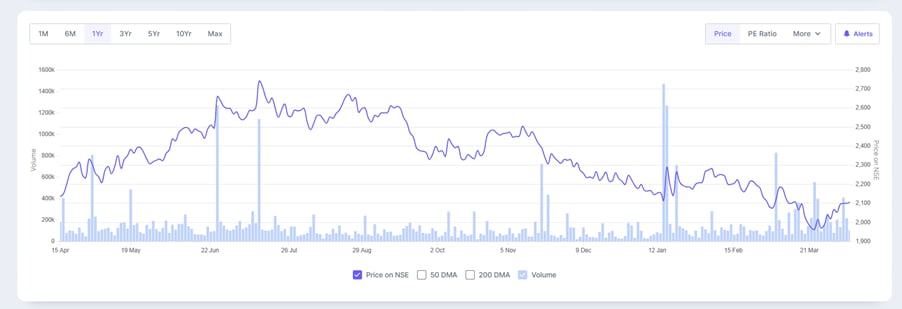
This is not a collapse. It is a plateau. It is clearly visible in the stagnant stock price over the last twelve months..
IndiaMart 1-Year Share Price Trend
IndiaMART has likely already onboarded its most valuable, digitally active suppliers. What remains is a more fragmented base, where conversion is challenging and willingness to pay is lower.
Which leads to a simple structural reality:
The original growth engine, adding new paying suppliers, is no longer adequate to drive the next phase.
From Discovery to Workflow: The SaaS Pivot
The company’s response to this shift is not to push harder on listings, but to change what it sells.
Until now, IndiaMART has monetised discovery. Businesses paid to be visible, to generate enquiries, and to contest for interest in crowded categories.
But just discovery has a natural restriction: it is sporadic.
A supplier may need leads at certain points in the cycle, not constantly. Which means the platform’s monetisation is tied to demand cycles, not daily operations.
That is the gap IndiaMART is now trying to address.
Over the past few years, the company has begun investing in tools that sit inside the business, not just outside it.
Accounting and billing software (through investments like Busy), CRM, lead management systems, and Workflow tools that integrate supplier-side operations
This reflects a deliberate shift: From selling prominence to entrenching functionality
The distinction is critical.
Visibility is optional.
Workflow is essential.
If IndiaMART can move into the second layer, then the revenue could become more predictable, customer stickiness would rise, and monetisation would shift from sporadic to continuous
But this is not a simple extension of the existing model.
Selling listings is a distribution issue.
Building software acceptance is a product and behaviour challenge.
IndiaMART is now trying to solve the latter.
And that evolution will define whether it stays a high-margin discovery platform or changes into something fundamentally deeper.
Marketplace or operating system?
At this point, the discussion around IndiaMART has become less about its current performance and more about future positioning.
Is this business primarily a marketplace, or can it change into an operating system for SMEs?
A marketplace monetises finding suppliers: The revenue is connected to visibility and lead generation, usage is episodic, and growth is tied to expanding the paying base
An operating system, on the other hand, monetises participation. So, revenue is linked to daily workflows, usage is continuous, and growth comes from deeper integration, not just size
IndiaMART today sits firmly in the first category, but is trying to move towards the second.
That transition is not just tactical. It is structural.
Because if discovery becomes easier, more distributed, or less segregated, then the value moves to the layer that businesses depend on, not just the one they visit.
The question is not whether IndiaMART understands this change.
The question is whether it can implement it fast enough.
A platform at crossroads
IndiaMART already has what many platforms struggle to achieve: scale with profitability.
It has organised a fragmented market, monetised it selectively, and created a high-margin business around discovery.
But that model now has perhaps reached its natural limit. Growth from adding new paying suppliers is decreasing. Price is holding but not speeding.
And the broader ecosystem is progressing toward more open, integrated structures.
Which means the next phase will not be driven by growth alone.
It will depend on whether the company can move away from discovery and increase its importance within the businesses it serves.
The shift from being used occasionally to being relied on daily is where the next leg of value will be decided.
Investors seem to be considering the slowdown as the stock trades at a P/E of 21x, far lower than its 5-yr median of 50.4x. The sectoral median sits at 25x.
The EV/EBITDA (Enterprise value/ earnings before interest, taxes, depreciation, and amortisation) at 15.4x is again significantly lower than it’s 5-year median of 34.5x. The sectoral median is 14.3x, a slight discount to Indiamart’s current multiple.
On either valuation parameter, one thing is clear. The stock has de-rated significantly over time.
With Pulak Prasad’s big bet, the next question that arises is this:
What does Pulak Prasad see in Indiamart that the market seems to have missed?
Perhaps a transition. But until that transition becomes visible in numbers, the business remains what it has already proven to be: a highly efficient discovery platform.
Want to keep an eye on this company? Add it to your watchlist.
Disclaimer:
Note: We have relied on data from the company’s January 2026 investor presentation throughout this article. Only in cases where the data was not available have we used an alternate, but widely used and accepted source of information.
The purpose of this article is only to share interesting charts, data points, and thought-provoking opinions. It is NOT a recommendation. If you wish to consider an investment, you are strongly advised to consult your advisor. This article is strictly for educative purposes only.
Archana Chettiar is a writer with over a decade of experience in storytelling and, in particular, investor education. In a previous assignment, at Equentis Wealth Advisory, she led innovation and communication initiatives. Here, she focused her writing on stocks and other investment avenues that could empower her readers to make potentially better investment decisions.
Disclosure: The writer and her dependents do not hold the stocks discussed in this article. The website managers, their employees (s), and contributors/writers/authors of articles have or may have an outstanding buy or sell position or holding in the securities, options on securities, or other related investments of issuers and/or companies discussed therein. The content of the articles and the interpretation of data are solely the personal views of the contributors/ writers/authors. Investors must make their own investment decisions based on their specific objectives, resources, and only after consulting such independent advisors as may be necessary.