



The global brokerage firm Jefferies, in its latest report, has given its outlook on India’s broking, asset management and exchange-linked stocks. As per the brokerage report while some players still offer healthy upside, others could face earnings pressure due to upcoming regulatory changes.
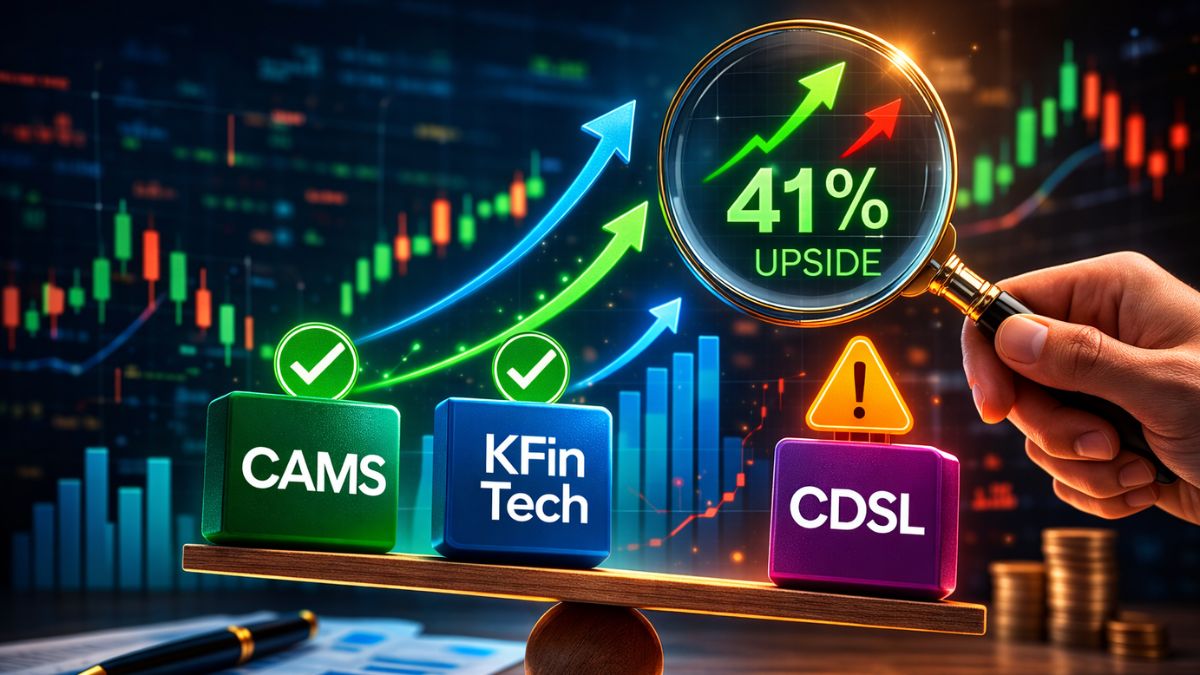
Jefferies has maintained a positive view on Computer Age Management Services and KFIN Technologies, but remains cautious on CDSL or Central Depository Services (India).
The brokerage has set a target price of Rs 845 for Computer Age Management Services and Rs 1,350 for KFin Technologies. For Central Depository Services (India), the target price stands at Rs 1,300 with a ‘Hold’ rating.
Based on these targets, the upside potential works out to about 24.63% for Computer Age Management Services, 41.07% for KFin Technologies and just around 2.19% for Central Depository Services (India).
Let’s take a look at what is the brokerage say –
What has changed from April 2026?
According to the brokerage report, “KYC Registration Agency (KRA) charges will be reset from 1st April 2026.” KYC stands for Know Your Customer, and a KYC Registration Agency is responsible for maintaining investor records for financial market participants.
The brokerage noted that “The label rate for new KYC creation and fetch of existing KYC records will fall by 75% and 20%, respectively, relative to previous rates.”
However, the report also added that “current realised KYC rates are not very different from the proposed rates due to volume discounts.”
This means that although official rates are being cut, actual realised revenue may not change dramatically because discounts were already being offered.
Still, Jefferies believes “volume discounts will be necessary with new KYC rates as well given increasing competition, resulting in an overall pricing deflation of 20%.”
Higher impact for CDSL, limited impact for CAMS
The earnings impact will not be the same for all companies. According to the brokerage report, Central Depository Services (India) earns about 15% of its consolidated revenue from the KYC Registration Agency business. In contrast, Computer Age Management Services gets around 4% from this segment.
Importantly, this is a high-margin business. The brokerage noted that earnings before interest and tax (EBIT) margins in this segment are around 55%. Because of this, even a 20% price reduction can affect profits.
Jefferies estimates that such pricing deflation could reduce earnings by about 4% for Central Depository Services (India) and around 1% for Computer Age Management Services.
For KFin Technologies, the impact is expected to be minimal because its KYC business is relatively new and small.
Pricing pressure becoming a pattern
The brokerage also highlighted that this is not the first time pricing has come under pressure. According to the brokerage report, “Pricing deflation is not new challenge for depositories.”
It pointed out that in the FY25, transaction charges fell due to a shift to “true to label pricing” and because volume benefits were passed on to customers.
This trend, combined with rising technology expenses, suggests that margins for depository businesses may not expand much even if volumes grow.
Rising technology costs a concern
Another key issue flagged in the report is the rise in technology spending.
According to the brokerage, “Technology costs have increased 3-4x since FY23 in contrast to 2x increase in revenues.”
The report also pointed out that there was limited clarity from the company on the future path of these expenses and that passing on such costs may depend on approvals from the SEBI, which is India’s capital markets regulator.
Conclusion
According to the brokerage report, earnings estimates for FY27-28 have been cut by 3-4% for Central Depository Services (India) and 1-2% for Computer Age Management Services.
Jefferies has therefore maintained a hold rating on Central Depository Services (India) Ltd with a price target of Rs 1,300. At the same time, it has retained a buy rating on Computer Age Management Services and KFin Technologies, seeing better growth visibility and valuation comfort.