



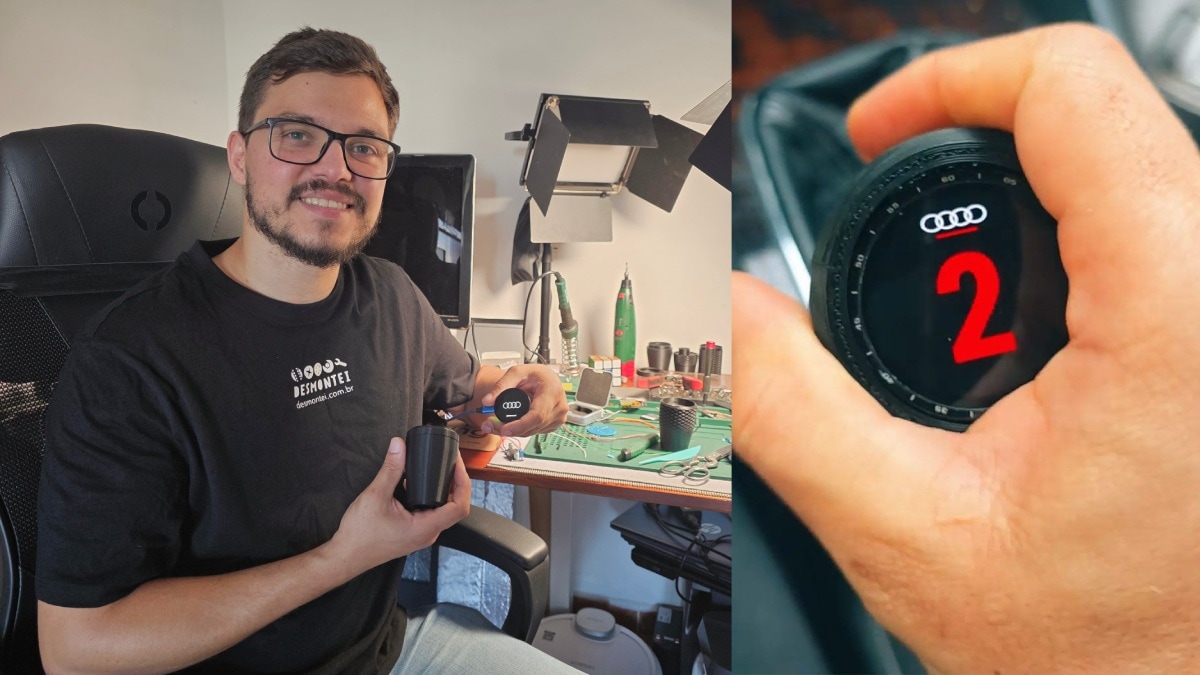
What do you do when your old smartwatch stops being smart, i.e., when it no longer gets software updates? Most of us relegate it to the storage, or worse, the trash can. If you care for Mother Nature, you might consider donating it to a recycling centre, hoping that your ‘useless’ obsolete gadget will be good for parts to some supplier. A Brazilian developer, however, chose none of these ways for his old Ticwatch smartwatch. Instead, he relied on his vibe coding skills to make it irresistibly cool.
Luan Valladares, a Brazilian developer and content creator who runs his YouTube channel by the name of Desmontei, decided to give his obsolete Ticwatch smartwatch a second life as a smart gear knob display on his old 2001 Audi.
Before we proceed, consider the premise thoroughly for a moment, an old, complex piece of technology on a car from over two decades ago. The car – a 2001 Audi A4 B5 – doesn’t understand the modern electronic complexities of today’s smart connected-car tech and AI-infused vehicle management systems. It may sound like an easy-to-do DIY project, but it isn’t. Two technological pieces from completely different eras that need to talk to each other.
Also, for context, the Ticwatch is a popular Wear OS based smartwatch, which relies on software updates from Google. The model in question here is from 2021 – obsolete by today’s standards.
Valladares, however, made it happen and, in the process, showcased a clever and interesting way to demonstrate how e-waste can be saved by vibe coding. The project caught attention globally, including ours. Hence, we sat down with him for a conversation on how he pulled it off well.
Stick around, as he has some great tips for budding DIY coders wanting to play with vibe coding.
A hardware geek who needed coding knowledge for his DIY project
For Valladares, the journey into software development didn’t start with years of syntax training, but with a sudden spark of curiosity. Prior to the ‘Audi smart gear knob’ project, he had zero experience building mobile apps. He initially intended to only use the smartwatch’s native, out-of-the-box features.
“To be completely honest, ‘vibe coding’ was the absolute backbone of this project, and I say that with pride,” Valladares admits right at the beginning of the conversation with Financial Express Digital.
“Out of sheer curiosity, I spent one night experimenting with AI and ended up with a fully functional working app. That ‘lightbulb’ moment elevated the project far beyond my original scope,” he added.
For his DIY project idea, the software needed to interpret data from the watch’s internal accelerometer to display the correct gear position on a custom touch interface. This introduced complex environmental variables that standard code templates couldn’t account for.
“Once the prototype was alive, the real engineering began,” Valladares explains. “I used AI as a brainstorming partner to tackle physical challenges—like filtering out the random G-forces and vibrations of a moving car, since a gear knob doesn’t sit on a fixed axis. The AI didn’t just write the code; it helped me confirm theories and solve complex logic. It turned a hardware guy into a software developer overnight.”
‘Software-skinning’ the future of sustainability
Instead of purchasing a resource-heavy, commercial aftermarket multimedia display for his DIY project, Valladares looked at a piece of discarded tech and saw premium, untapped hardware. He notes that a typical 2021 smartwatch is already packed with incredibly advanced components – precision Inertial Measurement Units (IMUs), vibrant AMOLED displays, Bluetooth radios, and powerful Systems-on-Chip (SoCs). Most of these devices become e-waste prematurely simply because a manufacturer stops updating the ecosystem.
This realisation highlights what Valladares sees as a massive paradigm shift for sustainable DIY culture – moving away from buying new components and toward what he terms “software-skinning.”
“Software-skinning (writing purpose-built new firmware for old hardware) is the logical next step for the maker community,” Valladares says. “Today, we have extremely well-manufactured devices packed with thousands of high-quality components. This works perfectly in my favour, making the purchase of new parts an absolute last resort. It is more sustainable, more creative, and frankly, far more interesting than just buying a €200 commercial aftermarket display.”
The point where AI fades, and human ingenuity takes over
Despite the power of generative AI, Valladares is quick to point out that software tools have hard limits when they collide with physical reality. Upcycling old gadgets requires deep hardware hacking and acute safety awareness — areas where human intuition remains irreplaceable.
One of the biggest hurdles of the gear knob display build was its power management. Leaving a volatile lithium-ion battery inside a closed vehicle enclosure is a recipe for disaster – it could end up being lethal in an old car. Valladares made the decision to completely bypass the internal battery and hardwire the TicWatch directly into the Audi’s 12V electrical system.
“This part was pure hardware hacking — no AI shortcuts here,” Valladares says. “Modern smartwatches usually refuse to boot if they don’t detect their native battery controller. So, I carefully dismantled the original dead battery, separating the chemical Li-ion cell from its small battery management system (BMS) board.”
By utilising a DC-DC buck converter, he stepped down the car’s fluctuating voltage to a stable 3.7–4.2V range and injected it straight into the salvaged controller board, effectively tricking the smartwatch into thinking a healthy battery was attached.
“The decision to remove the chemical cell entirely came from first principles,” he notes. “A degraded Li-ion battery inside a sealed 3D-printed enclosure, sitting in a parked car that can reach 60–70 degrees Celsius in the summer, is a thermal runaway waiting to happen. AI only helped me cross-reference the converter specs, but the physical bypass and safety logic were entirely human engineering.”
Vibe coding doesn’t mean anybody can build stuff
While vibe coding drastically lowers the barrier to entry for aspiring makers, Valladares warns non-coders looking to get their hands dirty with discarded gadgets. He says that the ease of generating code can easily create a false sense of security.
“Vibe coding doesn’t eliminate the need to understand what you are building,” Valladares says. “I’ve seen people in the maker community generate code with AI that they simply can’t debug when something inevitably breaks. My advice is this: use AI to build quickly, but always make an effort to understand why each block of code exists. The goal shouldn’t be to blindly publish code you can’t read; it should be to learn faster than ever,” he suggests.
When applied with this balanced mindset, however, the pairing of plain-language AI prompts and hardware hacking becomes a powerful tool for environmental democratisation. “Today, someone with pure curiosity and a broken gadget can describe what they want in plain Portuguese, my native language, and get a working prototype in an afternoon,” he says. But the basic knowledge of the platforms needs to be there.
More automotive e-waste DIY projects with AI are planned
With the digital gear shift project completed, Valladares is onto executing a much grander blueprint for his workshop. Rather than moving away from automotive tech, he plans to expand his vehicle’s digital footprint by building a cohesive, modern smart ecosystem for his older Audi entirely out of upcycled components.
“I’m currently working on adapting an old, discarded tablet into a fully customised multimedia center that connects seamlessly with the digital gear knob and my smartphone,” Valladares reveals. “I’m also developing a custom OBD2 plug to read the car’s telemetry. The grand challenge is to make it 100% functional while buying the absolute minimum number of new components.”
The techie, however, isn’t planning to set up a shop for selling these as a product kit that you can install in your old vehicle. Valladares is choosing to educate his followers rather than settle for retailing his hardware. He is currently developing a step-by-step educational course to hand his blueprints back to the community.
“True democratisation is about teaching people how to build, not just selling them another product,” Valladares says. “I want to teach people how to build their own gear knobs and repurpose their own e-waste using free AI tools, exactly how I did.”