



A deep-tech startup is quietly engineering the future of indoor environments in a world where over 99% of the global population breathes polluted air. Praan, a venture-backed climate-tech company with headquarters across San Francisco and Mumbai, is building what it calls the foundational air infrastructure for the next 100 years — an end-to-end system that doesn’t just filter pollution but actively designs cleaner, healthier air to improve sleep, recovery, and cognitive performance.
Praan is one of the six startups in the inaugural Atoms X cohort, highlighted as the portfolio’s climate and infrastructure play. Accel and Prosus describe it as a company building full‑stack air infrastructure, using filterless technology for advanced purification along with sensing and environmental control, aimed at optimising indoor air for human physiology.
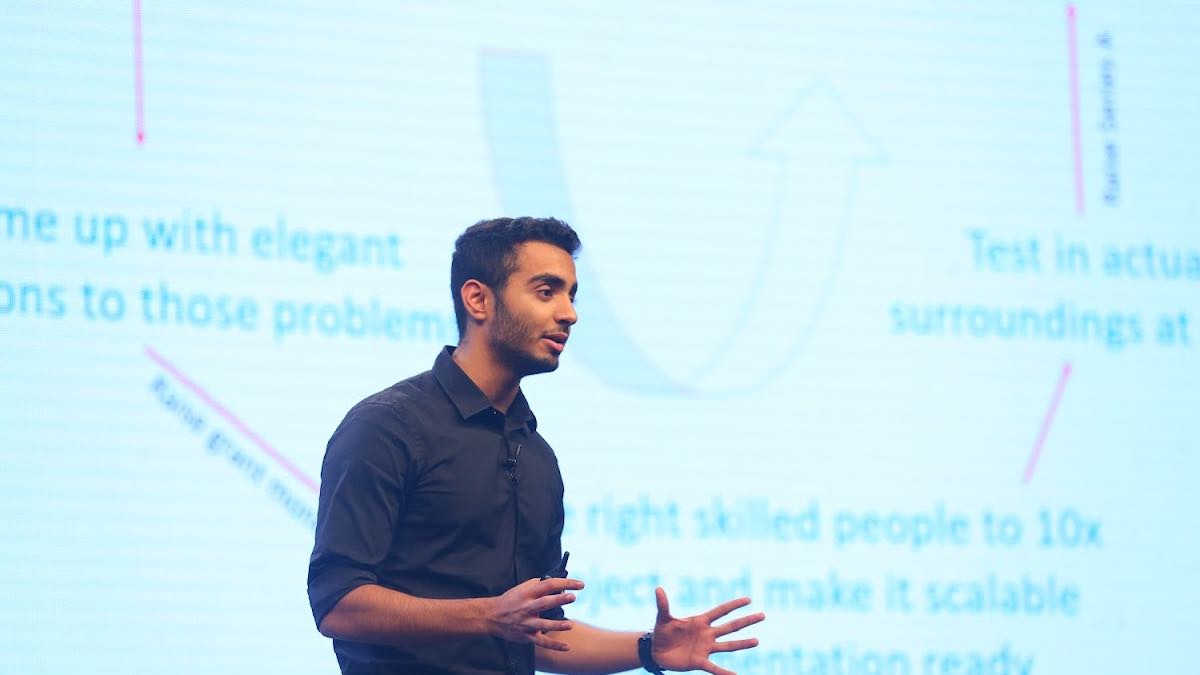
At its core, Praan tackles one of the most pressing yet overlooked aspects of the climate crisis. “In all things climate, what’s affecting people the most is poor air quality,” says founder and CEO Angad Daryani. “I grew up with asthma in Mumbai, and each winter, my parents had to take me out of the city so I could breathe better. I waited my entire life for someone to solve this,” he told while sitting down for a quick chat with Financial Express.
Meet Angad Daryani: The man who took indoor air cleaning seriously
Daryani is a deep‑tech inventor and climate‑tech entrepreneur whose personal struggle with air pollution in Mumbai became the catalyst for one of the world’s most ambitious air‑infrastructure startups.
Daryani grew up in a polluted Mumbai, battling asthma that flared every winter, when his family would sometimes leave the city so he could breathe more easily. As a result, he made it his life’s mission to build the breathable air infrastructure.
Around the age of 8, Daryani built his first robot and a solar‑powered boat. By 13, he had assembled a homegrown 3D printer, and at 15, he developed an e‑reader called the Virtual Brailler for the visually impaired. Frustrated with rote‑learning‑heavy schooling, he briefly dropped out and approached MIT professor Ramesh Raskar, who invited him to collaborate with the MIT India Initiative for two years, long before he formally joined a university.
Daryani education and path to Praan
After that MIT‑linked stint, Angad returned to formal education in an IB‑style school and later studied electrical engineering at the Georgia Institute of Technology (Georgia Tech). It was during his sophomore year at Georgia Tech, in 2017, that he founded Praan out of his dorm room, turning air pollution from a personal irritation into a technical moonshot.
Before Praan, he had already founded Shark Kits, an educational‑robotics company, which he led for about six years starting in his teens. That early startup experience gave him a taste of product development, hardware, and growth under resource constraints – skills that later helped him bootstrap Praan on a shoestring budget before it attracted major venture capital.
Early prototypes targeted extreme industrial settings, successfully handling PM2.5 levels exceeding 100,000 in plants and heavy facilities. The company’s filterless purification technology proved it could scale particle removal without relying on traditional, high-maintenance HEPA filters. These insights were later refined into Praan’s consumer and commercial offerings.
Today, Praan operates two main product pillars – advanced indoor air platforms for homes and workplaces, and the ambitious “Sanctuary” system that reimagines entire HVAC infrastructure.
“We started by trying to understand how to rebuild Earth’s atmosphere — and built all the core technologies to remove particles, gases, and even CO2 directly from the atmosphere,” Daryani says.
Internal prototypes of Sanctuary are complete, and multiple patents have been filed. The company plans to deliver the first mass-deployable systems to thousands of homes by 2027. “If successful, this would completely change how humans breathe for the next century!” Daryani adds.
From an inventor to a CEO
Angad serves as both CEO and CTO of Praan. He personally led the development of Praan’s filterless industrial‑air‑purification stack (product lines like MK‑II) as well as its commercial HIVE platform, spatial and environmental‑sensing systems, and the underlying computer‑vision and AI‑driven climate models that underpin the company’s tech stack.
“We started by trying to understand how to rebuild Earth’s atmosphere – and built all the core technologies to remove particles, gases, and even CO2 directly from the atmosphere. Then, to build the business, we focused on indoor spaces – where humans spend 90% of their time,” he said.
Under his leadership, all of Praan’s core patents have received ‘Notice of Allowance’ from the USPTO, highlighting his obsessive focus on IP‑driven, defensible hardware.
HIVE and Sanctuary: Praan’s flagship air purification systems
HIVE, which is Praan’s flagship indoor air platform, delivers medical-grade HEPA14 filtration. It removes particles up to 166 times smaller and gases up to seven times faster than conventional systems. It is already deployed in premium homes, enterprise offices, and commercial spaces, with notable clients including Blue Tokai, Shapoorji Pallonji, Epsilon, Wipro, Pidilite, Max Estates, Physical Intelligence, and Oura.
The more transformative offering is Praan Sanctuary — a first-of-its-kind integrated system that unifies HVAC, heating, humidification, and purification into a single stack tuned to human physiology. Described as bringing “mountain-like” air into every room, Sanctuary dynamically adjusts temperature, humidity, and air quality based on seasons and individual needs.
“What we noticed is that our air infrastructure — that is, the HVAC, heater, humidifier, purifier — haven’t significantly changed in 100+ years,” Daryani explains. “They all act on the same air, but pull it in different directions.” Sanctuary aims to change that by tying the indoor environment directly to human wellness, enabling deeper sleep, faster recovery, and sharper cognition at work.
Praan has already secured agreements to deploy Sanctuary across more than 6 million square feet of luxury real estate in India, representing roughly $30 million (approximately Rs 277 crore) in committed projects on the waitlist.
Praan’s manufacturing scale in India
To support its ambitious vision, Praan runs a full-stack manufacturing facility in Mumbai. By the end of 2025, the company quintupled production capacity for the HIVE line. In 2026, it is building a new facility targeting an annual capacity of around 100,000 devices. The company is also bringing HEPA-14 nano-fibre production in-house, a move that would give it rare end-to-end control over core filtration materials.
Strong investor backing and strategic support
Praan has emerged as one of India’s standout deep-tech climate-hardware startups. It is backed by global investors, including Accel and Prosus, as well as Social Impact Capital. The company also counts operator-angels from Tesla, Anduril, Saronic, Boom, Brookfield, and industrial families such as Kirloskar and Thyssenkrupp India.
In India, it has attracted strategic investment from architects Sarah Sham (Essajees Atelier) and Mehul Shah (DSP Design Architects), along with support from Harsh Mariwala’s Marico Innovation Foundation.