



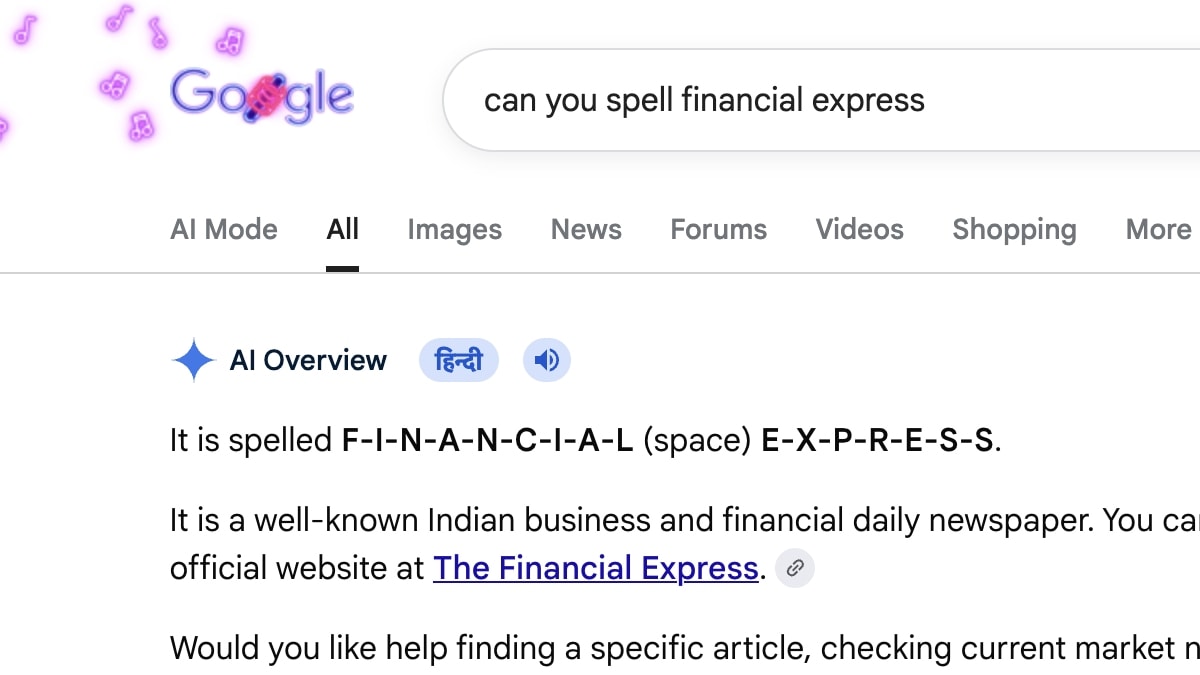
In Germany, a court has ruled on a decision that could change the dynamics of the AI industry. A regional court in the country has held Google responsible for content generated by the company’s AI Overview feature embedded in Google Search. The court treated the summaries created by AI Search Overview as Google’s statements rather than as neutral search results.
This now raises a question that almost all AI companies are possibly dreading at the moment – will OpenAI, Anthropic, Meta and others be held liable for the responses generated by their chatbots?
The Regional Court of Munich issued a temporary injunction on May 28, 2026, barring Google from repeating specific false claims about two Munich-based publishers in its AI-generated search responses. The plaintiffs, companies specialising in books, magazines, and online sales related to technology and history, were wrongly linked by Google’s AI to scams, subscription traps, shady business practices, and other allegations.
AI Overviews responses now treated as Google’s own content
The court determined that AI Overviews function differently from traditional search results. While conventional search engines primarily link to third-party websites, Google’s AI “rewrites and judges results in its own words and according to its own structure,” the ruling stated.
In the disputed cases, the AI produced confident, self-contained summaries, such as opening with “Yes, [company] is known for dubious business practices”—that included claims not present in any of the linked source materials.
“Google built the AI, Google offered it to users, so Google owns what it produces,” the court states, noting that the company alone controls the algorithms and the feature’s presentation.
This distinction is crucial.
Previous German Federal Court of Justice (BGH) incidents provided search engines and autocomplete features with limited liability as indirect infringers – the reason was that they merely make third-party content discoverable. The Munich court, however, ruled that these protections do not extend to AI Overviews, which generate these responses in “independent, new, and substantive statements” by synthesising and evaluating information.
AI-generated content should not be trusted, says Google
In a counter response, Google argued that users could verify information by checking the linked sources and that people generally understand that AI-generated content should not be blindly trusted.
The court, however, dismissed Google’s take. It noted that the AI summaries stand alone as understandable statements. The court drew parallels to press law, where publishers remain liable for misleading teasers even if readers do not click through to full articles.
The ruling also highlighted a potential “protection gap” for victims, i.e., if Google isn’t held responsible for the responses, victims of AI lies are left completely unprotected. They wouldn’t be able to sue anyone, because the websites Google cited as sources never actually made those false claims in the first place.
The court also limited free speech protections for AI-generated content, describing it as “the result of an algorithm” rather than an expression of personal conviction. It prioritised the plaintiffs’ rights against false factual claims.
Will this ruling affect the whole AI industry?
The ruling covers specific false assertions about scams, dubious connections, and other defamatory content. The court noted a continuing risk of repetition due to the algorithmic nature of the feature, as Google had not provided a formal cease-and-desist with penalties.
The outcome of this ruling could have international implications, since the AI Overviews feature is available internationally. If governing bodies from other nations start following similar laws related to generative AI, the entire AI fraternity could face severe difficulties in their business. There have been several instances where AI bots have shared controversial statements on sensitive topics, and AI firms get away by citing the ‘algorithmic’ reasons.
However, most AI chatbot platforms, including Google’s Gemini, always display a cautionary notice alongside user interactions stating that AI-generated responses may contain inaccuracies and that users should independently verify information. Such disclaimers generally indicate that outputs are generated probabilistically and should not be treated as definitive factual, legal, financial, or professional advice.
By contrast, a similar user-facing disclaimer is not prominently visible in Google’s AI Mode interface in the same manner during interactions.
Google has not publicly commented in detail on the ruling yet.