



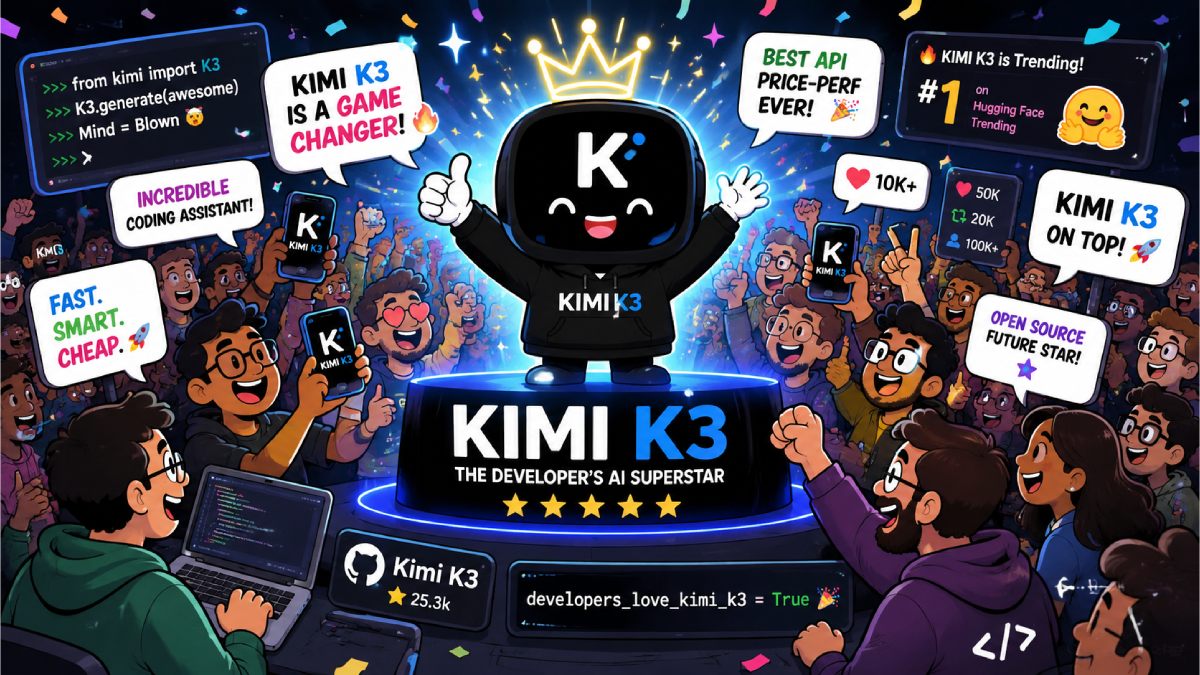
Days after unveiling its flagship AI model in Shanghai, China’s Moonshot AI finds itself dealing with a problem every AI company both dreams and dreads – the inability to meet consumer demand following viral success. Moonshot AI has presently halted new registrations for Kimi K3, preventing new sign-ups and subscribers from joining. The company assures that existing subscribers won’t be affected by the decision and can continue using the frontier-class model.
Within 48 hours of releasing Kimi K3, Moonshot was faced with a shortage of infrastructure to support the vast amount of demand. In a post on X, the company stated, “Over the past 48 hours, demand has pushed close to the limits of our current capacity. To protect the experience of existing subscribers, we’re temporarily pausing new subscriptions and prioritising compute for current members. Existing subscribed users are not affected.”
Once the company manages to provide more GPUs for new subscribers, Moonshot said it plans to bring a tiered approach to allow for easier availability. “Going forward, we’ll also split membership into two more focused plans: Kimi Membership for Kimi Web, App, and Work; and Kimi Code Membership for coding workflows,” wrote the company in its post.
While the company struggles to keep up with the demand, a more pressing question looms on the internet.
Why has Kimi K3 gone viral?
At the heart of Kimi K3 is its combination of raw scale, innovative architecture, and sticking to open weights, which developers and AI enthusiasts seek with a frontier-class model.
A 2.8-trillion-parameter open model: At 2.8 trillion parameters, Kimi K3 claims the title of the world’s largest open-source model class. Moonshot AI’s promise to release full model weights on July 27 gives the global developer community access to a model scale previously reserved for restricted Silicon Valley giants like Anthropic and OpenAI.
Built for efficiency: Rather than relying purely on brute-force compute, Kimi K3 utilises Kimi Delta Attention (KDA) alongside Attention Residuals and an ultra-sparse Mixture of Experts (MoE) system that activates just 16 out of 896 experts. This design achieves roughly 2.5 times the scaling efficiency of its predecessor, delivering high performance alongside a massive 1-million-token context window.
Agentic at its core: Beyond basic prompt-and-response interaction, Kimi K3 is designed to operate autonomously over extended workflows. It excels at long-horizon software engineering, navigating massive codebases, using terminal tools, and integrating visual feedback loops across frontend development, CAD design, and video editing.
Kimi K3 vs GPT-5.6 vs Claude Fable 5
The arrival of Kimi K3 helps the case for open-weight AI models against the dynamics of Western closed-API players.
1. Kimi K3 vs OpenAI’s GPT-5.6 Sol:
OpenAI’s flagship GPT-5.6 Sol has earned a reputation as an uncompromising and persistent worker. Sol is good at taking well-defined checklists and pushing through tedious multi-file code execution, debugging, and continuous integration tasks without giving up.
However, Kimi K3 offers two major advantages: cost and open accessibility. At an estimated API pricing structure of $3 per million input tokens and $15 per million output tokens, K3 is significantly cheaper to run than Sol ($5 for input and $30 for output), while matching Sol’s long-horizon task completion.
Furthermore, K3’s native visual execution provides an interactive feedback loop that moves beyond Sol’s standard textual execution.
2. Kimi K3 vs Claude Opus, Claude Fable 5
Anthropic’s Claude Fable 5 (the successor to Claude Opus 4.8) currently sets the gold standard for high-level reasoning, system design, and open-ended architectural planning. Fable 5 can absorb massive legacy codebases and refactor system architectures with minimal instruction.
However, Fable 5 comes with a heavy price tag ($10 input / $50 output per million tokens) and strict, built-in safety classifiers that can trigger refusals on complex or edge-case engineering tasks.
In contrast, Kimi K3 provides frontier-class reasoning and multi-agent coordination at a fraction of the cost. For developers who want full control over model weights, fine-tuning, and deployment, free from API rate limits and external safety throttles, Kimi K3 presents a compelling alternative to Anthropic’s ecosystem.