



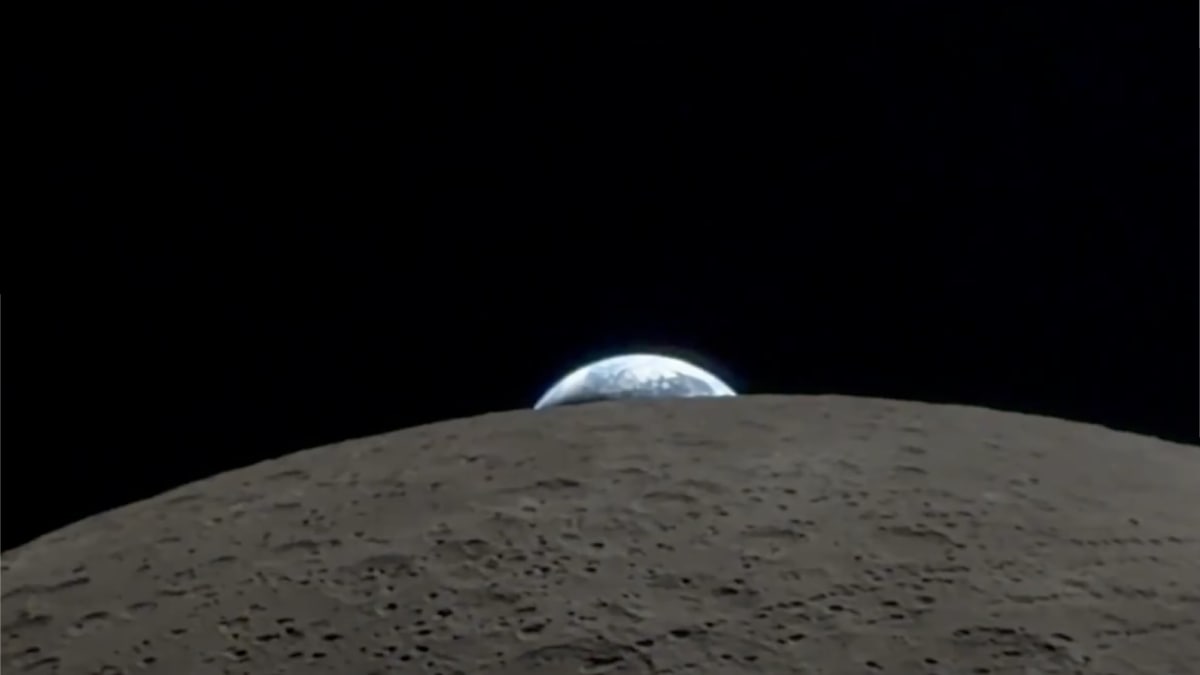
NASA’s Artemis 2 mission has highlighted how great the iPhone’s camera can be for taking photos beyond the realm of Earth. However, astronaut Reid Wiseman has now shared an iconic video of an ‘Earthset’ captured from the far side of the Moon, and the footage has been shot on an iPhone!
Wiseman used an iPhone 17 Pro Max to capture the rare sight of the Earth setting behind the Moon’s horizon while aboard the Orion spacecraft’s flyby of the Moon. The 53-second video, which is uncropped and unedited, was shot with the 8x digital zoom lens, showing our planet slowly slipping behind the dark lunar surface.
Wiseman, who was the commander of Artemis 2, described the scene as “watching sunset at the beach from the most foreign seat in the cosmos.” In his viral post, he wrote, “Only one chance in this lifetime…”
How the iPhone 17 Pro Max captured ‘Earthset’ like a pro
The iPhone 17 Pro Max’s camera is considered one of the most advanced smartphone imaging systems ever created, featuring an all-48MP triple Fusion camera array, consisting of a 48MP Main (ƒ/1.78), 48MP Ultra Wide (ƒ/2.2), and a new 48MP Telephoto (ƒ/2.8) with next-generation tetraprism design. We tested its camera system a couple of months ago as part of the review and found the iPhone 17 Pro Max outperforming most other high-end smartphones with regards to colour science, exposure management, noise suppression and contrast control.
However, it was the zoom performance, which played a crucial role in this Earthset photo, that left us impressed. The iPhone 17 Pro Max’s telephoto sensor is 56% larger than its predecessor, allowing for superior detailing, better low-light performance, and true optical-quality at 4x and 8x magnification — the longest optical-quality reach ever on an iPhone. Along with the Apple A19 Pro chip and the new Quantum Image Engine, which employs advanced computational photography and machine learning-based demosaicing, the iPhone delivers exceptional dynamic range, natural colours and reduced noise even when you are zooming in.
The iPhone also offers features like 48MP RAW, ProRes video, and second-generation sensor-shift stabilisation across multiple lenses. While Wiseman stuck to the Auto mode, the iPhone’s sensor-shift stability, along with the cutting-edge image sensor and the advanced computational photography, is what allowed it to capture the darker side of the Moon with all its craters, mountains and other details. No details on the zoom quality or any filter were revealed, but you get to see a cosmic view in great clarity and popping colours from a phone’s camera, that too in an environment it wasn’t designed for.
Artemis 2 commander shot the ‘Earthset’ next to a DSLR camera
In the video, Wiseman says that you can hear the rapid shutter clicks of fellow crew member Christina Koch’s Nikon camera as she fires off professional 3-shot brackets through a 400mm lens. Meanwhile, astronauts Victor Glover and Jeremy Hansen watch from an adjacent window of the spacecraft.
Wiseman writes that he could barely see the Moon through the narrow docking hatch window. However, the iPhone’s compact size made it the perfect tool to frame the view. “I could barely see the Moon through the docking hatch window but the iPhone was the perfect size to catch the view. This is uncropped, uncut… quite comparable to the view of the human eye,” he added.
NASA Administrator Jared Isaacman simply replied, “Yes.” Other users called it “the most incredible video ever captured by a phone” and “the coolest camera roll of any iPhone user on the planet.”
This wasn’t the only time the iPhone got its shot at fame during NASA’s Artemis 2 mission. While the Orion spacecraft was en route to the Moon, mission specialist Christina Koch captured a striking and widely shared photograph using an iPhone 17 Pro Max’s front-facing selfie camera from inside the capsule. The image shows Koch in silhouette, quietly gazing out one of Orion’s windows at the brilliant blue crescent of Earth floating in the vast blackness of space, with the dimly lit interior of the spacecraft framing the moment.
Taken roughly two days after launch as the crew travelled farther from Earth than any humans since Apollo, this unposed shot quickly went viral for its raw emotional power and human perspective, especially for a photo captured on a consumer smartphone rather than professional gear.
Internet in awe to see iPhone photos take stunning space photos, videos
Wiseman’s post got a lot of reaction from the scientific community as well as tech enthusiasts. Many were quick to point out how the iPhone’s capabilities highlight the rapid advancement of consumer technology. Some pointed out that a device that fits in a pocket achieved what the most advanced cameras of the Apollo era could not.
“The most advanced camera humanity sent to the Moon in 1969 could not take this shot. A device that fits in a pocket did it in 2026,” one commenter wrote.
Another user expressed gratitude towards Wiseman, stating, “Thank you for grabbing your phone and sharing this raw. Makes it feel so much more real than the pro camera shots.”
The Artemis 2 has made history by flying humanity the farthest from planet Earth. It was also the first time since humanity flew around the Moon after Apollo 17 in 1976. NASA wanted the astronauts to take lots of pictures this time, especially of the Moon’s farside. The agency also wanted to see how a consumer device behaved in the fragile environment of space. In the mix of professional Nikon DSLR cameras were four iPhone 17 Pro Max units that NASA had assigned to each of the astronauts.