



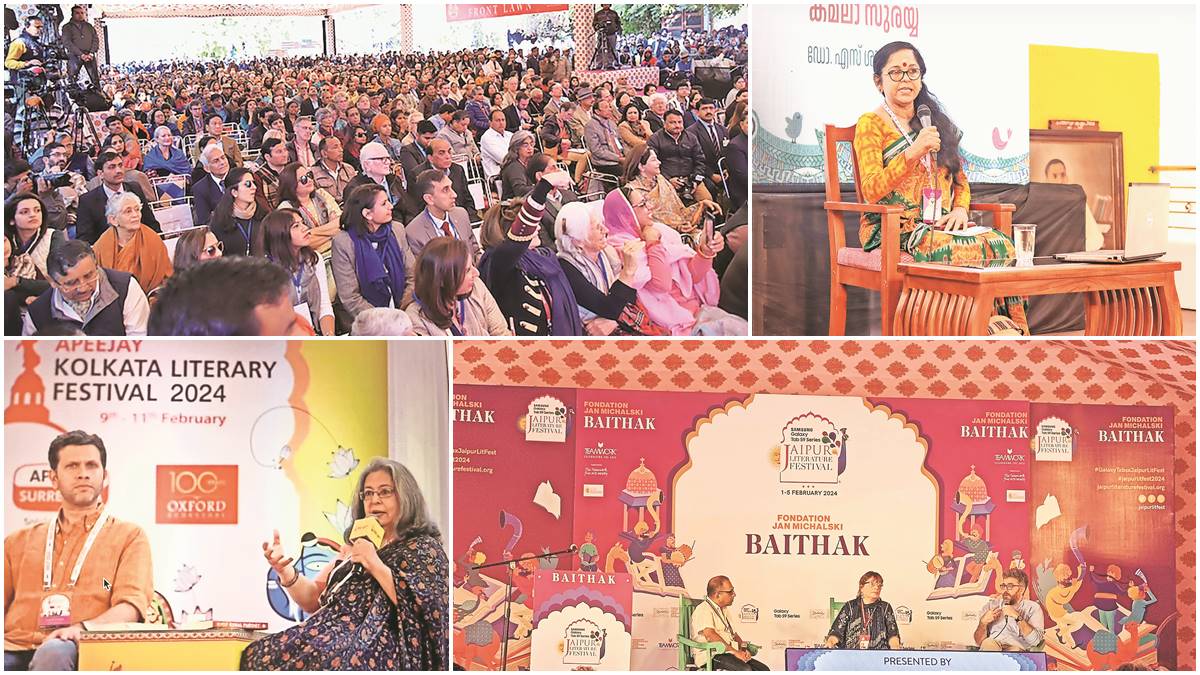
The December chill was in the air as Shashi Tharoor slowly walked to the podium to begin his speech. The acclaimed author and senior politician lavished praise on the high literacy of Kerala, the state he represents in the Lok Sabha. Words like literacy, books and reading made it apparent that Tharoor felt at home talking about the things he practised as a profession. In fact, it was his home, the official residence as a member of Parliament, in the national capital. Tharoor had thrown open his residence to the Kerala Literature Festival (KLF) last December to announce its new edition set to take place a month later. Diplomats matched the number of writers at the KLF curtain-raiser reflecting the host’s continued kinship with members of his former job as an under-secretary general at the United Nations.
Number was a recurring theme for the speakers at the KLF’s announcement of its seventh edition in January. To be precise, it was one number, half-a-million, that was repeated by KLF chief facilitator Ravi Decee, the publisher of DC Books, and Tharoor himself. The claim of having a half-a-million audience in the post-pandemic editions of KLF was significant because no other literary festival in the world had such an attendance of visitors. Half-a-million, incidentally, was the figure the organisers of the Jaipur Literature Festival (JLF) used to give out at its pre-pandemic editions. To further muddle the waters, the Mathrubhumi International Festival of Letters (MBIFL) held in Thiruvananthapuram, calls itself the ‘biggest literature festival of south India’. There was an air of one-upmanship as JLF, KLF and MBIFL, the country’s three biggest literary festivals, approached their newest editions early this year. The schism appearing between the biggest festivals seems to widen as JLF, which had a traditional January fourth week schedule suddenly became an early February festival, making exchange of authors difficult.
“The question is not which is the biggest literature festival in the country, but which is the more serious about literature,” says poet K Satchidanandan, who has been the KLF festival director in its past three editions. Interestingly, the Kerala Sahitya Akademi, which Satchidanandan heads, launched its own international literature festival this year in Thrissur, considered the cultural capital of Kerala. The International Literature Festival of Kerala (ILFK) held between January 28 and February 3, three days longer than JLF and KLF, had 40 writers from outside Kerala and 14 from abroad, including writers from South America, Europe and a Palestinian writer.
The first edition of ILFK, held in the town of Thrissur unlike the major cities of Kochi or Thiruvananthapuram or Kozhikode, the venue of KLF, in Kerala, is also an indicator of the springing up of literature festivals in small towns and even small villages across the country. Every district in Kerala today has a literature festival. It is not a different story in other states. Last year, Sikkim opened its first literature festival in the historic town of Yuksom, a picturesque place in the middle of rolling hills, pristine forests and majestic monasteries, instantly gaining the tag of the literature festival with the ‘most beautiful venue’. Another literature festival, Taj Literature Festival in Agra, had held that honour until it became defunct two editions later. Some estimates say the country has about 300 literature festivals spread across big cities, small towns and even villages. Kerala alone boasts of at least 20.
The springing up of literature festivals in every nook and cranny of the country is a good sign, but ambition may need to match content and character. A good literature festival is measured in terms of a variety of factors—programming, presence of Indian and international authors and audience. Above all, other major factors like inclusiveness, gender parity and diversity come in because of still existing patriarchal systems, violence against women and under-representation of backward communities and minorities in jobs, judiciary, government and platforms like literature festivals.
“We are not in the game of numbers, we are for quality,” says author Sabin Iqbal, curator of MBIFL. “Plurality in the curation is important,” he adds. “We have a discerning audience who comes prepared for sessions. Every venue and session is packed.”
Iqbal, the author of The Cliffhangers and Shamal Days: A Novel, admits he is aware of mushrooming literature festivals in the country. “Every district in Kerala today has a literature festival. Some communities and political parties too have started literature festivals,” says Iqbal, who remembers the Hay Festival organisers telling him about 50% gender parity of their event when he was preparing for the first edition of MBIFL. “We made conscious efforts to have a minimum 35% of female speakers,” he adds. “More literature festivals are a good thing, but the intent and the motive are important,” says Iqbal. This year, the MBIFL gave its biggest award, the Mathrubhumi Book of the Year award, to debutant author Devika Rege’s Quarterlife, which explores the anxieties of the youth in India in dealing with the social, political and religious divides in society.
The JLF, too, wouldn’t want to focus on numbers. “We have the advantage of being the first starters. When you have 25 million people viewing you, then the rest of the figures are irrelevant,” says Sanjoy Roy, managing director of Teamwork Arts, which produces JLF. “Our purpose is never to be the first, the best, or biggest, or brightest,” adds Roy, explaining the philosophy of production. “We have a fundamental approach—can we reach out to young people, can we do it in a democratic accessible way, and can we get the best, most exciting ideas across ideologies and spectrum, so everything from particle physics, and artificial intelligence and health, business and administration is discussed.”
Anshu Khanna, who has more than a decade of experience in programming for literature festivals, views the increasing number of literature festivals as a good sign of a growing culture of reading. “We, however, need to be careful in not trivialising literature,” says the Delhi-based Khanna. “A literature festival is all about programming. What can you offer to your audience and how can you package that offer are the important aspects along with branding,” adds Khanna, who is working towards reviving the Taj Literature Festival in Agra this year. “The JLF is the most successful because they do all these aspects the best.”
Agrees Roy, who emphasises the role JLF in its 15 editions has played in inspiring and creating literature festivals across the country. “Look at the range of sessions that we have, everything from disability and environment to four Booker Prize winners, Pulitzer Prize winners, plus there is education, craft, design, fashion and cricket. And for us, success has never been that we have to be the biggest, but it’s really that everybody has been inspired to create another literature festival. So there are 300-odd festivals today that have found inspiration from the JLF. And our effort has been to create a space where people want to come to. This is a place you can be a part of, feel part of—a safe space. Thousands of young people, thousands of single people from across the identity spectrum. So that’s where our focus has been,” says Roy.
“I welcome more new literature festivals in the country,” says Satchidanandan, a former Kendriya Sahitya Akademi secretary. “But competition is not necessary among festivals. The level of discussion at each session needs to be of high quality,” he adds. The newest literature festival in the country, the first ILFK edition in Thrissur (January 28-February 3) presided over by Satchidandan boasted a budget of `1 crore, a budget JLF had in its initial years. Though all the major literature festivals in the country, from JLF to KLF and Tata Literature Live! and Times Literary Carnival in Mumbai to Apeejay Kolkata Literary Festival, The Hindu Litfest in Chennai and Bangalore Literature Festival in Bengaluru, have big budgets, only JLF has been able to sustain a permanent presence of international authors, including the reigning Booker Prize winner, sometimes a Nobel laureate and many Pulitzer winners at every edition. But the lack of diversity among international authors, like the participation of authors of colour from Africa, something an MBIFL manages to do, has been a bone of contention in the discerning audience at JLF every year.
Faizal Khan is a freelancer