



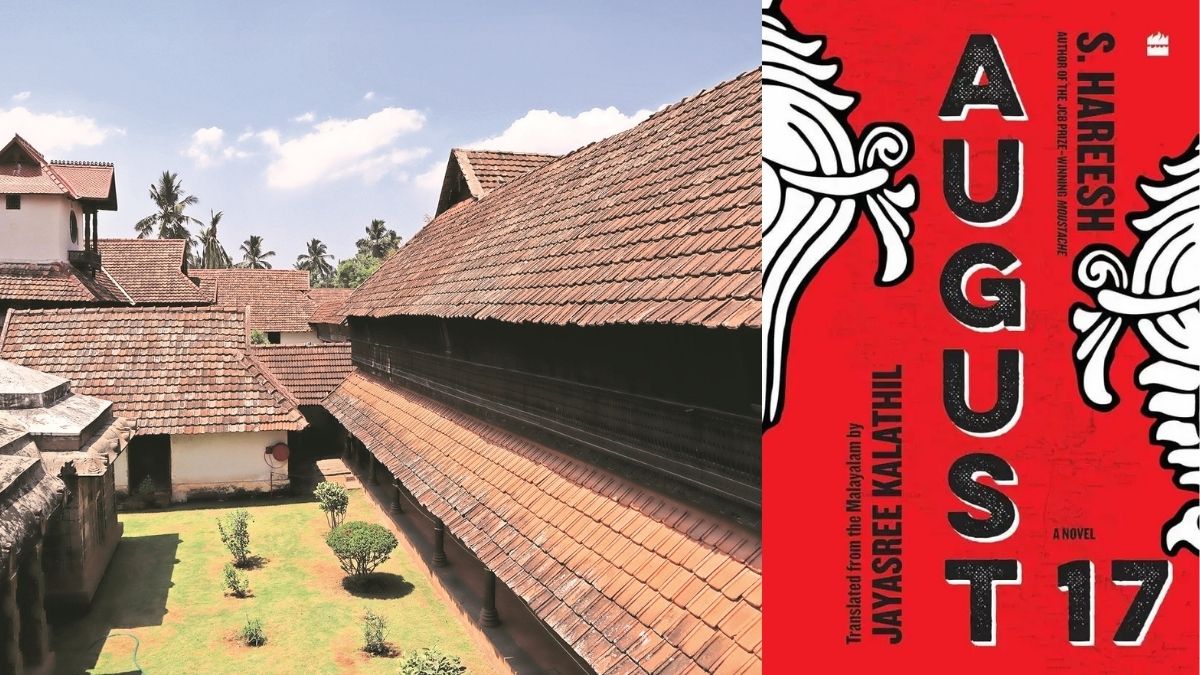
Award-winning Malayalam writer S Hareesh wades into the turbulent waves of history dealing with Indian independence in his new novel, August 17. In an Author’s Note at the beginning of the English translation of the original Malayalam work, Hareesh explains that the “novel imagines what would have happened if, in 1947, Thiruvathamkoor (Travancore) had not joined the Indian Union, and had instead retained its sovereignty and remained an independent nation”.
A gist of geography would help understand the political map of present-day Kerala in the year 1947. There were three separate parts — the princely state of Travancore comprising most of the southern part of present-day Kerala along with parts of today’s Tamil Nadu stretching to Kanyakumari, the kingdom of Kochi, and the Malabar Province of British India incorporating the northern parts of present-day Kerala. While Kochi acceded to a newly-independent India almost immediately, it took some prodding from Jawaharlal Nehru and Sardar Patel to receive Travancore’s agreement. An anecdote from history refers to Travancore Diwan CP Ramaswamy Iyer’s argument that the kingdom belonged to its deity, Sree Padmanabhaswamy, something Sardar Patel was not willing to concede.
Hareesh, who won the JCB Prize for Literature in 2020 for his debut novel Moustache, picks on the procrastination of the Travancore rulers to make his case for an alternative history of the southern strip of land and its people. He chooses a Travancore government’s spy as the narrator of the novel, who wanders into the rallies, processions, meetings and hide-outs of politicians planning an end to the royal rule and the beginning of democracy in the land.
The author sharpens the edge of the novel’s narrative tool through a character popular in present-day Kerala as a giant in Malayalam literature. Thus Vaikom Muhammad Basheer becomes a major character in the book, appearing as Basheer, a writer and wrestler who masterminds most of the political upheavals in Travancore. Early in the novel, whose story begins in the late 1930s, Bhasi befriends Basheer to gain entry into the inner circle of the political party spearheading the freedom struggle in Travancore in line with the ideology and philosophy of Mahatma Gandhi and Nehru. The author invokes the freedom fighter in Vaikom Muhammad Basheer’s real life in which the litterateur, influenced by Gandhi, joined protests against the British Raj and invited the ire of the Travancore Diwan through his radical writings.
Bhasi also ends up in a central jail in Travancore with Basheer, disguised as a prisoner himself. The novel replays Muhammad Basheer’s famous short story, Mathilukal (Walls), which was inspired by the real-life writer’s own experience in a prison in Malabar as a freedom fighter. August 17 races ahead through the mid-19th century Travancore’s picturesque places surrounded by islands and islets, often the backyard of the struggle for freedom. Bhasi’s daily reports to the Travancore Diwan from the inner circle of the freedom fighters help the royal administration’s crackdown on the struggle and its leaders.
Relying on Bhasi’s daily reports, the Diwan acts against the political leaders, who he accuses of “spearheading falsehoods that freedom of press was non-existent and political torture was rampant” in Travancore. The Diwan further accuses the freedom fighters of conspiring to bring Travancore, a “complete Hindu rajyam (country), under a Christian government”. Those fighting for freedom send memoranda to the Maharaja demanding the “right to vote, freedom of worship, freedom to organise, freedom of the press, an independent judiciary”. The Diwan also faces charges of corruption from the freedom fighters.
Built on the strength of an avalanche of characters from real-life, including Muhammad Basheer, socialist leader KCS Mani, who tried to kill the Travancore Diwan, and a host of the provincial Congress and Communist leaders like Akkamma Cherian, August 17 relies on a radio declaration in July 1947 by the Travancore king that “Travancore would reassume in full measure its independence and sovereignty” from August 15, 1947, a date changed to August 17 in the novel. In the novel, the king’s declaration, which was based on the British rulers’ own declaration a month earlier that its dominance over the Indian princely states would lapse with the transfer of power to India and Pakistan, seems to bring congratulatory messages from Muslim League leader Mohammad Ali Jinnah and Hindu Mahasabha president VD Savarkar.
Hareesh’s deft craft and narrative prowess continues with the building up of the political scene after Travancore refuses to accede to India. A slew of measures are announced by the king — cow slaughter is banned and voting rights are for the taxpayers alone. For the reimagining of Travancore’s history after August 15, 1947, the author gathers allies like English writer Somerset Maugham and Muhammad Basheer himself. “Writing is about making meaning,” says Muhammad Basheer’s character in the novel. “It is about collecting together words and events from which readers can make their own meaning,” he adds. The words echo in the novel when some pages later the Travancore Diwan considers himself and others characters in a novel after an imaginary meeting with Maugham. “Characters who will redirect the course of the narrative,” he tells the narrator.
Faizal Khan is a freelancer
August 17: A Novel
S Hareesh
Translated by Jayasree Kalathil
HarperCollins
Pp 432, Rs 599