



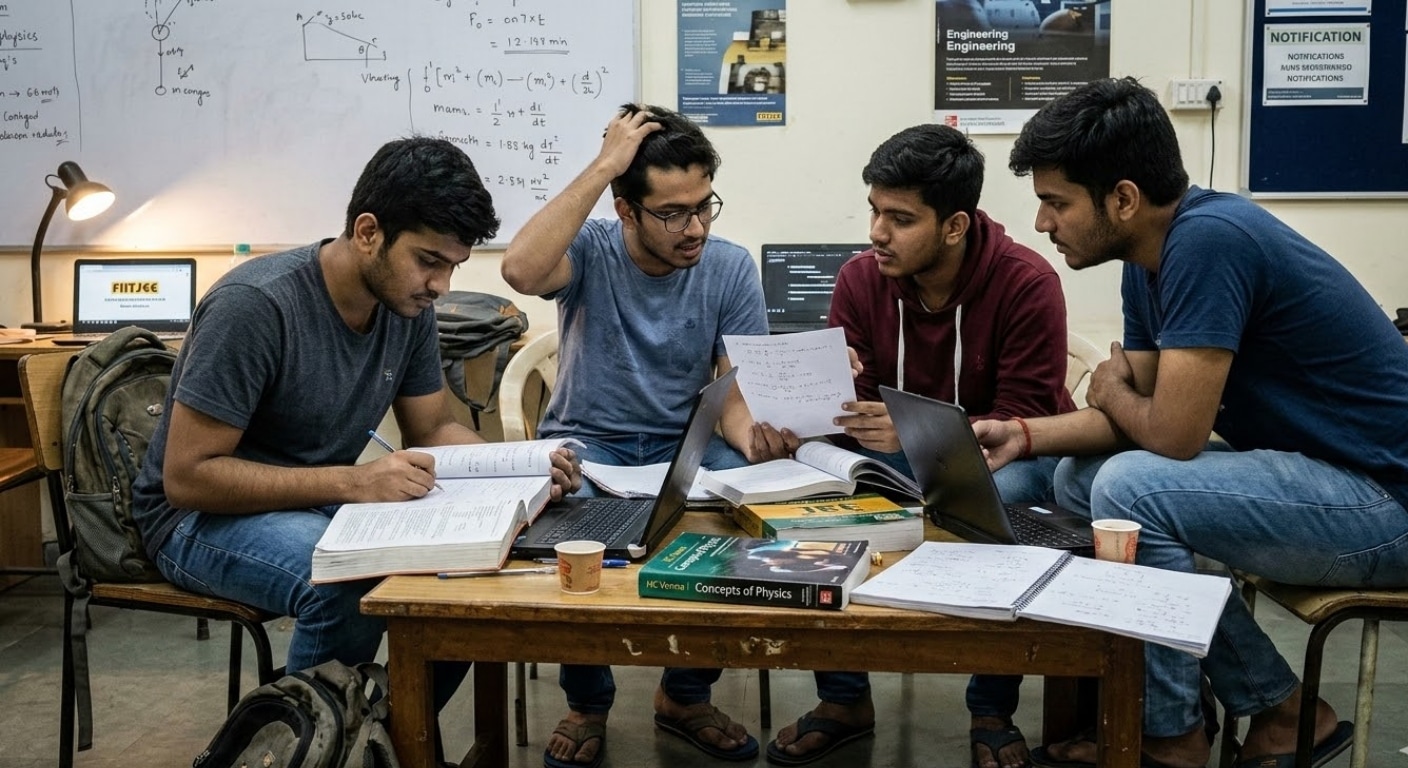
The competitive examination landscape is at a crossroads. For decades, the Joint Entrance Examination (JEE) has been the gold standard of merit, but the system is facing a reckoning. In a recent discussion with the Indian Express, IIT Bombay’s director, Prof Shireesh Kedare, raised concerns that the current coaching culture prepares students to “game the system” rather than build the critical thinking skills required to survive – and thrive – within the IITs.
‘Coaching culture trains students to game exams, not build concepts’: IIT Bombay Director Shireesh Kedare at Idea Exchange.
For parents and students, this raises a question: If the exam is evolving to favour conceptual understanding over cracking the code, is traditional coaching becoming obsolete?
Ujjwal Singh, founding CEO of Infinity Learn – who has spent over two decades in the education sector – argues that the solution isn’t to eliminate the JEE, but to reimagine how we prepare for it.
The gaming dilemma
Prof Kedare’s call to move away from multiple choice questions (MCQs) and direct numerical answers towards a focus on core concepts has sent ripples through the industry. Singh, however, sees this not as a threat, but as a necessary evolution.
“We see this as a pivotal moment,” Singh said. “Mathematics and Science are foundational disciplines that build life skills; they aren’t just pathways to an IIT seat. While students must excel in the current system, we have to future-proof their skills for the education landscape of tomorrow.”
Singh believes the “coaching culture” label needs a nuance check. To him, the gap between “cracking an exam” and “building critical thinking” is bridged by AI-enabled personalised learning. By identifying individual learning gaps rather than drilling formulas, the goal is to foster a depth of understanding that serves students long after they leave the exam hall.
How to use AI
Singh said that technology is designed to provoke thought rather than provide answers. “Infinity Learn’s AI mentor, AINA, is a thinking tool,” he said. “Instead of providing a direct answer, it guides students through the logic of a problem step-by-step, and is responsive and adapts to a student’s rhythm.”
Through strategic partnerships with tech giants like Intel and academic leaders like Pearson India, Singh is pushing for an ecosystem where high-quality content meets cutting-edge infrastructure. In addition, with shrinking attention spans and a digital-first upbringing, Gen Z students require a different engagement strategy. Singh suggested that parents must shift the conversation from “How did you do in class?” to “Baccha seekha ki nahi? (Did the child actually learn?).”
A guide for parents
Parents constantly evaluate how to choose the coaching partner for their kids. With marketing claims often revolving around a handful of top-rankers, Singh advised parents to look for consistency over celebrity. “When choosing a coaching institute, focus on consistency of outcomes (forget top-10 ranks, look at how the institute helps the average student improve over time); depth of support (does the institute offer 24/7 academic assistance and instant doubt resolution); and philosophy of learning (look for a brand legacy that values conceptual clarity over rote drills),” he said.
Ultimately, as the JEE evolves to demand more critical thinking, the institutes that succeed will be those that treat students as thinkers, not just test-takers. Singh said that, at Infinity Learn, the mission is to ensure the student doesn’t just reach the gate of an IIT, but has the intellectual stamina to walk through it.”