



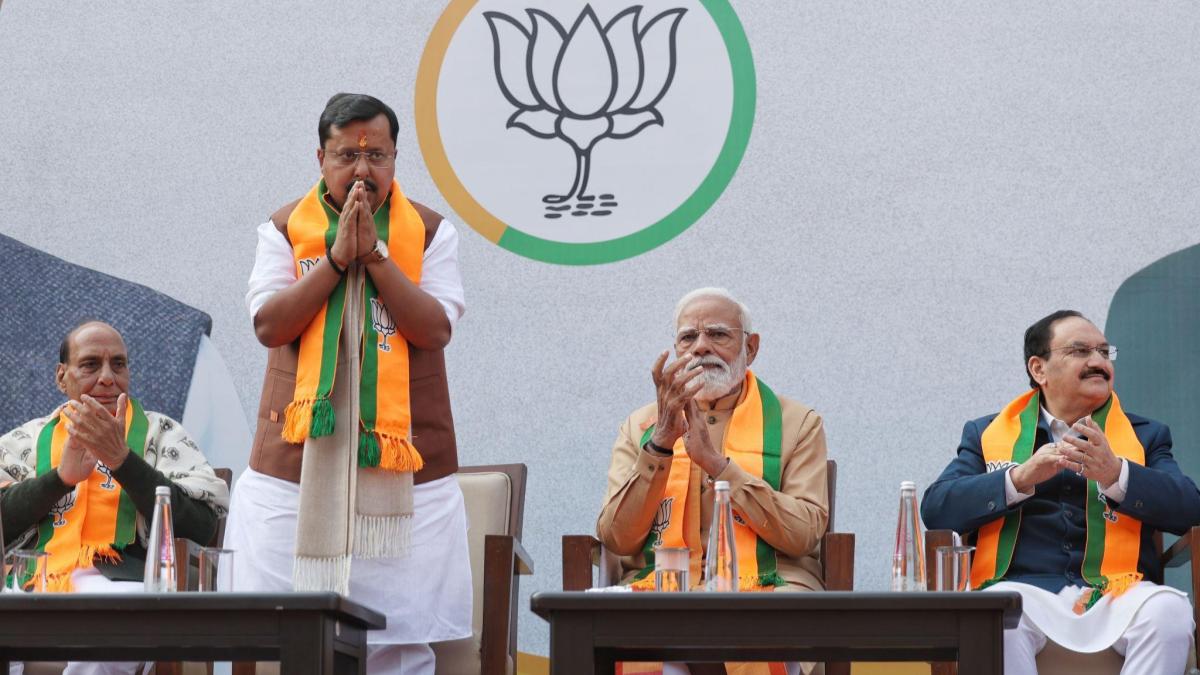
The Bharatiya Janata Party (BJP) formally turned a new leaf on Tuesday as Nitin Nabin took charge as its national president. The elevation of the Bihar leader brings to a close the extended tenure of JP Nadda.
For the past year, Nadda has continued as BJP president beyond his scheduled term, with the party opting for continuity at the helm to ensure organisational stability during the Lok Sabha election year.
How world’s largest political party elect its President?
Unlike political parties that rely on competitive internal elections for top posts, the BJP has historically favoured consensus-driven leadership transitions. Since its formation in 1980, the party has never seen a contested election for the post of national president, despite its constitution allowing for one. Nabin’s unopposed elevation follows this well-established tradition.
According to an Indian Express report, the decision of Nabin’s selection was finalised by the party’s Parliamentary Board, the apex decision-making body that retains wide discretion in organisational matters. The Board can arrive at decisions through formal meetings or informal consultations and even appoint a full-time president in urgent situations, subject to ratification by the National Council within six months.
This leadership-centric model has become more pronounced over the past decade, coinciding with the BJP’s sustained dominance at the Centre. When the party has been electorally strong, the choice of president has largely reflected the preferences of the Prime Minister and a small circle of senior leaders, rather than broader organisational bargaining.
How the organisational process works
Though uncontested at the top, the election of the BJP president is preceded by a detailed internal process. It begins with a nationwide membership drive, followed by elections at successive organisational levels namely, local committees, mandals, districts, regions and states.
At each tier, the elected president nominates office-bearers for that unit. Only after organisational elections are completed in at least half the states does the party move towards electing its national president. This requirement was met ahead of Nabin’s elevation.
Confirming this, the party’s National Returning Officer K Laxman said the election process was initiated after presidents had been elected in 30 out of the BJP’s 36 state units, well above the mandated 50% threshold.
Once elected, the national president nominates the central team that oversees the party’s organisational and electoral machinery.
Electoral strength and shifting influence
The balance of power in selecting the BJP president has historically varied with the party’s electoral fortunes. The IE report further explained that when the BJP was weakened after the 2009 Lok Sabha elections, the Rashtriya Swayamsevak Sangh played a more visible role in shaping leadership outcomes. This was evident when Nitin Gadkari was brought in to revive the party after its tally fell sharply.
In contrast, during periods of electoral dominance, leadership decisions have been more tightly controlled by the political executive. Over the past decade, this has meant a decisive role for the Prime Minister and his closest political associates.
The party’s approach stands in contrast to that of the Congress, which has occasionally witnessed contested presidential elections, most recently in 2022.
A tightly layered organisation
At the core of the BJP’s organisational system is its membership structure. Any Indian citizen above the age of 18 can become a primary member by paying a subscription valid for six years. To qualify as an active member — a requirement for contesting internal elections beyond the local level — one must complete three years as a primary member, pay a non-refundable fee of Rs 100, actively participate in party programmes and subscribe to the party’s official publications.
The organisational ladder begins with local committees of at least 25 members, each catering to populations of no more than 5,000. Above them are mandal, district, regional and state committees. Urban centres with populations exceeding five lakh are treated as districts, while cities above 20 lakh can be divided into multiple districts by the state executive.