



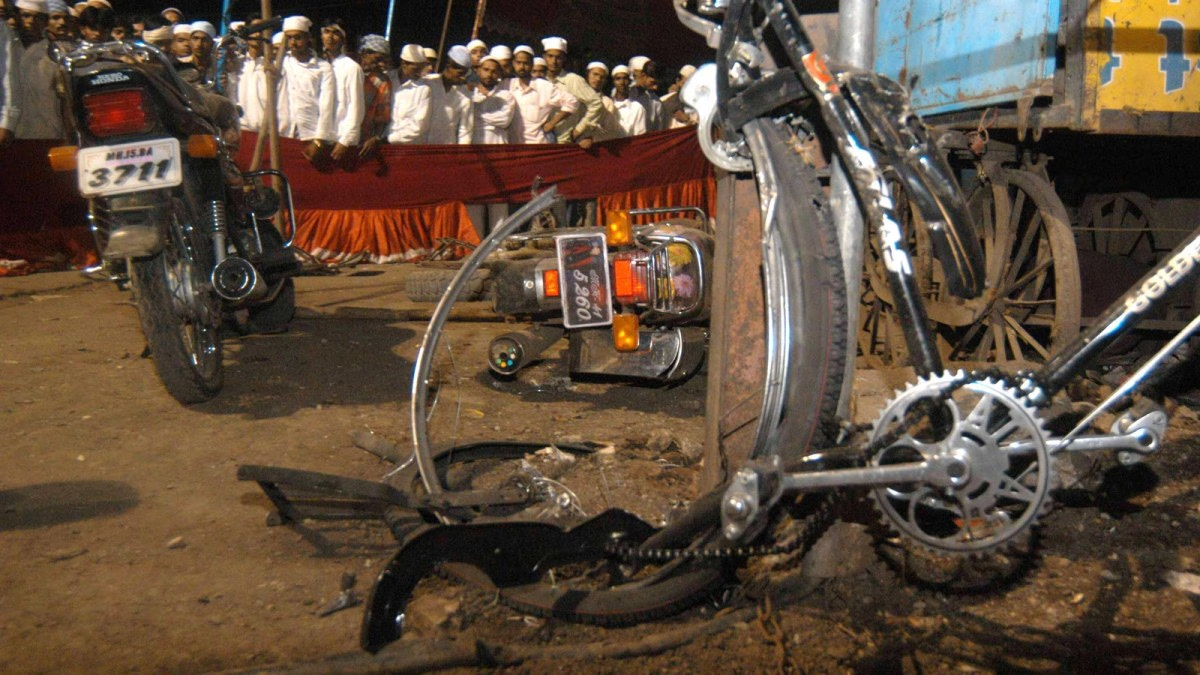
The Bombay High Court delivered a landmark ruling on April 22 (Wednesday), discharging four men accused in the deadly 2006 Malegaon bomb blasts and overturning a special court’s order to frame charges against them, citing the National Investigation Agency’s (NIA) failure to produce credible evidence.
A bench led by Chief Justice Shree Chandrashekhar and Justice Shyam Chandak approved appeals from Rajendra Chaudhary, Dhan Singh, Manohar Ram Singh Narwaria and Lokesh Sharma, who faced severe charges under the Indian Penal Code (IPC) for murder and conspiracy, as well as the stringent Unlawful Activities (Prevention) Act (UAPA).
2006 Malegaon blast case: Bombay HC discharges four accused; quashes charges framed against them.
— Press Trust of India (@PTI_News) April 22, 2026
This decision halts their trial proceedings, which the High Court had stayed in January 2026 after prima facie finding grounds for intervention, underscoring persistent investigative gaps in one of India’s longest-running terror probes.
Blasts’ tragic timeline and shifting investigations
On September 8, 2006, four bombs ripped through Malegaon in Nashik district- three near Hamidia Masjid and Bada Kabrastan post-Friday prayers, one at Mushawarat Chowk- killing around 31 people and injuring 312 in an attack initially blamed on Islamist militants. Maharashtra’s Anti-Terrorism Squad (ATS) arrested nine Muslim men, who were later discharged by a special court due to insufficient proof.
The NIA took over, pivoting to allege right-wing extremist involvement and charging these four Hindu accused, but the HC ruled their evidence fell short, echoing acquittals in related 2008 Malegaon cases where courts cited “grave suspicion but not enough proof,” contaminated forensics, and unproven links like bomb placement.
Accused’s defense in Malegaon blast case
The four petitioners argued NIA presented no substantive evidence linking them to the conspiracy or blasts, a claim the HC upheld while quashing charges and pausing lower court actions. This mirrors criticisms in parallel “Hindu terror” probes, where special public prosecutors like Rohini Salian noted NIA’s inability to add fresh proof since takeover.
Victims’ families in the 2008 case had appealed acquittals, but today’s order reinforces judicial emphasis on proof beyond doubt, potentially reopening debates on investigative integrity amid UAPA’s heavy application.