



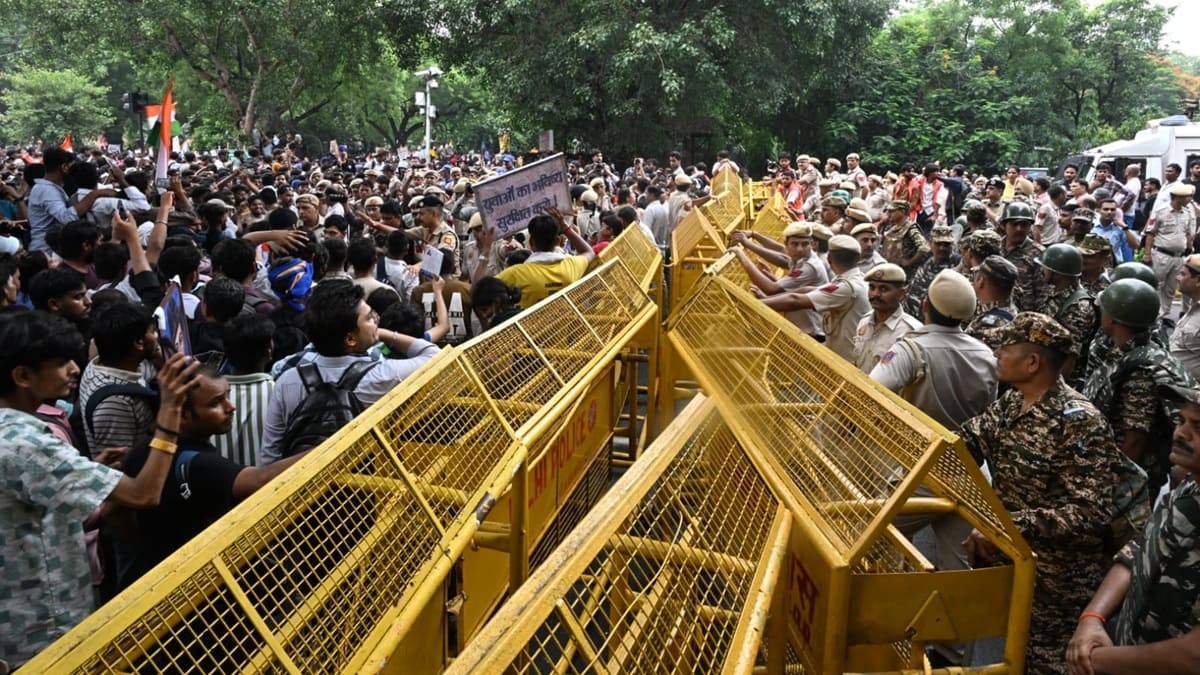
Delhi’s ongoing Cockroach Janta Party (CJP) protest at Jantar Mantar has triggered a wide set of security and movement restrictions, including the closure of several Metro stations, suspension of food and quick-commerce deliveries in parts of Central Delhi, mobile internet curbs and advisories from major universities.
Despite the restrictions, the protest has continued to draw large crowds, with officials stepping up security measures following clashes, tear gas shelling and lathi charges in the area.
Why are Delhi Metro stations being shut?
On Friday, the Delhi Metro Rail Corporation (DMRC) closed several stations in and around Central Delhi as part of security arrangements linked to the protest. The list of stations affected included Lok Kalyan Marg, Rajiv Chowk, Patel Chowk, Ramakrishna Ashram Marg, Barakhamba Road, Supreme Court, Seva Teerth, Janpath, Mandi House, Central Secretariat, ITO, Delhi Gate, Indraprastha, Khan Market, Jor Bagh, Shivaji Stadium, Jhandewalan and New Delhi.
The closures began at 7:30 am and remained in force until further instructions. However, interchange facilities continued to be available at select stations, including Rajiv Chowk, Mandi House and Central Secretariat.
Later in the day, the DMRC said entry gates at Mandi House and Central Secretariat had been reopened. The move eased restrictions in parts of the capital, although several other stations continued to remain closed. The restrictions have affected thousands of daily commuters who use the Central Delhi network to reach offices, courts, government buildings, hotels, media organisations and commercial establishments.
Service Update
— Delhi Metro Rail Corporation (@OfficialDMRC) July 24, 2026
Entry gates for Mandi House and Central Secretariat metro stations are now open.
Why were food delivery and quick-commerce services affected?
Food delivery and quick-commerce services were also disrupted in and around the Jantar Mantar protest zone. Swiggy, Zomato, Blinkit, Zepto and Instamart were reportedly unavailable at different times, with users complaining that deliveries could not be made to the affected area.
Swiggy reportedly displayed a message stating that deliveries could not be made in the area due to “external reasons beyond our control”.
The disruption came amid restrictions imposed around the protest site and a directive from the Ministry of Home Affairs to suspend mobile internet services within a 1.5-km radius of Jantar Mantar between 4 pm and midnight on Thursday.
The internet restrictions may have further affected app-based delivery services and other digital platforms operating in the area.
Delhi Traffic Police asks delivery, mobility apps to regulate operations
With the protests continuing, the Delhi Traffic Police advised the public to avoid areas under prohibitory orders unless travel was essential. The advisory also asked app-based mobility platforms, food delivery companies, quick-commerce operators, logistics providers and other e-commerce services to regulate their operations in the notified zones.
Authorities have imposed prohibitory orders under Section 163 of the Bharatiya Nagarik Suraksha Sanhita (BNSS), 2023, in parts of the capital to maintain public order.
The restrictions are aimed at controlling the movement of large crowds and preventing further disruption in areas surrounding the protest site.
What happened during the protests?
The security restrictions follow clashes between protesters and security personnel over the past few days. Videos and photographs circulating on social media showed police using tear gas shells and baton charges to disperse protesters after tensions escalated near the protest site.
The situation also led to road blockages and disruption in parts of Central Delhi, prompting authorities to deploy additional security forces.
The continuing presence of large crowds has made it difficult for authorities to fully reopen transport links and normalise services in the affected areas.
Universities issue safety advisories
The protests have also called educational institutions to issue advisories to students and faculty members. On Friday, Jawaharlal Nehru University (JNU) advised students and other members of its academic community to avoid visiting or participating in gatherings at or around Jantar Mantar. The university urged students to prioritise their personal safety and act responsibly on social media, warning that violations could invite legal action or disciplinary proceedings under the institution’s code of conduct.
JNU also cautioned students against the circulation of fake and misleading content related to the protests.
The advisory referred to Supreme Court directions regulating public demonstrations at Jantar Mantar.
Advisory
— Jawaharlal Nehru University (JNU) (@JNU_official_50) July 24, 2026
All stakeholders of JNU’s epistemic community are advised to act responsibly and prioritize their personal safety. In accordance with the Hon’ble Supreme Court of India’s directions on public demonstrations, you are requested to refrain from participating in or visiting…
The Delhi University had issued a similar advisory a day earlier, urging students and faculty members to stay away from unauthorised assemblies and demonstrations in the area. The university warned that participation in unlawful assemblies could lead to legal action and could also pose risks to students’ safety and academic and professional careers.
Dear students and faculty, your safety matters to us. Please note that any unlawful assemblies or demonstrations at Jantar Mantar, New Delhi, which are strictly regulated as per the directives of the Hon’ble Supreme Court of India, may invite legal action. Such activities can…
— University of Delhi (@UnivofDelhi) July 23, 2026
What is the CJP protest about?
The CJP began as a satirical social media campaign launched by Boston University graduate Abhijeet Dipke in response to a remark attributed to Chief Justice of India Surya Kant. The campaign later evolved into a broader youth-led protest movement focusing on alleged examination irregularities, including the NEET paper leak controversy.
The protesters have also demanded the resignation of Union Education Minister Dharmendra Pradhan.
On June 20, the movement began its Jantar Mantar protest and has since attracted growing support from students and other sections of civil society. The protest gained momentum after climate activist Sonam Wangchuk joined the agitation and announced an indefinite hunger strike. Tensions escalated after Wangchuk was forcefully taken to Safdarjung Hospital as his health deteriorated.
Why are restrictions not stopping the crowds?
The restrictions have made access to the protest site more difficult, but have not prevented people from gathering. With Metro stations shut, food delivery services restricted and mobile internet curtailed in parts of the area, officials have attempted to reduce the movement and concentration of people around Jantar Mantar.
However, the protest has continued to draw crowds, with supporters arriving through alternative routes and the agitation receiving increasing attention on social media.