



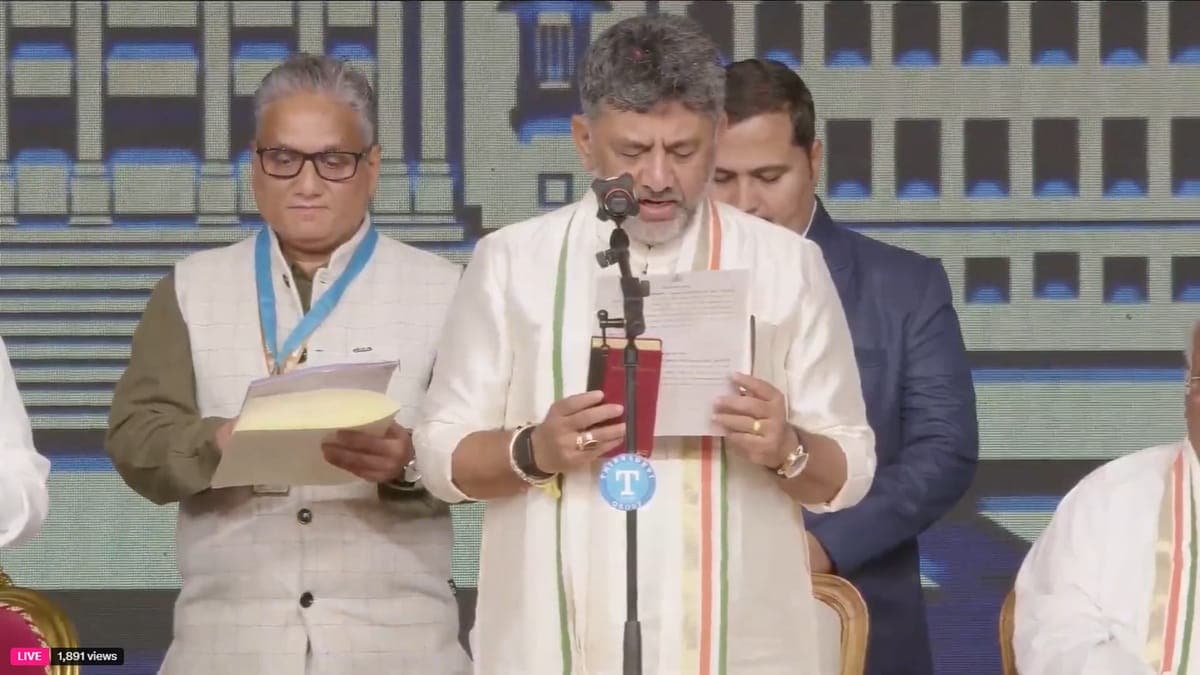
DK Shivakumar, the Congress’s chief troubleshooter, on Wednesday took oath as Karnataka’s Chief Minister, emerging as the wealthiest chief minister in the country with declared assets worth Rs 1,413 crore.
Along with Shivakumar, Dr G Parameshwara took oath as the Deputy Chief Minister of Karnataka.
Among the Congress leaders, Leader of Opposition in Lok Sabha Rahul Gandhi, Leader of Opposition in Rajya Sabha Mallikarjun Kharge, Kerala Chief Ministers VD Satheeshan, Telangana Chief Minister Revanth Reddy and Himachal Pradesh Chief Minister Sukhvinder Singh Sukhu attended the oath taking ceremony. A host of religious leaders, students, pourakarmikas, farmers’ leaders, Dalit leaders and Kannada activists were also present at the event.
LIVE: Swearing-in Ceremony | Bengaluru, Karnataka https://t.co/s7fSnD9opz
— Congress (@INCIndia) June 3, 2026
Top three richest chief ministers are from South India
According to his election affidavit, Shivakumar has overtaken Andhra Pradesh CM N Chandrababu Naidu, whose declared assets stand at Rs 931 crore, and Tamil Nadu CM C Joseph Vijay, who reportedly declared assets worth Rs 648 crore.
The development means India’s three richest chief ministers are now all from southern states.
Assets jumped sharply between 2018 and 2023
According to disclosures made in his 2023 Karnataka Assembly election affidavit, Shivakumar and his dependents declared combined assets worth Rs 1,413.78 crore.
The figure marked a significant rise from the Rs 840.08 crore declared during the 2018 Assembly elections. The affidavit listed movable assets worth Rs 273.42 crore and immovable assets valued at Rs 1,140.36 crore. Personal immovable assets alone were valued at Rs 972.65 crore, while liabilities stood at nearly Rs 263 crore.
Despite the massive wealth declaration, Shivakumar reportedly listed only one registered vehicle in his name, a Toyota Qualis. The affidavit also included luxury watches such as Rolex and Hublot along with large gold and silver holdings.
The Congress leader also disclosed that 19 criminal cases were pending against him at the time of filing his nomination papers for the 2023 Karnataka Assembly elections.
Bengaluru infrastructure projects became Shivakumar’s signature
During his tenure as Deputy Chief Minister, Shivakumar became closely associated with a series of ambitious infrastructure proposals aimed at reshaping Bengaluru’s urban future. From underground tunnel corridors and satellite townships to airport expansion and Cauvery-linked water projects, many of these proposals evolved into defining elements of his long-term political and administrative vision.
Rs 18,000 crore Bidadi township project gains traction
Among Shivakumar’s most ambitious urban expansion proposals is the development of a 7,000-acre integrated township near Bidadi, around 35 kilometres from Bengaluru. Recently, the Karnataka cabinet approved nearly Rs 18,000 crore for the mega township project, envisioned as a self-sustaining satellite city with residential areas, industrial clusters, educational institutions, commercial districts and modern transport infrastructure.
The project is expected to reduce pressure on Bengaluru’s core urban zones while creating new investment corridors in the region.
Second Bengaluru airport proposal gathers pace
Another proposal strongly linked to Shivakumar’s infrastructure push is the idea of a second airport for Bengaluru. With Kempegowda International Airport handling more than 40 million passengers annually, discussions around a secondary airport have intensified despite ongoing expansion at the existing facility.
Possible locations being explored reportedly include Kanakapura, Nelamangala and Sira in Tumakuru district.
Tunnel road project remains highly debated
Perhaps no proposal has generated as much discussion as Bengaluru’s underground tunnel road project. The plan reportedly proposes a 17-km underground corridor connecting Hebbal and Silk Board Junction in a bid to reduce traffic congestion and improve faster cross-city movement.
Estimated project costs range between Rs 17,000 crore and Rs 40,000 crore, potentially making it one of Karnataka’s most expensive urban infrastructure projects.
While proponents describe it as a transformative mobility solution for Bengaluru, critics have questioned the project’s environmental impact, execution challenges and financial sustainability.
Mekedatu project remains politically sensitive
The Mekedatu balancing reservoir project continues to remain one of Karnataka’s most politically significant infrastructure proposals and has long been associated with Shivakumar’s leadership ambitions.
The project proposes a reservoir across the Cauvery river near Mekedatu in Ramanagara district to strengthen Bengaluru’s drinking water supply while generating hydroelectric power.
Initial estimates prepared in 2019 pegged the project cost at around Rs 9,000 crore, although revised projections are expected to be substantially higher due to inflation and rising construction costs.
However, the proposal has repeatedly triggered tensions between Karnataka and Tamil Nadu over Cauvery water-sharing concerns.
Kanakapura remains Shivakumar’s political fortress
Much of Shivakumar’s infrastructure-driven political identity was built in Kanakapura, the constituency he has represented for decades. Popularly known as the “Kanakapura Bande” or the “Rock of Kanakapura,” Shivakumar transformed the constituency into one of Congress’s strongest political bastions in Karnataka through a mix of infrastructure development, water projects and grassroots outreach.
Road connectivity emerged as a major focus area under schemes such as PMGSY, NABARD projects and the “My Village, My Road” initiative. Investments were also made in drainage systems, libraries, sports grounds, Sabha Bhavanas and solar street lighting.
Water infrastructure projects became another defining feature of his constituency politics, with several Cauvery-linked drinking water initiatives launched for villages across Ramanagara and Kanakapura taluks.
A major Rs 540 crore drinking water project covering Ramanagara, Kanakapura, Magadi and Channapatna also became a key part of Shivakumar’s development agenda.