
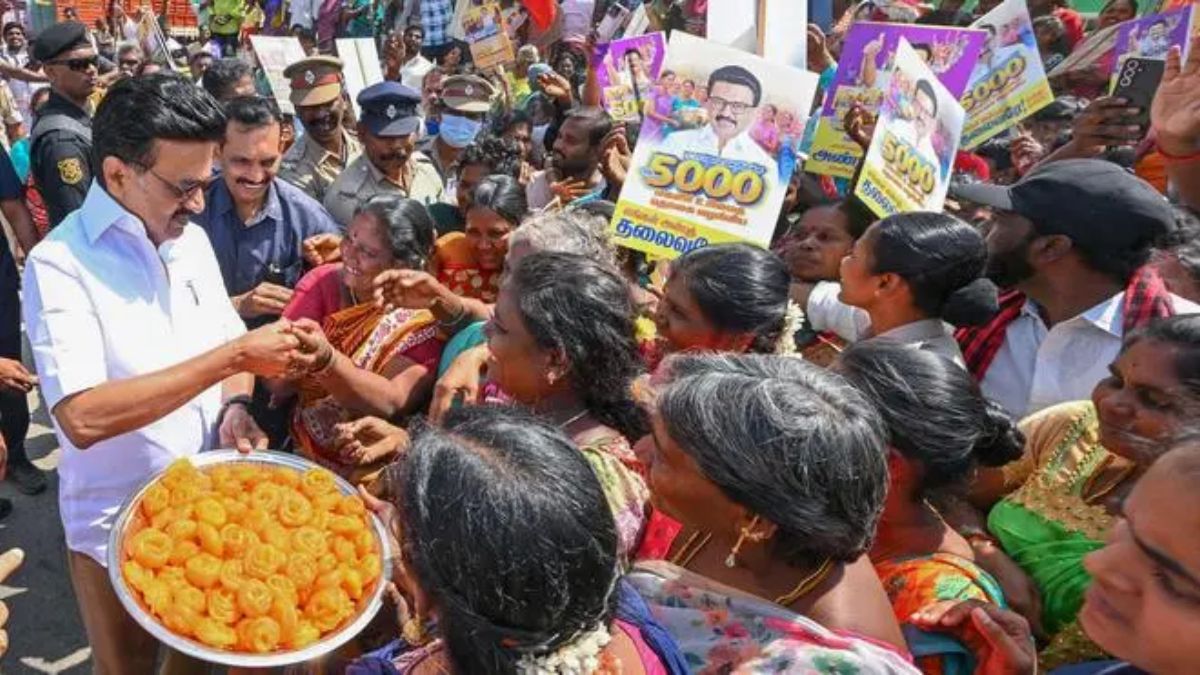
As Tamil Nadu edges closer to the 2026 Assembly polls, Chief Minister M.K. Stalin’s DMK has unveiled a manifesto that places a heavy emphasis on the expansion of pre-existing welfare schemes, setting the stage for a high-stakes fiscal gamble.

Released on Sunday at the party headquarters, the document attempts a delicate balancing act, where on one hand DMK is promising voters increased cash transfers and freebies while simultaneously targeting a $1 trillion economy by 2030-2032.

The cornerstone of the manifesto is the doubling of the monthly financial assistance for women heads of families from Rs 1,000 to Rs 2,000. With the scheme already reaching over 1.37 crore recipients, this move effectively doubles the state’s committed expenditure on a single welfare scheme.

This promise becomes slightly economically worrying when one considers that this expansion comes at a time when the state’s revenue deficit for 2025–26 has already widened sharply to Rs 69,219 crore. Furthermore, the interim budget for 2026-27 projects a revenue deficit of Rs 48,696 crore, a figure that may require drastic upward revision as per Times of India if these new commitments are implemented.

Welfare competition and rising debt

The DMK’s pivot to a Rs 2,000 payout is widely seen by some as a response to the AIADMK, which earlier pledged the same amount to win over female voters. This competition of offering the better welfare schemes has become slightly concerning when one looks at the rising debt faced by the state of Tamil Nadu.

Tamil Nadu’s outstanding debt is already expected to touch Rs 10.71 lakh crore by March 31, 2027. Beyond the women’s grant, the manifesto also pledges to raise elderly pensions to Rs 2,000 and provide interest-free loans of up to Rs 5 lakh for women self-help groups.

In a bid to bolster its “human capital” credentials, the DMK has promised to distribute laptops to 35 lakh students pursuing higher education. While the state government had previously launched a plan for 20 lakh laptops in early 2026, the manifesto significantly scales up this ambition.

However, the immediate procurement cost for 3.5 million devices will likely further squeeze the stage budget.

Despite the welfare-heavy tilt, the manifesto retains a bold growth narrative. While presenting the budget, Stalin said the party aims to attract investments worth Rs 18 lakh crore to boost the state’s economy, targeting an USD 120 billion economic size.

Neo Tidel Parks will be set up to expand employment opportunities, particularly in the technology sector. While the state CM maintains that Tamil Nadu can improve its debt situation without compromising on welfare schemes, recent reports published by the Times of India suggest that DMK’s promise of free electricity for 20 lakh beneficiaries and pump sets without meters could prove to be a potential drag on the state’s growth target.

Growth vs Welfare debate

The 2026 manifesto thus sets up a definitive “growth vs. welfare” debate for the upcoming term. While the DMK’s strategy aims to fuel local consumption through direct cash transfers and education-led productivity, the fiscal room for such expansion is shrinking.

Ultimately, the success of this roadmap will depend on whether the state can stimulate enough revenue growth to outpace its mounting debt, ensuring that the promise of building a mega economy does not get overshadowed by the weight of its own welfare commitments.

This analysis inclusive of the economic figures has been taken from statements made by ministers and budget documents that has been previously released by the Tamil Nadu government. Some of the highlights from the budgetary document released by the Tamil Nadu government have been posted below:

Government of Tamil Nadu · Citizen’s Guide Tamil Nadu Interim Budget 2026-27
₹40.67L Cr GSDP Population: 7.22 Cr Total Outlay: ₹4,67,264 Cr
₹4,67,264 Cr Total Disbursements
₹3,45,314 Cr Total Receipts
74.67% State’s Own Revenue Share
25.33% Central Share + Grants
+7.30% Growth Over RE 2025-26
Budget Context Self-reliant fiscal posture Tamil Nadu’s own tax revenue grew +11.15% over 2025-26, with the state funding nearly three-quarters of its budget from its own sources. The GSDP is projected at ₹40.67 lakh crore for 2026-27, up from ₹35.68 lakh crore in the revised estimates for 2025-26.
Key Ratio Outstanding debt at 26.12% of GSDP Down marginally from 26.43% in RE 2025-26. Total disbursements include revenue expenditure of ₹3,93,272 Cr, capital expenditure of ₹59,562 Cr, and net loans and advances of ₹13,708 Cr.
State’s own tax revenue
₹2,29,579 Cr 66.6%
Share in central taxes
₹62,531 Cr 18.1%
State’s own non-tax
₹27,704 Cr 8.0%
Grants-in-aid from Union
₹24,762 Cr 7.2%
Tax Head
Amount
Share
Commercial taxes (GST etc.)
₹1,62,311 Cr
70.7%
State excise
₹31,920 Cr
13.9%
Motor vehicles taxes
₹14,923 Cr
6.5%
Stamps and registration
₹13,775 Cr
6.0%
Others
₹6,650 Cr
2.9%
Own tax revenue total: ₹2,29,579 Cr · +11.15% over 2025-26
Category
Amount
Subsidies and grants
₹1,56,108 Cr
Salaries
₹94,378 Cr
Interest payments
₹78,677 Cr
Pension and retirement
₹45,323 Cr
Operation and maintenance
₹18,785 Cr
Sector
Capex
Roads and bridges
₹18,809 Cr
Transport and energy
₹16,254 Cr
Urban development
₹7,218 Cr
Water supply schemes
₹6,093 Cr
Water bodies
₹5,076 Cr
Education and health
₹3,466 Cr
₹69,219 Cr Peak Revenue Deficit (RE 2025-26)
₹48,696 Cr Projected Revenue Deficit (IBE 2026-27)
3.00% Fiscal Deficit % of GSDP (IBE)
Year
Fiscal Def %
Revenue Def %
2021-22
3.56%
2.25%
2022-23
3.46%
1.51%
2023-24
3.32%
1.66%
2024-25 (Accounts)
3.25%
1.47%
RE 2025-26 (Peak)
3.48%
1.94%
IBE 2026-27
3.00%
1.20%
Fiscal Watch Back within FRBM ceiling after 2025-26 breach Fiscal deficit is projected at exactly 3.00% of GSDP in IBE 2026-27, back within the FRBM target after touching 3.48% in RE 2025-26. However, manifesto commitments — such as doubling the Kalaignar women’s scheme to ₹2,000/month — could push the revenue deficit significantly higher than the ₹48,696 Cr estimate.
01
Education
₹57,039 Cr
02
Urban development
₹35,773 Cr
03
Rural development
₹28,687 Cr
04
Health
₹22,090 Cr
05
Highways
₹21,132 Cr
06
Energy
₹18,091 Cr
07
Food and co-operation
₹17,068 Cr
08
Police
₹13,583 Cr
09
Transport
₹13,061 Cr
10
Water resources
₹10,076 Cr
11
Social welfare
₹8,633 Cr
12
Industries and MSME
₹6,224 Cr
13
Adi-Dravidar and tribal welfare
₹3,934 Cr
Power Assistance to power utilities ₹22,457 Cr Agriculture and domestic subsidies
Women welfare Kalaignar Magalir Urimai Thittam ₹14,412 Cr Monthly assistance to women heads of families
Food security Public Distribution System subsidies ₹14,000 Cr Subsidies and grants for PDS
Transport Assistance to transport undertakings ₹10,108 Cr Free bus passes, subsidies, VGF
Roads Comprehensive Road Infrastructure Dev. ₹9,359 Cr State-wide road development programme
Urban infrastructure Chennai Metro Rail Phase II ₹5,467 Cr Ongoing metro expansion
Social security Social security pensions ₹5,463 Cr Old age, widow pensions etc.
Child development Integrated Child Development Services ₹3,693 Cr Nutrition and care for children
National health National Health Mission ₹2,846 Cr Healthcare infrastructure and services
Child nutrition Puratchi Thalaivar MGR Nutritious Meal ₹2,834 Cr Mid-day meal and nutrition programme
Education Laptops to college students ₹2,000 Cr For 10 lakh college students
Housing Kalaignarin Kanavu Illam ₹1,500 Cr Affordable housing programme
Express InfoGenIE | Financial Express