



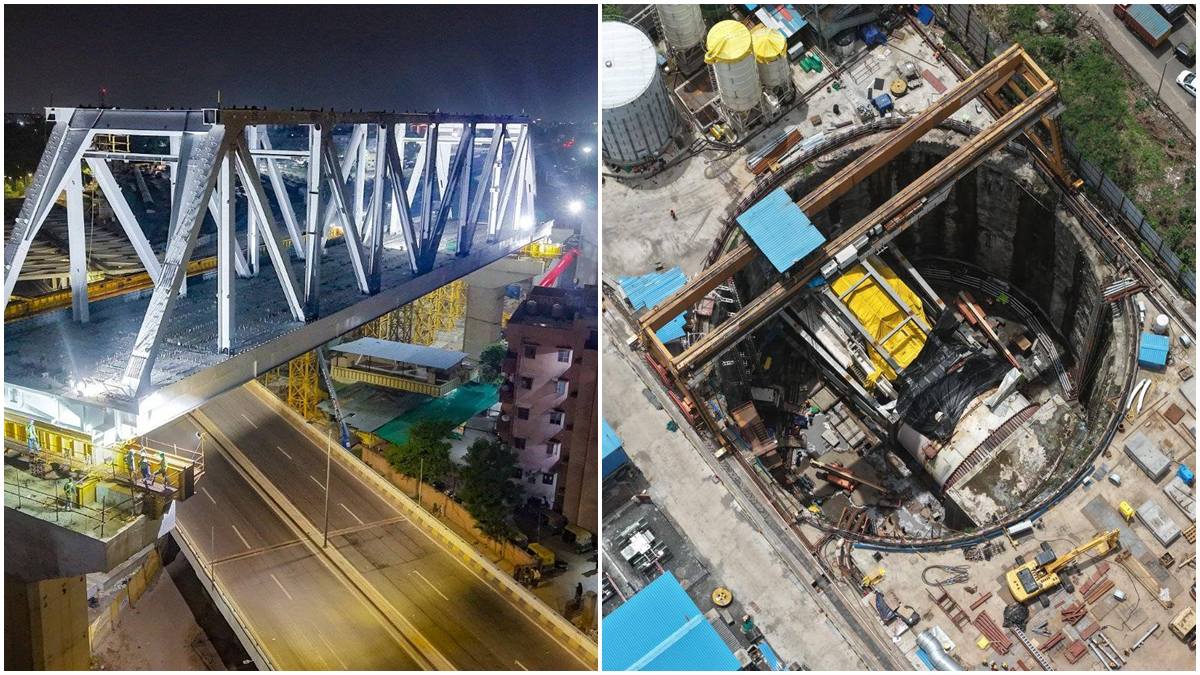
The Mumbai-Ahmedabad Bullet Train project has marked two major construction milestones. An 80-metre steel bridge has been launched in Ahmedabad, whereas a second tunnel-boring machine has begun excavation in Maharashtra.
As per PTI, the made-in-India steel bridge has been placed over the Anupam Railway over bridge in Ahmedabad. This structure will carry the elevated bullet train track across a challenging 80-metre gap.
With its completion, Gujarat has now finished 15 out of steel bridges.
Meanwhile, the National High Speed Rail Corporation Limited stated that the second TBM had started tunnelling from the 39-metre-deep Sawli shaft at Ghansoli towards Vikhroli.
How will the second TBM help the project?
The machine will excavate part of the 21-km tunnel interlinking Mumbai Bullet Train Station at Bandra Kurla Complex with Thane. The tunnel will include India’s first seven -kilometre undersea rail section beneath Thane Creek.
“The second Tunnel Boring Machine has commenced excavation from the 39-metre deep Sawli shaft towards Vikhroli,” NHSCRL posted on X.
The first TBM started its six-kilometre drive from Vikhroli towards BKC on July 5, 2026. The second machine will work from Sawli towards Vikhroli on a 10-km stretch that comprises the undersea section.
Together, the machines will excavate 16 km. The rest five-kilometre section towards the Shilphata tunnel portal has already completed by using the New Australian Tunelling Method. Through this, the tunnel is excavated in smaller sections and supported as work progresses.
How big is the tunnel-boring machine?
NHSRCL mentioned that the TBM is among the largest machines used for railway tunnelling in India.
Its main dimensions are:
-Total weight: 3,200
-Cutterhead diameter:13.6 metres
-Total length: 96 metres
-Supporting units: Four double-storey gantries
As there is limited space inside the shaft, the machine was lowered underground in parts. The gantries were put down first, followed by the main shield and cutterhead.
How does the TBM work?
The machine uses a pressurised, slurry-based Mixshield system. In simple terms, a bentonite-clay mixture supports the soil at the tunnel face during excavation, it reduces ground movement and disruption to structures above
It can also excavate while concrete lining rings are installed behind it, helping work move faster.
Safety teams and waterproof seals to protect the tunnel
The tunnel lining will utilise double-layer rubber gaskets and water-reactive seals to prevent leakage. Instruments will monitor ground settlement, vibrations, groundwater and movement in nearby structures.
The machine has sensors for methane, carbon dioxide, carbon monoxide, along with fire detection, emergency systems and extinguishing.
The Sawli site also has treatment plants, operational facilities and backup generators.
The bridge and tunnel work mark important progress on the high-speed corridor.