



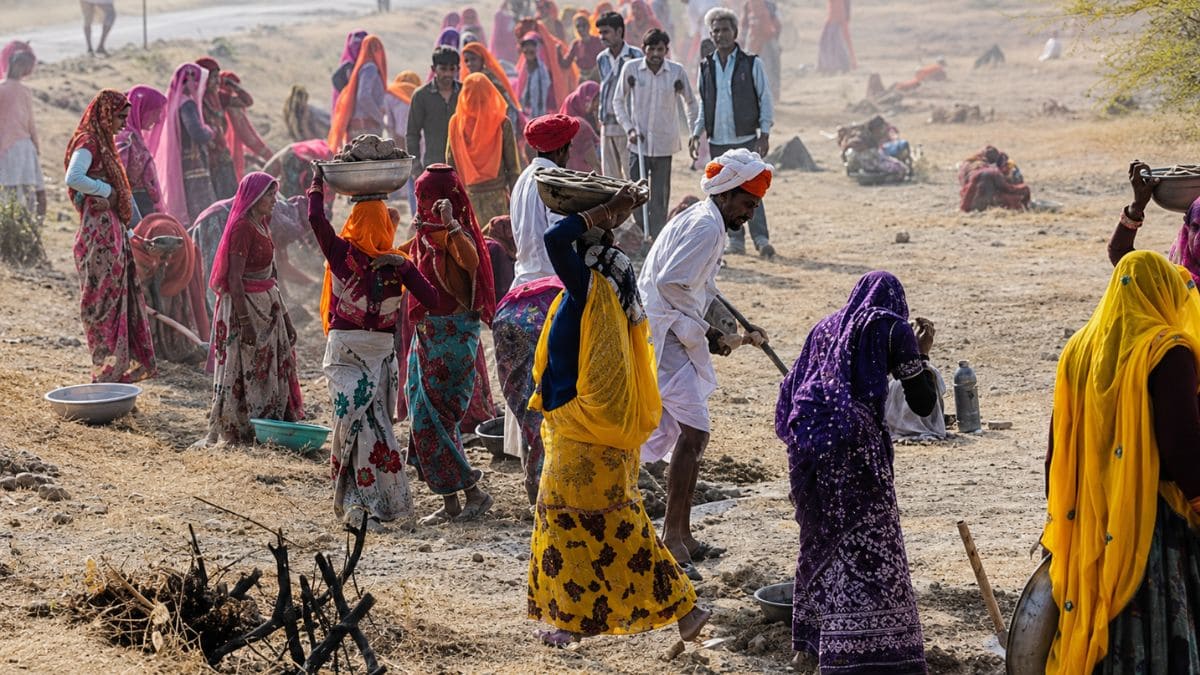
While the government has begun work to revise the national floor wage, experts call for a significantly higher minimum wage level and more frequent revisions to accommodate price pressures in the economy.
Minimum wages in India have been stagnant for nearly a decade. According to reports, the government is working to form a Central Advisory Board that will recommend India’s first statutory national floor wage under the Code on Wages, 2019.
The current national floor level minimum wage is Rs 176, last updated in 2017. This brings the monthly minimum earnings to Rs 5,500, which is only slightly higher than the monthly per capita consumption expenditure. As per the latest Household Consumption Expenditure Survey, the nominal monthly per capita consumption expenditure (MPCE) in 2023–24 was Rs 4,122 in rural areas, and Rs 6,996 in urban India.
“The minimum wage should be ideally indexed with the rate of inflation and this can be the floor. This can be done periodically- may be once in three years so as to be more contemporary in nature,” said Madan Sabnavis, chief economist, Bank of Baroda.
The current minimum wage is also non-binding, meaning actual minimum wages could be even lower. Low minimum wages were a key issue raised during the workers’ protest in Noida earlier this year, which prompted some states to raise their minimum wage levels.
The proposed statutory national floor wage will also help address low wages in the informal sector, experts said.
“To a large extent this will help, though admittedly in the interiors labour can still be paid lower wages where there is surplus labour and the jobs concerned are not in the organized sector,” Sabnavis said.
According to Devendra Pant, chief economist at India Ratings and Research, an increase in informal sector wages would help sustain consumption demand since a large proportion of workers are employed in the informal sector. “Movement in MNREGA wages could be a proxy for the movement of minimum wages,” Pant said.
Previously, the government has also considered the idea of living wages, which is the minimum income required for a worker to cover basic expenses. “Living wages become more subjective and difficult to assess,” Sabnavis said. “Therefore a minimum wage makes more sense. However, its composition can be reviewed so that all aspects of the cost of living are included.”
Higher minimum wages will only be one step toward improving the standard of living for the country’s lower-income workforce. The government needs to set standards for the number of work hours, along with breaks and facilities to care for small children when women are working, Sabnavis said. “Also providing equal wages for males and females should be on the agenda.”
While higher minimum wages will help in improving living standards of workers, this may have impact on the balance sheet of companies and have some impact on inflation,” Pant said.