



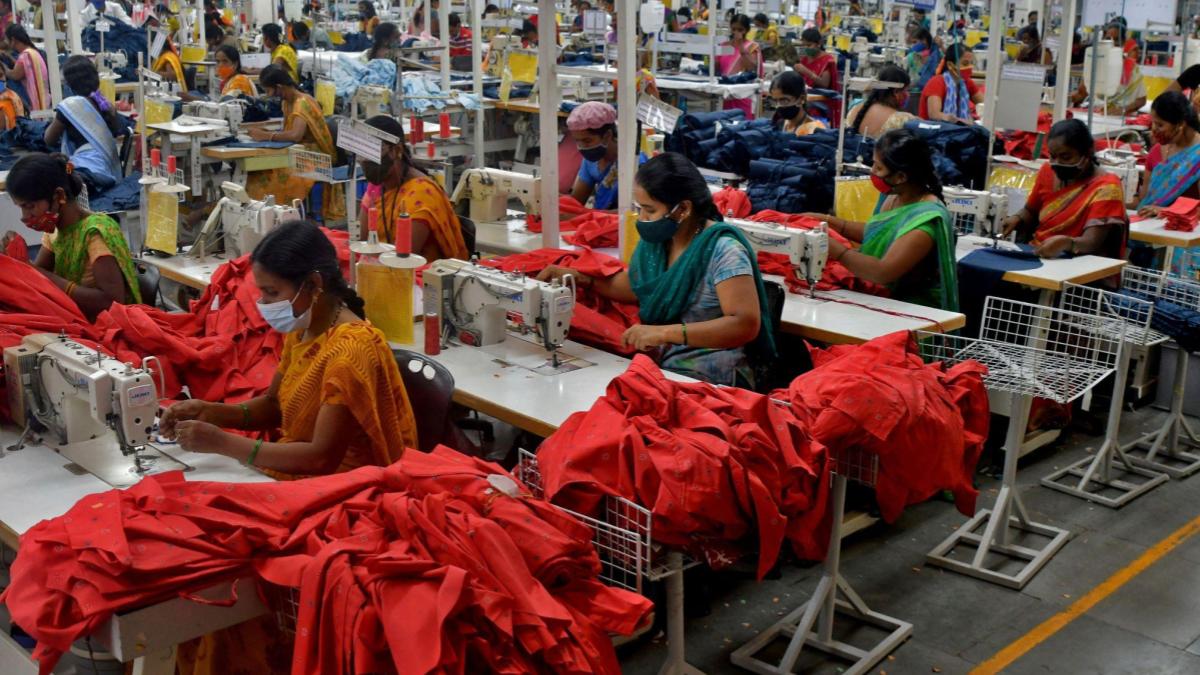
As businesses in Surat begin assessing the damage caused by last week’s floods, the Gujarat government on Wednesday announced a relief package comprising direct financial assistance and interest-subsidised loans to help affected traders and small enterprises resume operations.
While the package covers all eligible flood-hit businesses, the textile industry—which is the backbone of Surat’s economy—is expected to be among the biggest beneficiaries after floodwaters disrupted manufacturing, processing and wholesale trade across the city.
Announcing the package, Gujarat Deputy Chief Minister Harsh Sanghavi said affected businesses would be eligible for financial assistance of up to Rs 1 lakh, besides subsidised loans of up to Rs 30 lakh to help them resume operations.
Traders and small business owners without insurance coverage will qualify for direct financial assistance. The government has also announced aid of Rs 7,500 for lorry and auto-rickshaw drivers whose livelihoods were disrupted by the floods.
Under the package, traders operating from permanent establishments and who have filed GST returns in recent months will be eligible for assistance of up to Rs 1 lakh.
To facilitate the revival of businesses, the government has introduced an interest subsidy scheme under which it will bear 7% of the interest on business loans for three years.
Tiered Loan Structures
Sanghavi said traders with an annual GST turnover of up to Rs 7 lakh will be eligible for loans of up to Rs 20 lakh, along with interest assistance of up to Rs 5 lakh. Those with turnover of up to Rs 7.5 lakh can avail loans of up to Rs 25 lakh with interest support of up to Rs 8 lakh, while traders with turnover exceeding Rs 7.5 lakh will be eligible for loans of up to Rs 30 lakh and interest assistance of up to Rs 10 lakh.
The relief comes at a time when Surat’s textile industry was already grappling with rising raw material costs triggered by higher crude oil prices amid the West Asia crisis. The floods have compounded those challenges, bringing manufacturing and trade to a virtual standstill.
Torrential rain lashed the city for two days, with Surat receiving nearly 18 inches of rainfall. Water from overflowing creeks inundated several industrial estates, submerging the ground and mezzanine floors of wholesale textile markets, while the first floors of numerous units in GIDC estates also went under water.
Known as the country’s man-made fibre (MMF) capital, Surat accounts for nearly 40% of India’s synthetic fabric production and around 90% of synthetic garment manufacturing.
The spike in crude oil prices had already pushed up the cost of yarn and other key raw materials, squeezing manufacturers’ margins. Many textile units were struggling with rising production costs and subdued demand before the floods forced industrial activity to a halt.
Industrial units and commercial establishments are yet to resume normal operations. Factory owners have deployed workers to repair damaged machinery and salvage raw materials and finished goods.
Mahendra Kajiwala, a leading textile merchant, said nearly 200 of his power looms were submerged under one-and-a-half feet of water, while his wholesale shop in Millennium Market was also flooded.
“The damage is still being assessed, but it will take at least a fortnight to restore production,” he said.
The dyeing and printing segment has suffered the worst, according to Jitubhai Vakharia, president of the South Gujarat Textile Processors Association.
“The production losses are enormous. Surat produces nearly 5 crore metres of cloth every day, valued at Rs 30-40 per metre,” he said. Based on four days of disrupted production, the industry estimates the loss in output at around Rs 600 crore.
“Surat has already borne the brunt of higher yarn prices, and now we have the floods. Moreover, yarn prices are expected to rise further if shipping through the Strait of Hormuz is disrupted again,” Vakharia said.
He noted that many small and medium textile units do not have insurance coverage and therefore depend heavily on government assistance. While welcoming the relief package, he urged the government to ensure speedy disbursal so that businesses could restore working capital and restart operations. He also called for uninterrupted electricity and water supply, saying disruptions during the monsoon continue to affect industrial production.
Ashok Chodvadiya, president of the Southern Gujarat Chamber of Commerce and Industry, told Financial Express that the losses are substantial. He said the chamber has asked industries to submit detailed assessments of their losses, supported by documentary evidence, so that the overall impact can be accurately quantified.