



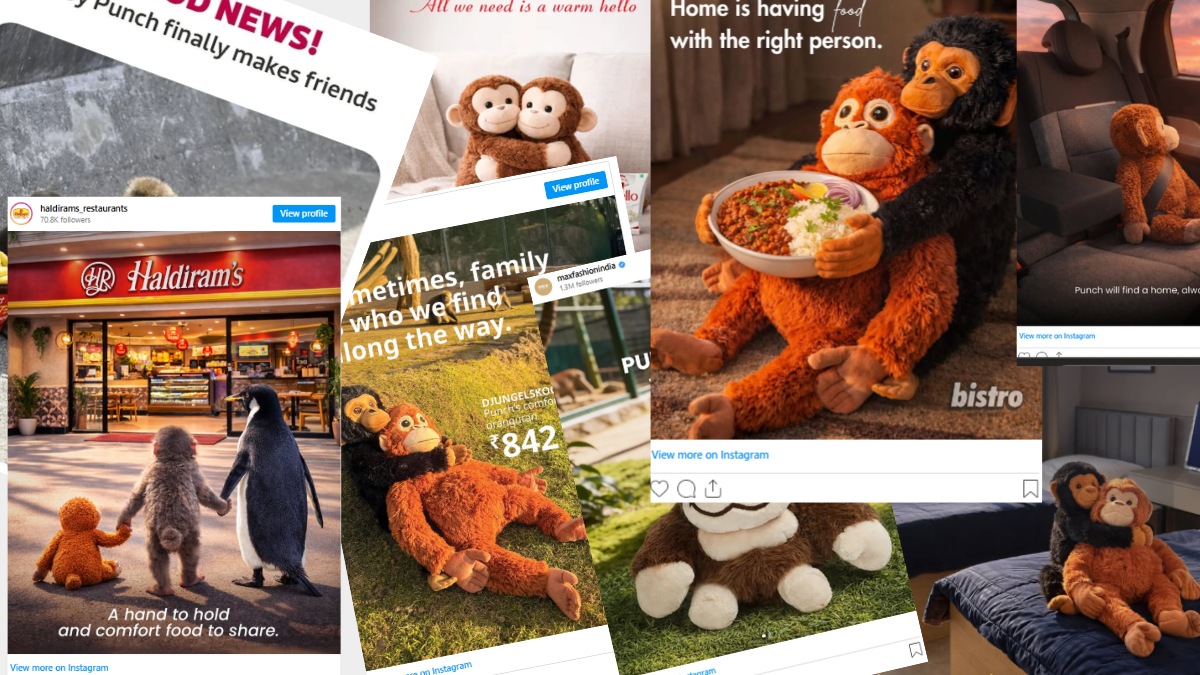
When videos of a baby macaque clutching a stuffed orangutan began circulating online, brands were never going to stay away for long.
Punch, born last July at Ichikawa zoo in Japan and reportedly abandoned by his mother, was seen wandering alone, toy pressed tightly to his chest. Later clips showed him being chased and cornered by other macaques. The hashtag #Punch clocked 2.8 million posts across platforms. Within days, Indian brand handles, from auto and fashion to food delivery and even public institutions, were posting their own takes.
“The key thing in moment marketing is that there is an event hitting the news in a big way. If you remove all the clutter, what you’re trying to do is—you’re piggybacking on something that has just happened,” Ashish Bhasin, Founder, The Bhasin Consulting Group and former CEO Asia Pacific Dentsu, told financialexpress.com.
He added that moment marketing works best when the brands do what is in sync with their character. For example, if there’s a very serious, trustworthy brand and it tries to do something frivolous, then it will not work, Bhasin added.
In 2025, some of the sharpest moments marketing wins came from brands that moved early and stayed culturally fluent. Instamart’s collaboration with viral Bhojpuri dance creator Praveen worked because it leaned into his meme momentum at peak relevance.
Maddock Films’ integration with the wildly popular “Ganji Chudail” reels for Stree 2 stood out for being one of the first to smartly plug into the page’s absurdist humour.
Meanwhile, Swiggy received a lot of flak for using suggestive and borderline offensive language to promote its invite-only service, ‘OneBLCK’.
The rush to react
The Punch episode followed a now-familiar pattern. First comes the viral cultural moment. Then comes brand participation. Santosh Padhi, Founder, Chief Creative Officer & Chairman, INTO Creative, said brands today feel they cannot afford to ignore such moments. “You can’t escape from the viral moments these days, and you need to find a linkage with it. You need to find what you stand for and what your brand assets or philosophies are and try to blend in beautifully,” he said.
But the compulsion to show up can dilute thinking.
“At times, I would say looking at the content, clients are forcing themselves to have the presence, which is where I feel is a big, huge problematic area,” Padhi added. He said that it was okay for a few moments to be skipped if they were not sinking in or if a brand was unable to blend in correctly with the moment, adding that participation should happen only in a way that allows a brand to win; otherwise, it was better not to participate.
The Tata Punch moment
Few brands had as obvious a naming coincidence as Tata Punch.
A monkey named Punch. A car named Punch. Social media users connected the dots almost instantly. The brand responded with a creative showing a plush toy placed inside the car, with messaging around giving Punch a home.
Padhi believes the synergy was strong. “Because the name was Punch and the monkey’s name was Punch, it was a great sort of seamless synergy that they could have got into,” he said. “Especially knowing that Punch was looking for a mother, a comforting mother, I think they could have connected beautifully.”
Bhakti Vaza, client partner at BC Web Wise, however, sees a broader issue in how brands respond to cultural spikes. “Miss. Not because it was bad, but because it was safe,” she said. “When a moment literally writes your brief for you – power, impact, breaking through – and you respond with something cute, you’re playing not to lose instead of playing to win.”
FOMO versus strategy
For Vaza, much of the moment marketing today is driven less by brand fit and more by fear. “Mostly it’s FOMO dressed up as a strategy. Brands see competitors trending and panic. They’d rather be average in the conversation than absent. That’s not marketing. That’s herd mentality,” she said.
The danger, she argues, is brand dilution. “When you chase everything, you stand for nothing. Your brand becomes a shape-shifter. One day, you’re funny. The next day, you’re serious. The next day, you’re dancing on trends. Nobody knows who you are anymore,” Vaza said.
Padhi echoes the concern about sameness. “I think most brands are making it like a template. People are not pushing the boundaries. Some of the content created by consumers is far edgier and braver than what brands do,” he said. “Why should it become a template? Every issue is different. So why can’t we address them differently?”
Speed matters
Moment marketing is defined by timing. “Agility is definitely key because if you don’t do it soon enough, then you’ve lost it,” Bhasin said. “Before you know it, 100 other people may have jumped on the same bandwagon. There is a bit of a prime mover advantage in moment marketing.”
But speed without alignment can backfire. Bhasin added that the first thing a brand had to assess was whether the activity it was piggybacking on was in sync with what the brand stood for in the eyes of the consumer, warning that if it was not enhancing the brand’s personality, it could end up eroding it.
Does it sell?
The harder question is whether these efforts move the business needle. “Let’s be honest. A viral tweet rarely sells cars. It makes your team feel good. It fills dashboards with numbers. But if you can’t trace it to sales, it’s entertainment, not marketing,” Vaza said.
Brands often measure impressions, sentiment or follower growth, she noted, because they are easier to track. “The only metric that matters is sales lift. But that’s hard to measure, so most brands stick to the easy stuff and call it success,” she said.
Padhi, however, insists the upside exists if done right. “Anything that you create will go viral. If you do it correctly, you’ll be remembered. If you do it because others are doing it and miss the opportunity in an appropriate way, then maybe you feel good that you caught the moment, but to me it’s a mess if it doesn’t have an edge,” he said.
To be or not to be
As Punch continues to clutch his stuffed toy at Ichikawa zoo, the internet’s attention is already shifting. Another cultural flashpoint will take his place, and then brands will be rushing to relate.
“I think it’s a big opportunity and the future belongs to the brave,” Bhasin said. “But don’t try to just do it for the heck of it. If you can tick both boxes, agility and alignment, then definitely do it. If not, don’t.”
In the race to be relevant, sometimes the bravest move is not posting at all.