



India has become the 123rd member of the World Trade Organisation (WTO) to join its Agreement on Fisheries Subsidies that prohibits government support for illegal fishing activities and overexploitation of stocks.
India on Monday deposited its Instrument of Acceptance of the agreement, thus becoming a party to it. The document was formally handed over by the Commerce SecretaryRajesh Agrawal to the Director-General of the World Trade Organization (WTO) Ngozi Okonjo-Iweala in Geneva.
The Agreement marks a major step forward for ocean sustainability by prohibiting government support for illegal, unreported and unregulated (IUU) fishing; fishing of overfished stocks; and fishing on the unregulated high seas.
The WTO members are also negotiating a second fisheries agreement that seeks to further restrict government support that allows industrial fleets to catch more fish than is biologically sustainable. Developing nations and Least Developed Countries (LDCs) are granted varying transition windows before they have to fully dismantle their domestic support structures
In this regard, India has maintained that its fishing sector is small-scale and linked to livelihoods of millions. It would need a 25-year window to further develop the sector and meet the obligations under this second fisheries agreement.
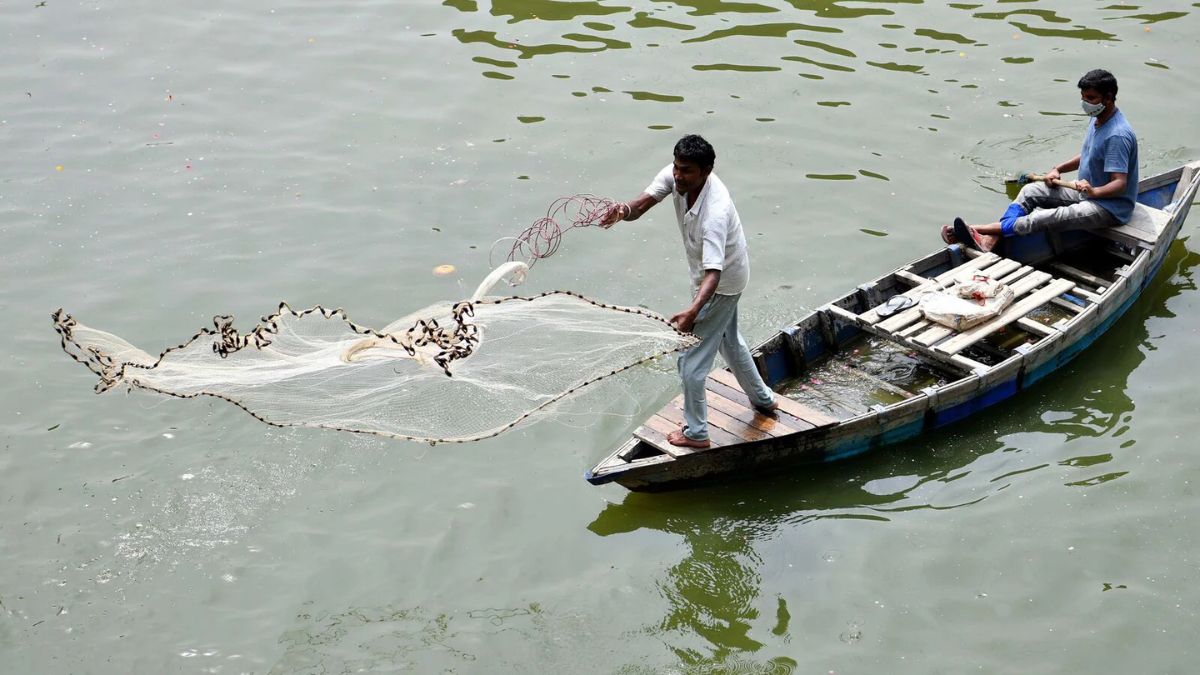
The agreement that India has joined now protects the livelihoods of traditional and small-scale fishers by promoting sustainable fisheries. It also creates a more equitable global fisheries regime by disciplining harmful subsidies that support large, heavily subsidised industrial fishing fleets operated by distant water fishing nations.
This benefits countries like India, where fisheries are predominantly small-scale and which are not major participants in industrial fishing, a statement by the Ministry of Commerce and Industry said. The Agreement further enhances India’s credibility as a responsible seafood exporter, thereby supporting improved access to premium markets that increasingly value sustainability and traceability, the statement added.
At the same time, the predominance of aquaculture-based shrimp in India’s seafood exports, which falls outside the scope of the Agreement, ensures the continued resilience and competitiveness of the country’s seafood export sector
The agreement was adopted by consensus at the 12th WTO Ministerial Conference in Geneva in June 2022. It is the first multilateral WTO agreement with an environmental sustainability objective. The Agreement entered into force on 15 September 2025 after acceptance by two-thirds of WTO Members.
According to a WTO note it is estimated that at least 37.7% of global stocks are overfished compared with 10% in 1974, meaning they are being exploited so quickly that the fish population cannot replenish itself.
Government funding — currently estimated at $ 35 billion per year globally, of which some $ 22 billion increases the capacity to fish unsustainably — continues to aggravate this dire situation by enabling many fishing fleets to operate longer and farther at sea than they otherwise could, to the detriment of marine life.