



The next e-commerce battle is no longer about reaching more PIN codes but about winning consumers in tier-2, tier-3 and smaller towns, where the bulk of incremental demand is now emerging. Industry estimates show nearly 63% of e-commerce orders originate from these markets, prompting companies to rethink strategies that were once built around metros.
While Flipkart has entrenched itself in mass-market retail, Meesho has built a strong value-commerce proposition and quick commerce players are redefining convenience. Amazon, which spent the past decade building one of India’s largest logistics networks, is now recalibrating its approach as it seeks to remain relevant in the country’s fastest-growing consumer markets.
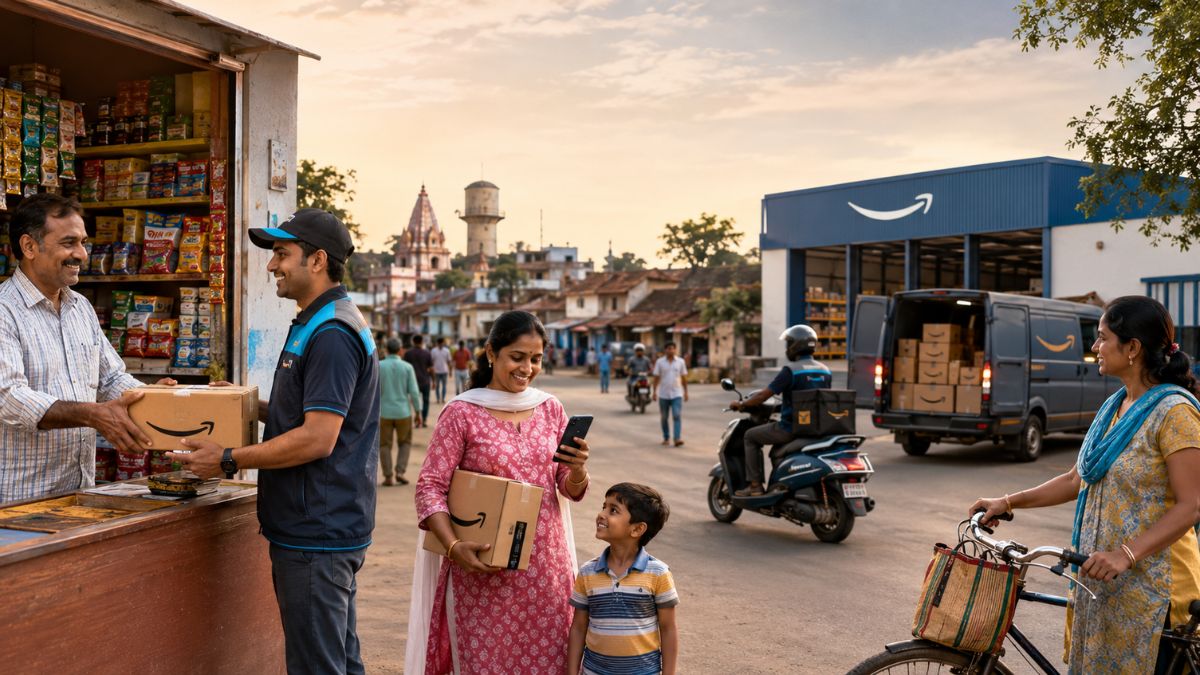
The company’s biggest strength remains its nationwide fulfillment network. Amazon says it now serves all serviceable PIN codes across the country through its fulfillment centres, delivery stations, India Post partnership and more than 25,000 kirana partners under its Hub Delivery programme across over 420 towns.
For Prime members, over 97% of serviceable PIN codes are eligible for one- or two-day deliveries. But industry experts say logistics is no longer the defining competitive advantage in Bharat.
According to an ICICI Securities report, Flipkart continues to lead the e-commerce market with an estimated 50-60% gross merchandise value (GMV) share, aided by its deep penetration beyond metros, while Amazon accounts for around 25-30%.
Meesho, with roughly 10% share, has emerged as the preferred platform for many value-conscious shoppers in smaller towns. “The competitive landscape has evolved significantly. Flipkart remains deeply embedded in mass-market retail. Meesho has built a strong hold among value-conscious consumers in smaller towns,” Somdutta Singh, founder and CEO of Assiduus Global, told FE.
That changing competitive landscape has prompted Amazon to widen its playbook beyond infrastructure. Last year, it launched Amazon Bazaar, a dedicated storefront for affordable, unbranded fashion and lifestyle products aimed at value-conscious consumers.
The shift reflects how consumer behaviour outside metros has evolved. During the first 48 hours of Amazon’s Great Indian Festival 2024, more than 80% of customer visits came from tier-2 and smaller towns, many from returning shoppers rather than first-time buyers. Deloitte estimates that while nearly 480 million consumers in tier-2 and smaller markets consume online content, only about 35% shop online, underlining the growth opportunity that remains untapped.
Consumers in these markets increasingly seek the right balance of affordability, assortment and convenience while relying heavily on ratings, reviews, trusted sellers, flexible payment options and hassle-free returns. At the same time, vernacular content, creator-led commerce and local influencers are playing a bigger role in shaping purchase decisions, trends that competitors have been quick to embrace.
Amazon is also confronting a new competitive reality. As quick commerce expands beyond metros, faster deliveries are beginning to influence consumer expectations even in smaller towns. The company recently committed another Rs 2,800 crore to expand its fulfillment network and strengthen Amazon Now, its quick commerce business competing with Blinkit, Zepto and Swiggy Instamart.
During a recent visit to India, Amazon CEO Andy Jassy said the company would add more than 20 fulfillment centres and over 100 last-mile delivery stations this year to support deliveries in minutes, hours and next day across the country. The company says nearly 70% of its new customers now come from tier-2 and smaller towns.
Experts believe, however, that the next phase of competition will be decided less by network expansion than by local relevance. Region-specific assortments, stronger partnerships with MSMEs, AI-led inventory planning and better demand forecasting will increasingly determine which platforms succeed in Bharat.
“The next phase will require more efficient fulfillment models, AI-led inventory planning, regional warehousing and closer collaboration with local sellers to reduce delivery costs rather than simply expanding network coverage,” Praveen Govindu, partner at Deloitte, said.