



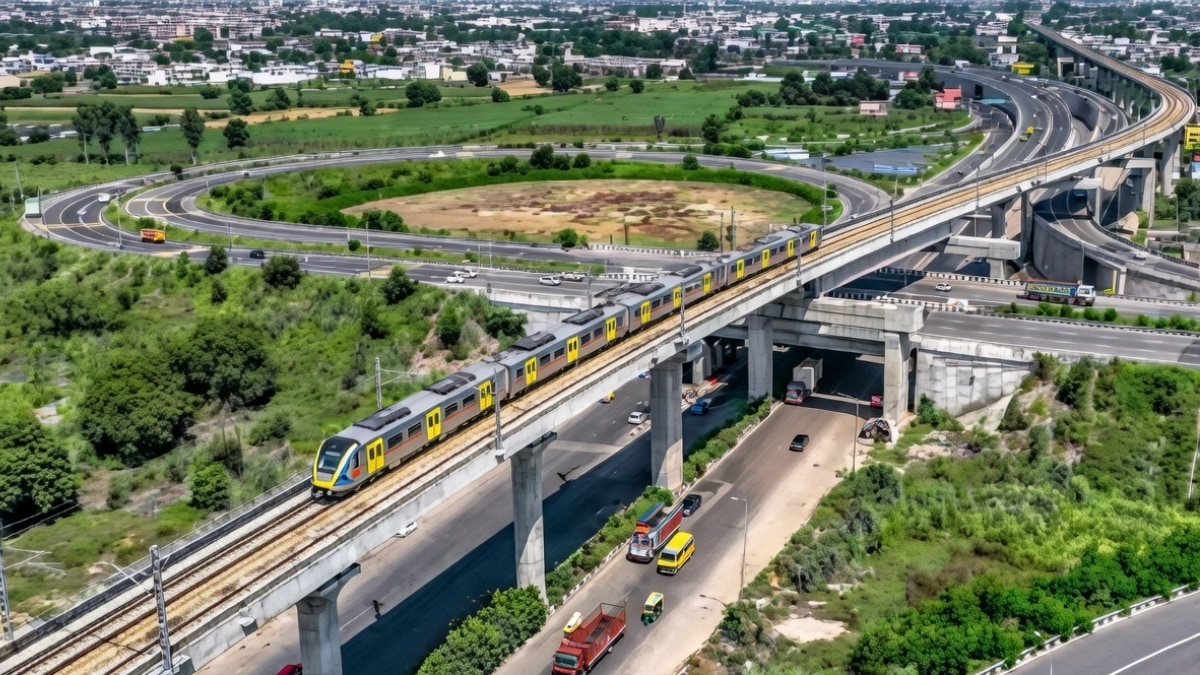
The Sarai Kale Khan (SKK) RRTS station in Delhi has now transformed from a busy construction site into one of the country’s biggest multi-modal transport hubs. From February 22, the station is fully operational and has become the main connecting point where three major Regional Rapid Transit System (RRTS) corridors will meet.
Prime Minister Narendra Modi on Sunday, February 22, inaugurated the remaining sections of the Namo Bharat RRTS Delhi–Ghaziabad–Meerut corridor. These include a 5 km stretch between Sarai Kale Khan and New Ashok Nagar in Delhi, and a 21 km stretch between Meerut and Modipuram in Uttar Pradesh. With this, the entire RRTS corridor is now fully operational.
The launch also makes Sarai Kale Khan one of the biggest multimodal transport hubs in Delhi, as it now connects the RRTS with the Delhi Metro, the railway network, the interstate bus terminal and the Ring Road.
What are the three major RRTS corridors?
Delhi–Meerut RRTS corridor
The station has been specially redesigned to handle three Phase-1 corridors at the same time. The first and most important is the Delhi–Meerut corridor, which runs up to Modipuram in Uttar Pradesh.
PM Modi visited the Shatabdi Nagar Namo Bharat Station, where he flagged off the remaining portions of India’s first Namo Bharat RRTS and country’s fastest metro. This 82-km stretch is now fully operational.
The Delhi-Meerut RRTS is being promoted as India’s fastest urban transit system and is expected to sharply reduce travel time between Delhi and Meerut. With modern coaches, integrated ticketing and frequent train services, the corridor aims to transform daily commuting across the NCR region.
The route passes through several key urban areas in Delhi NCR and Meerut. In Meerut, the stretch includes both elevated and underground stations. For passengers travelling from Delhi, the Namo Bharat service starts at Sarai Kale Khan, which is the main starting point of the corridor. From there, trains run through Ghaziabad and continue up to Modipuram in Meerut. Passengers can also easily switch to the Meerut Metro at selected stations along the route.
Key stations on the Delhi-Meerut Namo Bharat corridor
In the Meerut section, the key stations are Meerut South, Partapur, Rithani, Shatabdi Nagar, Brahmapuri, MES Colony, Daurli, Meerut Central, Bhaisali, Begumpul, Meerut North and Modipuram.
In the Delhi–Ghaziabad section, the key stations include Sarai Kale Khan, New Ashok Nagar, Anand Vihar, Sahibabad, Ghaziabad, Guldhar, Duhai, Duhai Depot, Muradnagar, Modinagar South, Modinagar North and Meerut South, which serves as an interchange toward the city section.
Delhi–Alwar RRTS corridor
The second corridor, Delhi–Alwar, will connect the national capital to Alwar in Rajasthan. This 164-km line is expected to begin civil construction work in August 2026, with partial operations likely by 2028, according to multiple media reports.
The Alwar RAPIDX rail corridor will connect Delhi, Gurgaon, Dharuhera, Rewari, SNB (Shahjahanpur–Neemrana–Behror) and Alwar. It will be built with a mix of tunnels and elevated tracks as part of Delhi’s RRTS.
In Phase 1, the line will run from Delhi to Dharuhera, covering 70.72 km with 13 stations. It is one of the three priority corridors being developed by the NCRTC. Trains on this route are expected to run at a top speed of 160 kmph, allowing passengers to complete the journey in just over an hour, according to NCRTC.
The Detailed Project Report (DPR) for the Delhi–SNB section was approved by the NCRTC board in December 2018. It later received approval from the Haryana government in February 2019 and the Rajasthan government in June 2019.
This RAPIDX corridor will pass through major urban and industrial areas of Haryana and will also link Delhi airport with the RRTS network. The aim is to improve connectivity and boost overall productivity in the National Capital Region.
Delhi–Panipat RRTS corridor
The Delhi–Panipat–Karnal RRTS corridor is a 136.3 km approved “Namo Bharat” high-speed rail project that will connect Delhi, starting from Sarai Kale Khan, with Haryana’s key industrial cities such as Sonipat, Panipat and Karnal.
This 136-km project received PIB clearance in November 2025 and pre-construction work has already begun. The National Capital Region Transport Corporation (NCRTC) has started shifting transmission lines as part of the initial preparations. Around 17 to 22 stations are planned along the route, which will largely run parallel to National Highway 44 (NH-44).
Impact of Sarai Kale Khan hub
The biggest impact of the Sarai Kale Khan hub is on travel time. The aim of the RRTS system is to reduce travel time by nearly 60-70 per cent compared to road journeys. The Delhi–Meerut journey, which earlier took around two-and-a-half to three hours by road depending on traffic, can now be completed in about 55 to 60 minutes.
Once the Alwar corridor becomes operational, the travel time from Delhi to Alwar is expected to come down to around 104 minutes, compared to the current four to five hours by road.
Similarly, the Delhi–Panipat/Karnal route is projected to take around 90 minutes to Karnal instead of the usual three-hour drive. After the full opening of the Meerut line, train frequency has improved significantly, with a train available every 10 minutes.
The remodeling has turned Sarai Kale Khan into a three-level mega hub rather than just a transit stop. The elevated station stands about 15 metres above the ground and has six platforms to manage trains from all three corridors smoothly.
Multi-modal integration: Interchange with the Delhi Metro’s Pink Line
One of the biggest strengths of the Sarai Kale Khan RRTS station is its multi-modal integration. It offers a seamless interchange with the Delhi Metro’s Pink Line at the Sarai Kale Khan–Nizamuddin station.
Officials from the NCRTC said they are building a 280-metre-long foot overbridge (FOB) to connect the RRTS station with Hazrat Nizamuddin Railway Station. The bridge will have six automatic travelators to make movement easier and faster for passengers, according to a report by Hindustan Times.
“This will ensure safe, seamless, and fast connectivity between the two transportation hubs. Civil construction of the FOB is nearly complete, and all six travelators have been installed. At present, finishing work is going on. It is expected to be open to the public by March,” HT reported quoting the official.
The station is set to become one of the biggest transport hubs in the area. It will link Hazrat Nizamuddin Railway Station, the Delhi Metro’s Pink Line, Veer Haqiqat Rai ISBT, and the Ring Road.
“This will significantly improve connectivity and reduce reliance on private vehicles, helping curb congestion and pollution. It will also ensure smooth, efficient, and convenient travel for lakhs of daily commuters,” the official added.