



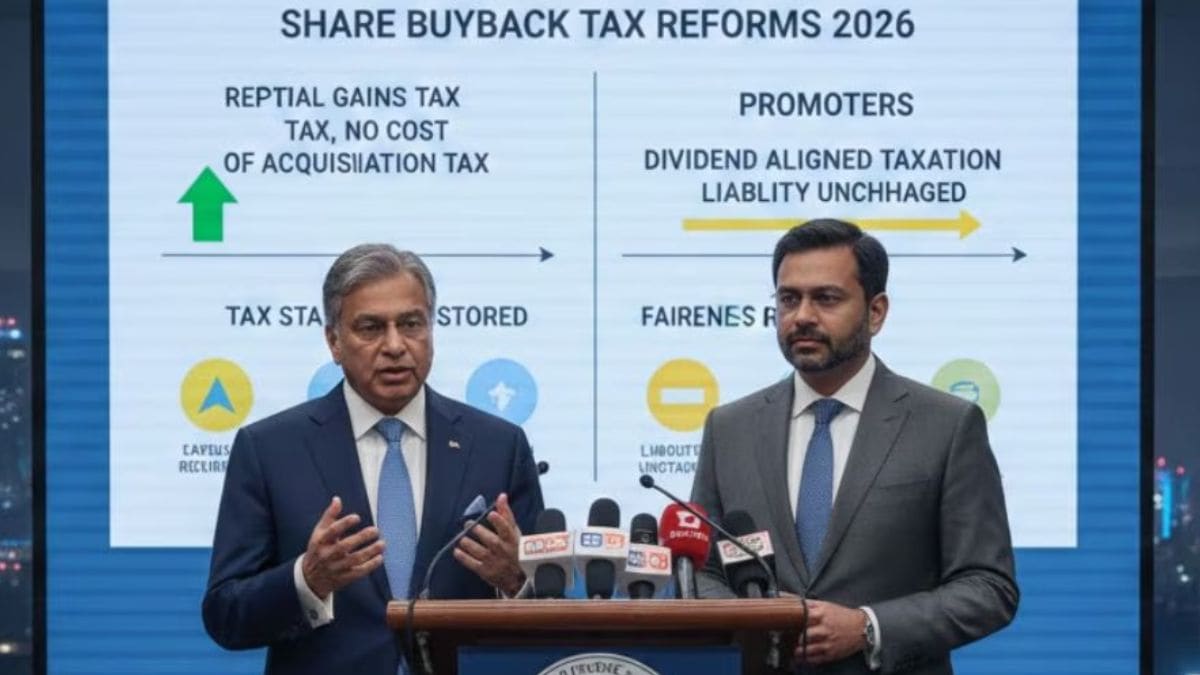
The Budget’s move to correct the tax distortion by shifting buybacks into the capital gains regime, on paper, brings dividends and buybacks closer to parity. In practice, however, promoters—especially corporate promoter entities—may still find buybacks more attractive than dividends.
Under the earlier regime, buybacks were taxed at the company level as if the entire payout were income in the hands of the shareholder. The law ignored the cost at which the shareholder had originally acquired the shares.
A promoter who had bought shares at Rs 90 and tendered them in a buyback at Rs 100 was taxed on the full Rs 100, not the Rs 10 gain. The cost of acquisition was recognised separately as a capital loss, creating a two‑track treatment for the same transaction. It was inefficient, distortionary, and increasingly out of sync with global tax logic.
Budget shifting to capital gains taxation
Budget shifting to capital gains taxation corrects this anomaly. Now, only the real gain—sale price minus the cost of acquisition is taxed. For ordinary shareholders, this is a clear win.
For promoters, too, the structure is more rational, though the government has simultaneously raised their tax rates to ensure buybacks are no longer used as a disguised dividend channel.
Individual promoters will now pay 30% on buyback gains, while corporate promoter entities will pay 22%. Non‑promoter shareholders, by contrast, pay 12.5% on long‑term gains.
Yet, even with these higher promoter‑level rates, buybacks retain an edge. Dividends are taxed on the full amount received, with no deductions. Buybacks, even at 30% or 22%, allow the deduction of the acquisition cost.
For many promoter groups—especially those who acquired shares at par, through legacy restructurings, or via promoter‑owned entities—the cost base is negligible. In such cases, the tax outgo on buybacks and dividends may converge, but the structural advantages of buybacks remain intact.
What do market observers say?
Lalit Kumar, Partner at JSA Advocates & Solicitors, said, “The earlier regime taxed the entire buyback amount as if it were income in the hands of shareholders, without recognising the cost of acquisition of shares so bought back. The Budget corrects this anomaly by treating buybacks as capital gains, which is the right conceptual approach.
While promoter tax rates have been increased to prevent misuse, buybacks will still remain attractive because they allow the cost of acquisition as a deduction and offer this advantage (that dividends do not).”
“While the tax treatment has been rationalised, the preference for buybacks goes far beyond taxation. A buyback is a strategic capital‑allocation decision and signals long‑term confidence in the company’s intrinsic value. For corporate promoters, especially those structured as companies, the post‑budget framework remains economically efficient. So even after the recent changes, buybacks will continue to be a preferred route over dividends for many firms,” said Amit Jain, Chairman and Managing Director, Arkade Developers, Mumbai-based real-estate developer listed on the BSE.
Those strategic advantages are not trivial. Mihir Tanna, Associate Director, SK Patodia & Associates LLP, said, “Buybacks reduce the equity base, improve earnings per share, and signal confidence in the company’s valuation. They also allow promoters to consolidate their stake without triggering open offer obligations.
Even with the new tax regime, it is expected to remain the same. Promoters who wish to manage float, optimise capital structure, or send a market signal will continue to prefer buybacks over dividends.”
Corporate promoters, in particular, retain a meaningful tax advantage at 22%, ensuring that buybacks will continue to feature prominently in promoter‑level decisions.
This creates a natural incentive for promoter groups to route shareholding through corporate entities—a structure already common in India’s promoter‑driven business landscape. The Budget has narrowed the arbitrage but not eliminated it.
Tanna of SK Patodia believes that the government’s intention is clear, it removes the misuse of buybacks as a tax-efficient dividend substitute. By shifting to capital gains and raising promoter level rates, it has largely neutralised the earlier loophole.
In some cases, buybacks still allow cost deduction, still offer capital structure benefits, and still provide promoters with strategic flexibility that dividends cannot match. “Buybacks will no longer be a tax dodge, but they will remain a preferred tool, because they continue to serve strategic, structural, and, in some cases, still efficient financial purposes,” Tanna added.