



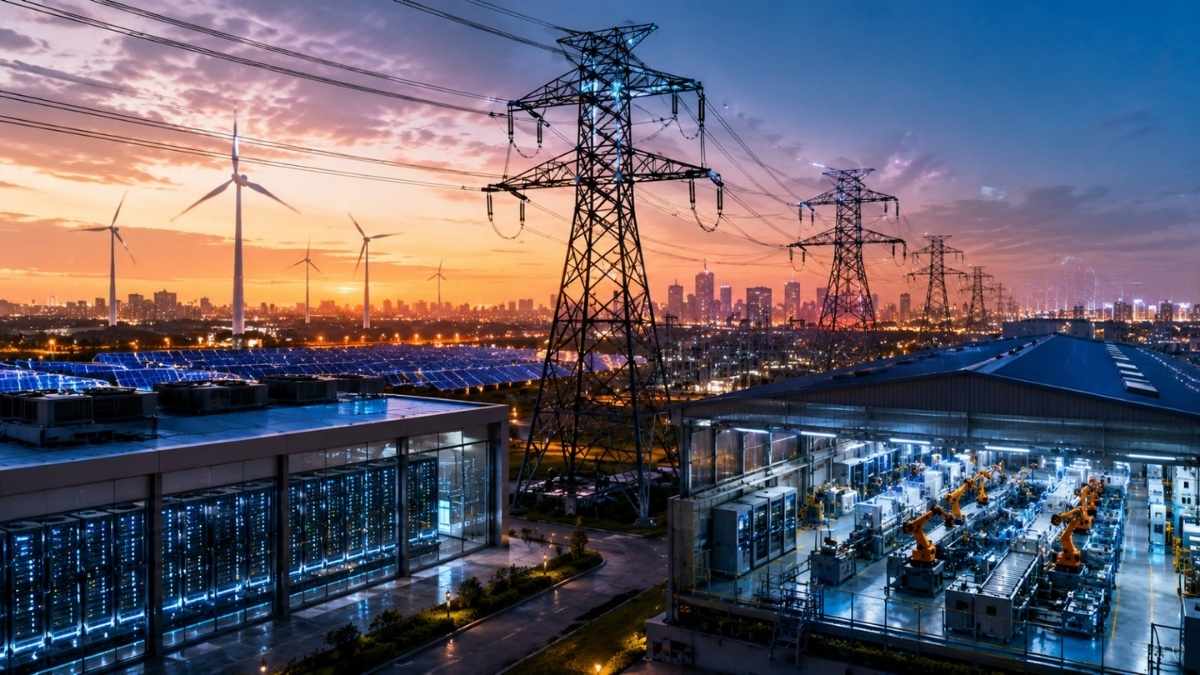
India has become the world’s fastest-growing major electricity market, with demand being driven by higher usage in manufacturing sector as well as data centres. Equirus estimates India will require nearly Rs 50 trillion of investments by FY32 across power generation, renewable energy, storage and transmission infrastructure to meet the country’s rising needs.
Electricity demand has grown at 7.3% annually on a compounded basis between FY21 – FY25. Going forward, IEA expects India’s electricity demand to grow 6.4% annually through 2030, ahead of China, the US and Europe.
According to Equirus, “Following a weather-led pause in FY26, demand growth should normalise at 6-7%, with peak demand rising from a record 271GW in May 2026 to 388GW by FY32.”
Rs 50 trillion investment opportunity
Equirus estimates India will require nearly Rs 50 trillion of investments across a host of renewable-power-related opportunities. They believe solar projects may attract Rs 12-13 trillion while wind projects could see a Rs 3.5-4 trillion investment.
The investment in the thermal power category may see Rs 4.1-6.6 trillion, while hydro projects could attarct Rs 2-2.2 trillion investments. Battery energy storage systems (BESS) and pumped storage projects are also expected to emerge as key investment opportunities over the next few years.
The report said installed power capacity will have to increase from about 537 GW currently to nearly 900 GW by FY32, while peak electricity demand is expected to rise to 388 GW.
What’s driving investment in power sector
Multiple structural factors are expected to keep electricity demand elevated over the next decade including rapid industrialisation, rising air-conditioner usage, expanding data centres, electric vehicles and weather-related demand.
1. Manufacturing: The biggest demand driver
Manufacturing is expected to remain the biggest contributor as Production Linked Incentive (PLI) schemes, along with capacity expansion in sectors such as steel, cement and chemicals, increase industrial power consumption. “The industrial and commercial segments accounted for approximately 49% of electricity consumption in FY25, growing at a 7.3% CAGR over FY21-FY25,” Equirus estimated.
2. Data centers
Data centres are another fast-growing source of demand. Equirus expects data-centre IT load to rise from around 1.5 GW currently to 8-9 GW by 2030, supported by rising investments in digital infrastructure and artificial intelligence.
3. Rising AC adoption & cooling demand
Cooling demand is also emerging as a major driver for higher power demand. Equirus noted that while AC penetration remains only 8-10%, cooling already contributes around 60 GW of peak demand.
They expect the annual AC sales to reach 25 million units, with cooling demand alone contributing 120-140 GW of peak demand by FY30.
4. Electric mobility to drive the next wave of demand
Electric mobility is also expected to add significantly to electricity consumption, with EV charging demand projected to reach nearly 100 billion units by 2030.
Weather-related agricultural demand is likely to remain another key variable, with El Niño conditions capable of boosting electricity consumption through higher irrigation requirements.
Coal to continue supporting India’s energy transition
Despite rapid growth in renewable energy capacity, Equirus believes thermal power will continue to remain the backbone of India’s electricity system.
Equirus noted that while non-fossil sources account for more than half of installed capacity, thermal plants still generate over 70% of India’s electricity because solar and wind power remain intermittent.
The brokerage firm also highlighted that India’s evening power demand continues after solar generation falls, making coal-fired plants essential for maintaining grid stability until battery storage scales up.
Power sector: Challenges ahead
Despite the projected Rs 50 trillion investment opportunity in the power sector, India is still facing challenges. Transmission infrastructure is seen as a key hurdle that could impact energy transition. Equirus warned that more than 35 GW of renewable energy capacity could face curtailment in FY27 as transmission networks struggle to keep pace with the rapid addition of solar and wind projects.
According to the report, renewable plants are increasingly being asked to reduce generation despite having available capacity because the grid lacks adequate evacuation infrastructure.
“India needs to add 137,500 circuit km (ckm) of transmission lines by FY32. However, execution continues to lag,” Equirus noted.
“Delays in transmission projects, land acquisition and right-of-way issues could slow execution, increasing the risk of renewable curtailment and affecting project returns, particularly in renewable-rich states such as Rajasthan and Gujarat,” Equirus added.