



As Indian PM, Narendra Modi landed in Tel Aviv on Wednesday, India and Israel moved closer to signing a landmark defence agreement. Officials say this deal could take security ties between the two “friendly countries” to an entirely new level. Unlike earlier agreements, this time the focus is not on simply buying weapons. There is unlikely to be any direct sale of arms. Instead, the emphasis is on transfer of technology for highly advanced weapons systems, some of which Israel has not offered to any other country so far.
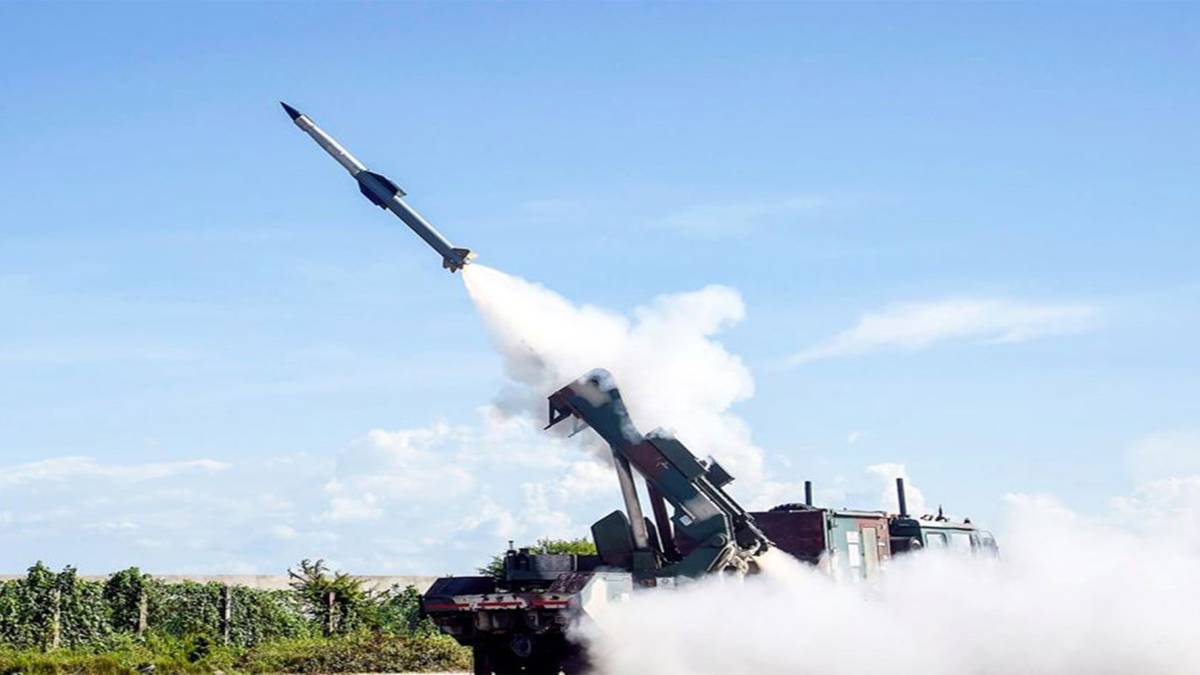
One of the most important parts of this growing partnership is missile defence. Prime Minister Narendra Modi announced “Mission Sudarshan Chakra” during his Independence Day speech, outlining a plan to build a powerful, multi-layered missile defence shield for the country.
The need for such a system became clear during Operation Sindoor. During the conflict, Pakistan reportedly launched nearly a thousand missiles at India, including ballistic missiles. While the actual damage was limited, the scale of the attack showed how intense future threats could be. To deal with such threats, India is planning a layered missile defence system under Sudarshan Chakra. The idea is to detect enemy launches early, using radars, aircraft and satellites, and then intercept missiles at different stages of their flight.
Addressing the Israeli Parliament, the Knesset, Modi made India’s position clear. “In today’s uncertain world, a strong defence partnership between trusted partners like India and Israel is of vital importance,” he said.
Mission Sudarshan Chakra: Building a shield
During Operation Sindoor, Islamabad reportedly sent waves of Turkish drones and Chinese PL-15 long-range air-to-air missiles towards India, targeting both military and civilian sites. The Modi government now wants to strengthen India’s borders with what it hopes will become an almost impregnable missile shield.
The goal is to manufacture these systems at home under the ‘Make in India’ initiative and integrate them into the proposed “Sudarshan Chakra,” planned for completion by 2035. In a world where stand-off missiles, loitering munitions and swarm drones are becoming common tools of war, India’s Sudarshan Chakra could be the key to Indian security.
India already has Russia’s S-400 missile defence system. It also operates Israel-developed Barak systems and its own Akash system. But officials believe that more advanced systems like Iron Dome and Iron Beam are needed to fully protect the country’s vast 15,106-km land borders and 7,516.6-km coastline.
According to Israeli media reports, the expected Memorandum of Understanding (MoU) may have two main sides to it. One would focus on defensive systems. The other would deal with offensive weapons.
On the defensive side, discussions are expected around some of Israel’s most powerful missile defence systems. These include Israel Aerospace Industries’ Arrow missile defence system. There is also Rafael’s David’s Sling, which can handle medium-range missiles and drones up to 300 km. The popular Iron Dome system, also made by Rafael, can intercept short-range rockets between 4 and 70 km.
Another system being talked about is the Iron Beam, developed by Rafael and Elbit. It is a 100-kilowatt laser weapon designed to destroy hostile aerial threats up to 10 km away.
What exactly is Sudarshan Chakra?
Named after the divine disc of Lord Krishna, Sudarshan Chakra is India’s vision of a multi-layered air defence shield. The idea is simple but ambitious, whih is to protect major cities, nuclear plants, military bases and key installations from all kinds of aerial threats. These threats can range from long-range ballistic missiles to short-range rockets, drones and even swarms of small unmanned aircraft.
The system is being built in layers. At the long-range level, India already has the Russian-made S-400 Triumf system. Within the Indian Air Force, this system is often referred to as “Sudarshan.” It forms the backbone of the shield.
Alongside this, India is working on its own long-range system under Project Kusha. This is an indigenous effort to build a missile defence system in the same class as the S-400, with ranges expected to go up to 350–400 km. Major trials are expected in 2026.
For medium-range protection, India and Israel have jointly developed systems like the MRSAM, also known as Barak-8. These are designed to intercept incoming threats at intermediate distances.
At the shorter range, elements of Israel’s Iron Dome are expected to be integrated. Iron Dome is known for stopping rockets and small missiles at distances between 4 and 70 km.
Then comes future technology. Directed Energy Weapons, or laser-based systems, are part of the plan. Israel’s Iron Beam and India’s own DURGA-II project are being looked at as cost-effective solutions to shoot down drones and low-flying threats. A laser shot can cost just a few dollars, far less than firing a traditional interceptor missile.
How defence deal with Israel may work
Israel has become India’s key partner in this mission. While Russia continues to supply heavy long-range systems, Israel is playing a major role in providing advanced electronics, sensors, guidance systems and precision technology.
One of the most important parts of the 2026 defence understanding is technology transfer. Israel has agreed to share sensitive know-how related to systems like Iron Dome and Iron Beam. Unlike older deals where India mainly bought ready-made equipment, this time the emphasis is on “Make in India.” The goal is to produce and integrate these systems domestically.
Artificial Intelligence is another important element. Israeli AI technology is expected to help connect thousands of Indian radars and sensors into one seamless network. This unified system would act like a single “brain,” and will be capable of detecting and responding to incoming drones or missiles in real time.