




Reserve Bank of India (RBI) deputy governor Viral Acharya has said that while the central bank has tried to strengthen the monetary transmission process, such efforts have yet not yielded the desired results. He added that transmission from the policy repo rate to bank lending rates, which is the dominant transmission channel in India, has remained a matter of concern. Acharya spoke at the Tata Institute of Fundamental Research (TIFR) on Thursday. “With the recent explicit objective of price stability mandated by the legislature, the issue of smooth monetary transmission has assumed an added significance,” he said, adding that against that backdrop, RBI has recently put out a report by the Internal Study Group to address the weaknesses of the existing monetary transmission system. A key suggestion, he said, is to whether to shift the loan pricing system from an internal benchmark to an external benchmark. “The Reserve Bank will take a considered view in the matter at an appropriate time,” Acharya said. According to him, there is a deeper economic issue at hand in the recommendation to move towards an external benchmark. “The issue is: who should bear the interest rate risk in the economy – the borrower, or the depositor, or the bank? Who is likely to be better at managing the interest rate risk?” he said.
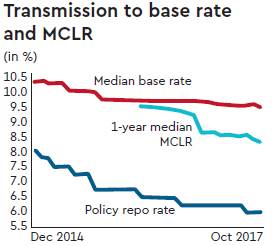
Retail depositors and borrowers, Acharya said, are unlikely to have efficient tools to manage the interest rate risk whereas banks, should have the wherewithal to manage interest rate risk. “Similarly, bulk depositors and large corporate borrowers can also be expected to be in a position to manage the interest rate risk. Non-bank financial institutions with less exposure to interest rate risk, such as insurance and pension funds, could also be good repositories of this risk,” he said. Acharya outlined a few reasons behind the delay in transmission of policy rates. He explained that a sizeable legacy loan portfolio of banks is still linked to the base rate (about 30% of the outstanding bank loans).
“Lending rates under the base rate system are relatively stickier than the loans linked to marginal cost of funds based lending rates (MCLR). During the current easing cycle of monetary policy, as against 200 basis points (bps) cumulative cut in the repo rate, the base rate has declined by about 80 bps,” he said. According to him, the Study Group’s analysis suggested that banks deviated in an ad hoc manner from the specified methodologies for calculating the base rate and the MCLR to either inflate the base rate and MCLR or prevent the base rate and MCLR from falling in line with the cost of funds.