



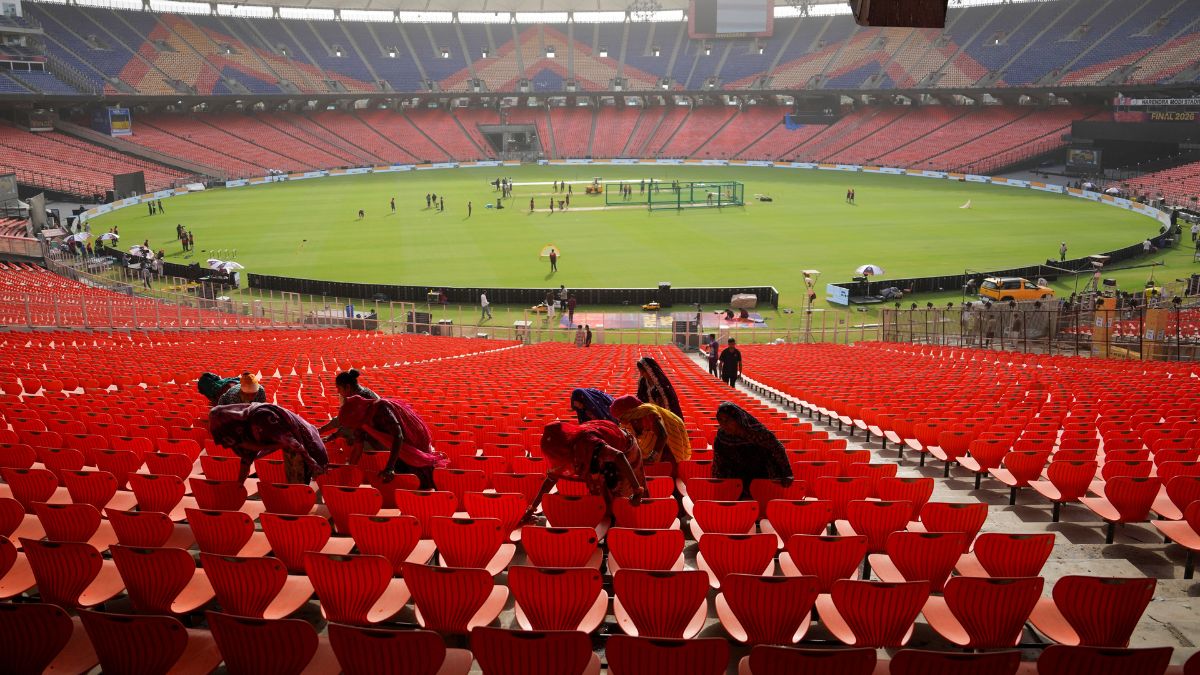
Rain could play a significant role in the Indian Premier League (IPL) final between Royal Challengers Bengaluru (RCB) and Gujarat Titans (GT) at the Narendra Modi Stadium in Ahmedabad but tournament regulations are designed to ensure that a champion is crowned whenever possible.
Unlike league-stage matches, where points can be shared if a game is abandoned, the IPL final operates under a separate set of playing conditions aimed at producing a winner.
Here is how the process works if weather affects the title-decider.
Is there a reserve day for the IPL final?
Yes. The IPL final has a reserve day in place to accommodate interruptions caused by weather.
If rain prevents the match from being completed on the scheduled day, officials can continue or replay the contest on the reserve day, depending on how much play was possible before the interruption. The reserve day is intended to maximise the chances of completing the final and determining the winner on the field. The reserve day for the IPL 2026 final is June 1 (Monday).
What happens if rain interrupts play?
Match officials will first attempt to complete the game on the scheduled day using the additional time available under the tournament’s playing conditions.
If a full 20-over contest is not possible, the match can be reduced in length. Overs may be deducted from both innings while preserving the possibility of a result. The minimum requirement is a five-over-per-side match.
Can the final be decided by a Super Over?
Yes. If a shortened or full-length final ends in a tie, a Super Over is used to separate the teams.The Super Over is played under the same principles as in other IPL matches, with each side receiving one over to score as many runs as possible. If required, additional Super Overs can be played until a winner emerges.
What if no result is possible even after the reserve day?
The IPL’s playing conditions contain a final contingency if weather makes cricket impossible on both the scheduled day and the reserve day. In that scenario, the team that finished higher in the league standings at the end of the regular season is declared the winner. This provision acts as the tournament’s ultimate tie-breaker when no result can be achieved on the field.
In the ongoing 2026 season, it was RCB who topped the league stages and that means if the match ends without a result, it would be RCB who will be deemed the winner.
Here’s what the IPL Match Playing conditions actually say
Play-off matches
“If any of the Final, the Eliminator, Qualifier 1 or Qualifier 2 matches are tied, or there is no result, the
following shall apply:
16.11.1 the relevant teams shall compete in a Super Over and if necessary further Super Overs to
determine which team is the winner of the match in question; and
16.11.2 if conditions do not permit a Super Over, or subsequent Super Overs within the time available to
determine the winner as described in Appendix F then the team which, at the end of the relevant regular Season, finished in the higher position in the League table (in accordance with clause 16.10 above) will be deemed the winner of the relevant play-off match,” reads the IPL Playing conditions document which can be accessed on their official website.
Could the trophy be shared?
No. Under current IPL regulations, the competition is designed to produce a single winner.
Tournament organisers first use additional playing time, reduced-overs cricket, reserve-day scheduling and Super Overs before turning to league-stage standings as a last resort.
If rain disrupts the IPL final between RCB and GT, officials will use every available option, including additional playing time, a reserve day, reduced-overs cricket and Super Overs, to determine a champion.
Only if weather prevents any result from being achieved across both the scheduled match day and the reserve day would league-stage finishing position be used to decide the title.