



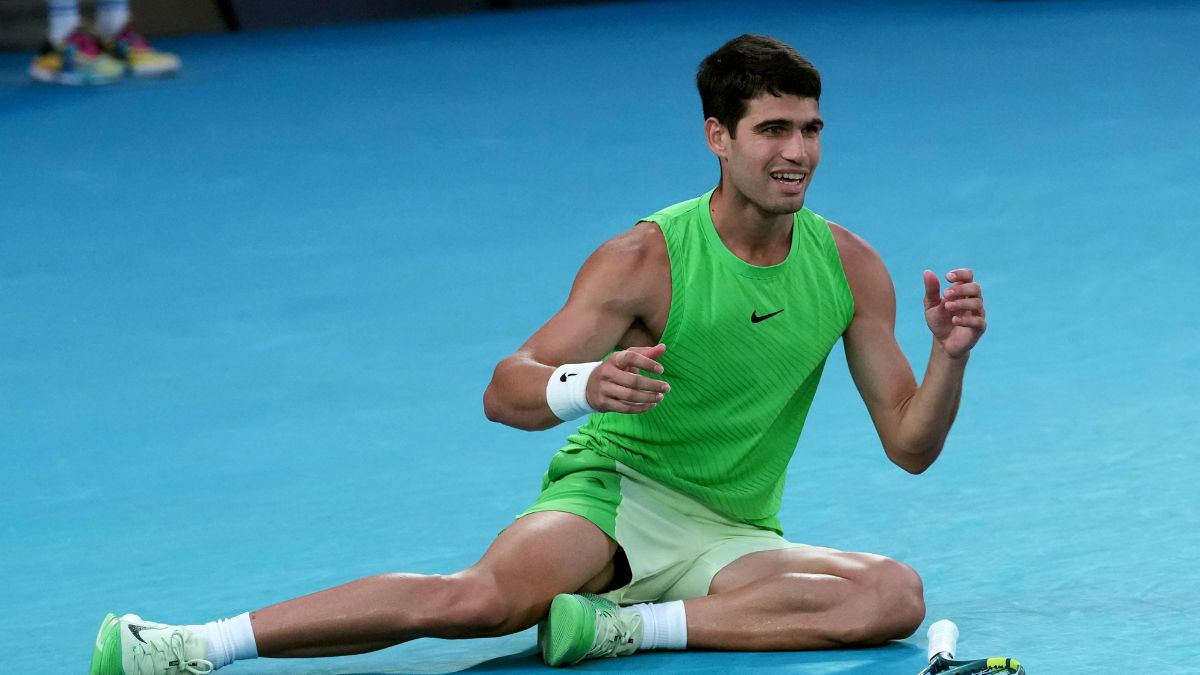
Carlos Alcaraz walked off Rod Laver Arena on Friday night with his arms raised, but also with a noticeable limp, a sight that summed up a semi-final that tested not just his tennis, but his physical and mental limits. The world No. 1 survived a dramatic five-set battle against Alexander Zverev to reach his first Australian Open final, even as serious concerns linger over his fitness ahead of Sunday’s title clash.
In a match that stretched five hours and 27 minutes, Alcaraz edged past the German 6-4, 7-6(5), 6-7 (3), 6-7(4), 7-5 in what was one of the longest semi-finals in Melbourne history. It was a contest defined as much by shot-making and stamina as by a mid-match injury scare that briefly threatened to derail the Spaniard’s campaign.
Carlos Alcaraz sustained an injury in the third set
Alcaraz appeared in control when the match turned. Leading by two sets and locked at 4-4 in the third, the 22-year-old suddenly slowed after a routine backhand exchange. Moments later, he was seen clutching his upper right thigh and groin, struggling to change direction and clearly in discomfort.
A hush fell over the stadium as Alcaraz called for a medical timeout. The physio worked extensively on his right leg, while speculation swirled in the commentary box and among fans about whether it was severe cramping brought on by Melbourne’s taxing conditions or something more serious.
The uncertainty seeped into Alcaraz’s movement when play resumed. His explosive lateral coverage, a key weapon, was visibly compromised and Zverev quickly sensed an opening.
Tempers flare as Zverev fights back, argues with umpire
The medical timeout sparked a heated reaction from Zverev, who challenged the decision to allow treatment, arguing that cramps do not qualify for an MTO under the rules.
“Why are you not starting the clock for 15 seconds?” the German was heard telling chair umpire Marijana Veljovic, his frustration spilling over as the momentum of the match shifted. He appeared to suggest that a medical timeout was not allowed for cramps.
Fuelled by the controversy and aided by Alcaraz’s reduced mobility, Zverev staged a strong comeback. He tightened his groundstrokes, extended rallies and forced errors, clawing his way back to level the match at two sets apiece and pushing the semifinal into a deciding fifth.
Alacaraz vs Djokovic or Sinner in the final: Grit, risk and history in the making
Alcaraz, however, refused to fold. Leaning heavily on drop shots, shorter points and aggressive first serves, he found a way to manage his body. A quick on-court recovery routine, including pickle juice, became part of his survival strategy as he searched for energy in the final stretch.
At 5-5 in the decider, Alcaraz produced one last burst, breaking Zverev before serving out the match to seal a historic victory.
The win makes Alcaraz the youngest man to reach finals at all four Grand Slams. A title on Sunday would complete a Career Grand Slam at just 22, a feat achieved by only a handful in the Open Era.
Yet, even as records beckon, the focus now turns to his right leg. With either Novak Djokovic or Jannik Sinner awaiting in the final, Alcaraz’s recovery over the next 48 hours may prove just as crucial as his shot-making brilliance.