



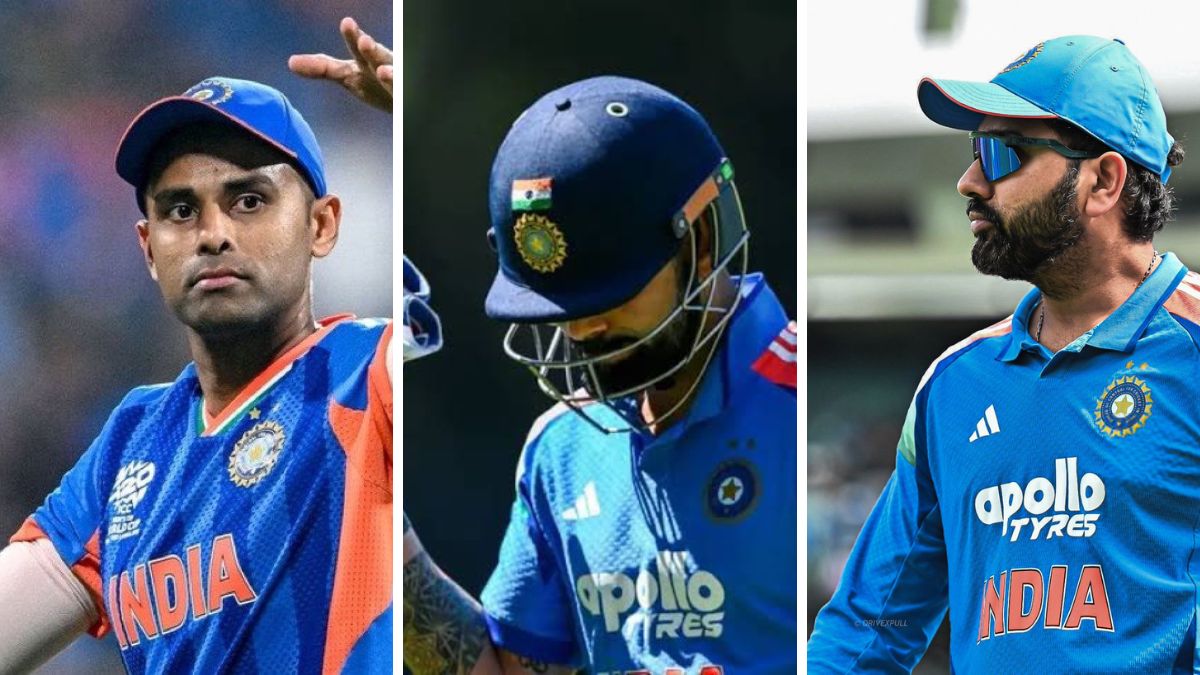
There is a principle in financial markets that even the most decorated stock cannot survive a sustained loss of investor confidence. It does not matter what the decade-long returns looked like. It does not matter how many bull runs the asset powered, how many portfolios it anchored, or how many crises it weathered.
One bad quarter, one ugly earnings call, one season of underperformance and the institutional money walks. Once a Blue-Chip, takes no time in becoming a write-off.
Indian cricket’s captaincy market seems to operate on precisely the same logic. And over the last four years, it has delivered three case studies in how quickly confidence evaporates, each more instructive, and more brutal, than the last.
Kohli: The Blue-Chip That Never Paid the Dividend
Virat Kohli was, by every conventional metric, the finest leadership asset Indian cricket had ever produced. Over seven years, he led India in 68 Tests, delivering 40 victories at a win percentage of 58.82%, the highest return of any Indian Test captain in history. He restructured the organisation from the ground up: overhauled fitness standards, redefined India’s overseas appetite, and built a Test team that could compete on any surface in any country.
In ODIs, he averaged 72.65 with the bat across 95 matches as captain, achieving a 68.42% win rate, the best of any captain who has led a side in more than 20 matches. By any long-term valuation model, this was a high-performing asset.
But Kohli carried one liability that compounded over time: no ICC trophy. The 2019 World Cup ended in a semi-final. The 2021 T20 World Cup ended in a group-stage exit. The ICC dividend, the one payout the market truly prices in, never arrived. When India were beaten in South Africa, the board moved swiftly. Kohli stepped down from T20I captaincy and was removed as ODI captain in quick succession, in what the market politely called a restructuring but was, in practice, a forced delisting.
Seven years of compounding returns, written off across one bad series. The review cycle: an entire tenure.
Rohit: Strong Quarterly Numbers, Fatal Year-End Miss
Rohit Sharma entered the leadership role with a different mandate, deliver ICC returns, or the investment thesis collapses. He delivered. Between 2023 and 2025, India reached three consecutive ICC tournament finals, winning two — a run that cemented Rohit’s legacy among the most successful captains in modern cricket.
His overall win percentage of 73.23 across formats is the highest among Indian captains who have led in at least 50 matches. He ended an 11-year ICC trophy drought, then reinvested those gains into a Champions Trophy title in Dubai in 2025.
On paper, the portfolio had never looked healthier.
Then came the Border-Gavaskar series, one prolonged earnings miss that the market could not absorb. India suffered a historic whitewash at home for the first time in 130 years of Test cricket, and Rohit’s personal numbers in Australia were equally damaging. Confidence evaporated.
By May 2025 he had retired from Test cricket. By October, Shubman Gill had been installed as ODI captain, with the selectors citing the need to build toward the 2027 World Cup cycle.
Two ICC trophies in 12 months, rendered secondary by one overseas assignment. The review cycle had shrunk from a seven-year tenure to a single tour. The market, it turned out, had a very short memory and an even shorter tolerance for red ink.
Suryakumar: Fired Between Quarterly Reports
And then there is Suryakumar Yadav. The numbers Suryakumar generated as India’s T20I captain were, by any reasonable benchmark, exceptional. Under his leadership, India won 40 and lost just 8 from 52 outings, did not lose a single bilateral series, and claimed both the Asia Cup 2025 and the T20 World Cup 2026. That World Cup was not a routine title — India became the first nation to retain the T20 World Cup and the first three-time champion, defeating New Zealand by 96 runs in the Ahmedabad final in March 2026.
He lifted that trophy in March. By June, the position had been terminated.
What triggered the review? Not a bilateral series loss. Not an overseas tour. Not a single match in Indian colours. The trigger was an IPL, a franchise tournament, played in different kit, under different conditions, for a team that finished ninth. Suryakumar scored 270 runs in 13 IPL matches at an average of 20.76.
The board’s response was immediate. A BCCI source told PTI: “Surya is set to be removed from captaincy. The selectors wanted to wait till the end of the IPL to see whether he can get back to form. Since he looked completely out of form and not just out of runs… a tough call needs to be taken.” The tough call was taken. His international career now appears to be over across all formats.
A World Cup-winning CEO, showed the exit two months after the company’s best quarterly result, because his personal KPIs dipped in a side project.
The Shrinking Review Cycle
Place the three tenures side by side and what emerges is not just a pattern of ruthlessness — it is a pattern of acceleration. Kohli’s captaincy was evaluated across seven years before the final reckoning. Rohit’s across three. Suryakumar’s across less than two, with the decisive data point collected not during an India assignment at all, but during an IPL season that had no bearing on his international brief.
The performance review cycle, the window within which a leader is judged, has compressed from a tenure, to a series, to a tour, to a franchise season. In corporate terms, the board has moved from annual appraisals to quarterly reviews to, apparently, real-time monitoring of activity that has nothing to do with the role in question.
There is a version of this that looks like prudent governance. Suryakumar was 35. The 2028 T20 World Cup cycle demands a younger leadership investment. Capital allocation toward the future is rational. These are not indefensible positions.
But the timing, two months post-World Cup, right after-IPL, with no India series as a reference point, suggests something less considered than strategy. It suggests a market so conditioned to short-termism that it can no longer hold a long-term position even when that position just delivered a historic return.
Kohli asked: does a decade of outperformance matter if the ICC dividend never arrives?
Rohit answered it with two trophies, and discovered one bad tour could still wipe out the gains.
Suryakumar had no bad tour. He had a bad IPL. And in 2026, that is sufficient cause for a forced exit.
The review cycle keeps shrinking. The last innings keeps getting shorter. At this rate, the next India T20I captain will be subject to a performance improvement plan before the first series has been played.