



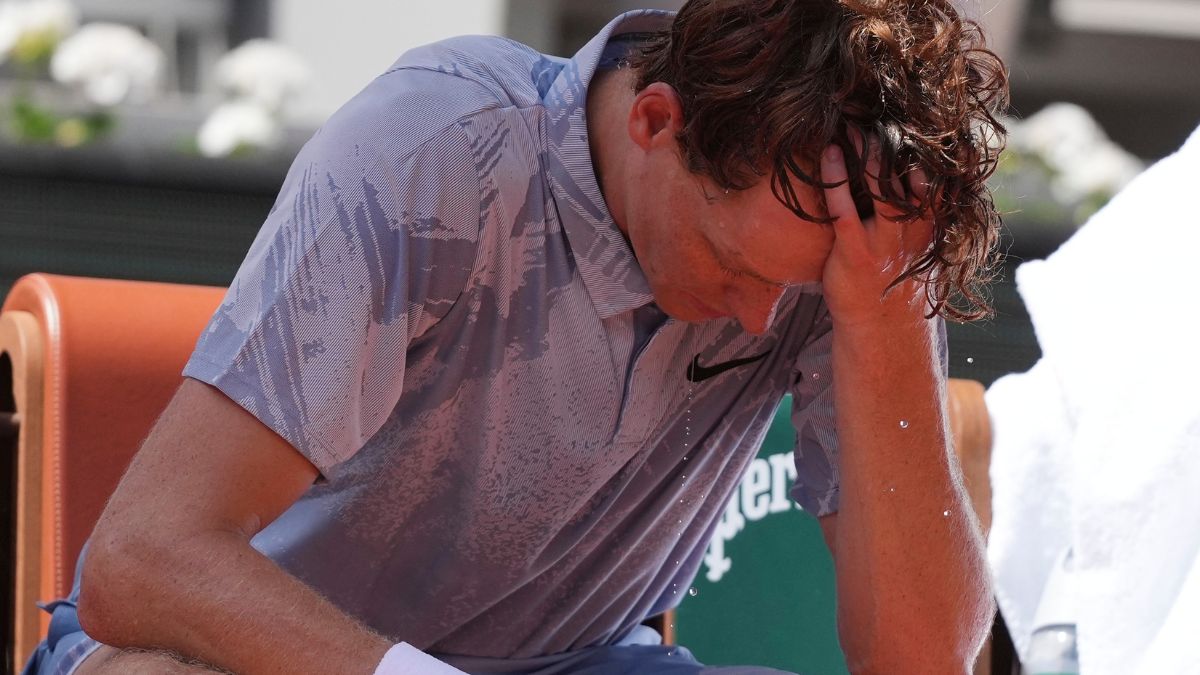
On Thursday afternoon, Court Philippe-Chatrier bore witness to one of the most sudden, baffling collapses in modern Grand Slam history.
World No. 1 Jannik Sinner—the tournament’s runaway title favorite riding a spectacular 30-match winning streak—was cruising into the third round of the French Open 2026. He was up two sets against Argentina’s Juan Manuel Cerúndolo and serving for the match at 5-1 in the third.
Then, his body completely flatlined. Sinner lost 18 consecutive points as the grueling Parisian conditions took a severe toll. Courtside microphones captured the Italian indicating to the chair umpire that he felt severely dizzy and nauseous, and he was visibly struggling to find his footing on the baseline.
Over the next 90 minutes, the top seed became completely uncompetitive, bending over his racquet in exhaustion and dropping 18 of the final 20 games to lose 6-3, 6-2, 5-7, 1-6 1-6.
While Sinner gracefully credited Cerúndolo, the blistering afternoon exposed a massive problem: soaring European temperatures are actively out-conditioning the world’s best athletes.
Why was it Sinner’s best shot at completing a career slam?
There was no Carlos Alcaraz, the man was on a 30-match winning streak and he had already played a final in the last year. Sinner had the perfect recipe to get him past the line. He already has US Open, Wimbledon and two Australian Open titles to his name The only thing keeping the 24-year-old Italian from greatness was a French Open title and thanks to the Paris heat, it will remain as it is for this year too.
Sinner’s Account: Waking Up Sick Under a Scorching Sun
In his post-match press conference, Sinner was reluctant to blame the weather entirely, pointing instead to a sudden morning illness and sleep deprivation that left him depleted before the match even commenced.
“I felt this morning I didn’t sleep very well,” Sinner said. “This morning when I woke up, I was struggling a bit… I tried to keep the points very short. Also, in the beginning, I was hitting very clean, very good, and then I kind of hit the wall. I didn’t have energy, really. I was very, very flat [in] the whole body. I don’t remember the last time I felt this weak.”
Despite Sinner’s hesitation to fault the environment, the sizzling sunshine heavily dictated the physical narrative on the court. As the thermometer hit a peak of 33°C (91.4°F) with a crushing humidity “feel factor,” Sinner was seen desperately wrapping ice bags around his neck and using a hand-held fan on changeovers to lower his temperature.
The Climate Shift: Paris Normals vs. The Unprecedented Jump
What happened to Sinner is part of a stark, documented climate anomaly hitting Western Europe. Historically, late-May weather in Paris is notoriously mild and brisk. According to long-term climate logs from Météo-France, the historical baseline maximum for May 25–28 typically sits around 19°C to 22°C (66°F–71°F)—the exact, comfortable spring conditions the tournament was built for.
This year, however, temperatures have shattered those baselines to experience a massive, vertical jump. Air temperatures in the shade have consistently spiked between 32°C and 35°C (90°F–95°F) across Paris due to an intense, early-summer “heat dome” trapping hot air over Western Europe.
Inside concrete stadium bowls like Court Philippe-Chatrier, the lack of air circulation combined with the dark red clay surface transforms the baseline into a radiant heat chamber. On a day where ambient thermometers read 33°C, the actual temperature trapped on the court surface easily feels closer to 38°C (100°F).
The Systemic Issue: The Critical Flaw in the Paris Heat Policy
Sinner’s sudden exit has reignited a fierce locker-room debate regarding Grand Slam scheduling, player safety, and the stark structural differences between major tournaments.
Earlier this year at the Australian Open against Eliot Spizzirri, tournament organizers utilized a strict, mathematically calculated heat policy when temperatures peaked, pausing play or closing stadium roofs to allow Sinner to safely recover.
Paris, however, offers no such protection. Roland Garros’ extreme heat protocol does not allow for roof closures or mid-match delays for standard heat stress. Sinner was forced to stay out in the direct glare of the afternoon sun during the hottest window of the day, which drew intense scrutiny. Sinner took an off-court medical timeout one point away from completely conceding his 5-1 lead in the third set, highlighting just how desperate the physical situation had become.
The Locker Room Warning: A Pattern of Casualties
Sinner is not the only player to break under the sweltering Paris conditions this week. Several top-line players have been vocally troubled by the sudden French heatwave, with structural concrete designs of modern stadium bowls trapping radiant heat directly on the clay.
Earlier in the tournament, Czech 26th seed Jakub Menšík suffered an identical physical breakdown. After battling through a grueling five-set match in the blazing midday sun, Menšík collapsed to the clay with severe, total-body cramping and had to be escorted off the court in a wheelchair.
These incidents mirror historical warnings from players like Daniil Medvedev, who famously looked at a chair umpire during a blistering, high-temperature Olympic match in Tokyo and warned: “I can finish the match, but I can die. If I die, who will take responsibility?”
With mid-afternoon sessions increasingly turning tennis into an unplayable sport of survival, the tennis world faces a harsh reality. For Jannik Sinner, waking up below 100% was an unfortunate disadvantage, but the unyielding Paris sun ensured it was a terminal one.