



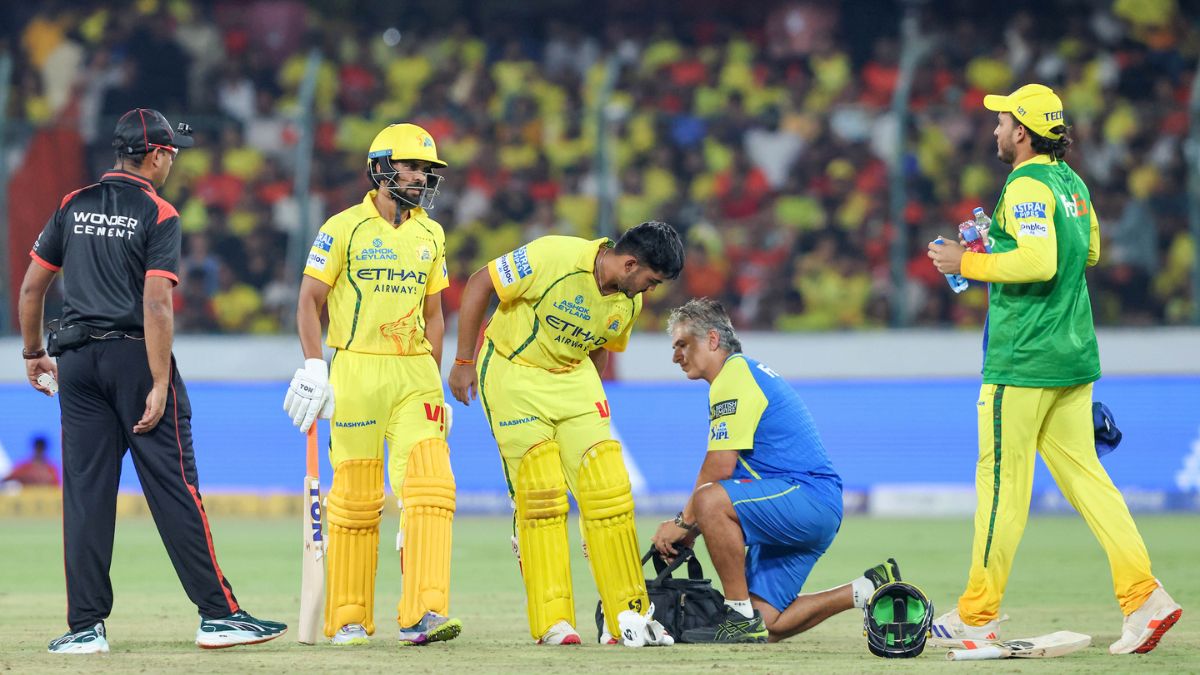
The Rajiv Gandhi International Stadium was buzzing as Chennai Super Kings (CSK) began their chase of 195 against Sunrisers Hyderabad (SRH). After the early loss of Sanju Samson, the spotlight shifted to the Impact Player and India U-19 World Cup-winning captain, Ayush Mhatre. The youngster looked like a man on a mission, racing to 30 off just 12 balls, but a split-second physical mishap and a questionable tactical choice have now sparked a massive debate: Should he have retired out?
The Moment of Crisis: Hamstring vs. Heroics
The drama unfolded in the 4th over. While pushing hard for a second run, Mhatre was seen hobbling and immediately clutching his left hamstring. The physio rushed out, the magic spray was applied, and for a few minutes, the game stood still.
At this point, CSK faced a critical crossroads. Mhatre was clearly struggling with his movement, unable to sprint or rotate strike freely. In a high-octane chase where every dot ball is a crime, the logical move—and one CSK has utilized before with tactical “retire outs”—was to bring in a fresh pair of legs like Shivam Dube or Dewald Brevis. Instead, Mhatre decided to soldier on.
The “Wrong” Decision and the Klaasen Blinder
The decision to stay proved fatal just balls later. Unable to use his lower body to generate power or adjust his footwork, Mhatre tried to muscle a delivery from Nitish Kumar Reddy.
- The Catch: The ball took a thick edge and flew toward Heinrich Klaasen.
- The Blinder: Klaasen, the man who had earlier smashed a 59 to set the target, pulled off a sensational diving catch to dismiss the hamstrung opener.
- The Damage: Mhatre departed for 30, and the momentum he had built vanished. Because he stayed on and got out, CSK lost a vital wicket and a set batter, whereas a “Retired Out” would have preserved the wicket for a later collapse.
Gaikwad’s “Fielding 50-50” and the Tactical Gap
This decision adds to a growing list of tactical head-scratchers for CSK this season. Earlier at the toss, skipper Ruturaj Gaikwad admitted the team’s fielding was “50-50,” but it seems the decision-making in the dugout might be facing similar inconsistency.
By allowing a visibly injured Mhatre to continue, CSK ignored the “team-first” philosophy that modern T20 demands. In a league where Ravichandran Ashwin has normalized retiring out for tactical gain, Mhatre’s choice to stay felt like an old-school move in a new-school game—and it cost Chennai dearly.