



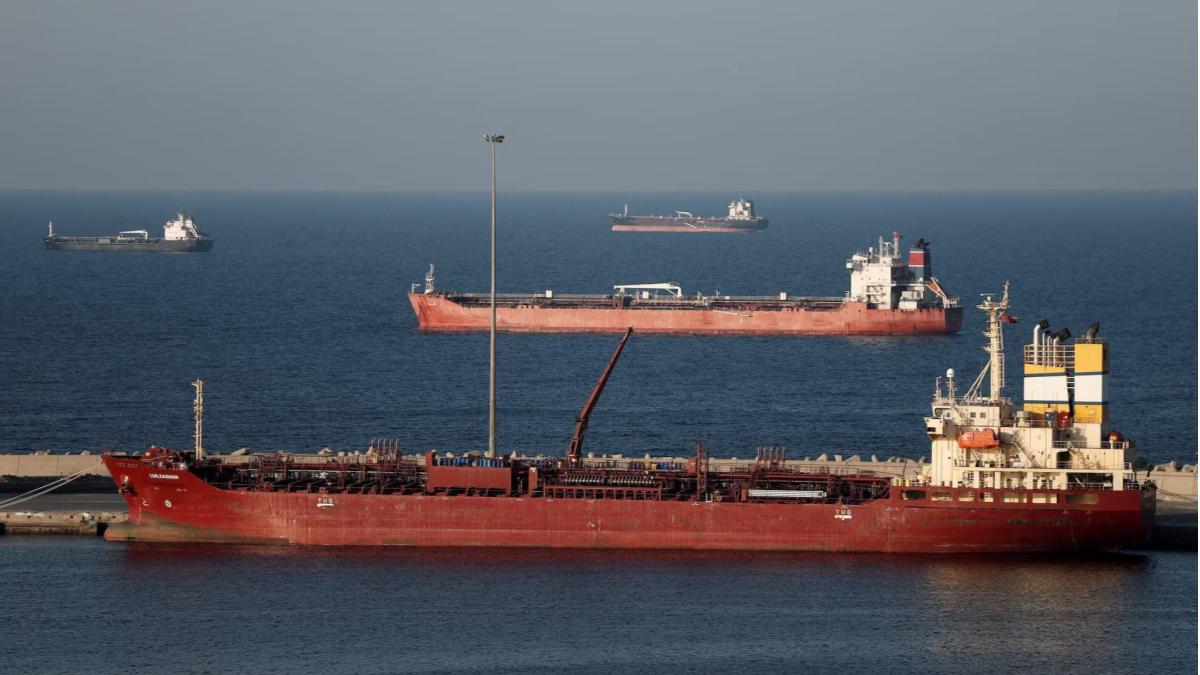
India’s annual crude import bill could rise by $8-10 billion if Houthi threats force Saudi oil tankers to avoid the Red Sea, adding a fresh supply risk alongside tensions around the Strait of Hormuz. The first operational response to the deteriorating security situation is already visible. According to MarineTraffic data, two crude tankers carrying Saudi oil for India and China have altered their planned voyages after departing Saudi ports.
The Singapore-flagged XIN LONG YANG, which left Yanbu on July 20 with Qinzhou in China as its declared destination, turned back in the Red Sea. The Liberia-flagged RODOS, which departed Al Muajjiz on July 20 carrying crude for New Mangalore, changed its declared destination to the Suez Canal earlier on Tuesday.
According to Kpler, traffic declined sharply at Bab el Mandeb down 34% to 29 amid a worsening security backdrop. Four confirmed U-turns near the Gulf of Aden indicate that ship operators are becoming increasingly cautious following Houthi threats against Saudi-linked shipping. Such diversions could delay crude deliveries to Asia by several weeks.
Escalating Freight Costs
India imports around 5.5 million barrels per day, with 40-45% sourced from West Asia. Hitesh Jain, strategist, institutional equities research at YES Securities, estimated that rerouting around the Cape of Good Hope would add 10-15 days and $0.75-2 a barrel to transport costs for a very large crude carrier carrying 2 million barrels. The increase could exceed $3 if tanker availability tightens.
War-risk insurance is surging. Jain said premiums for Hormuz transits had reached around 5% of vessel value in March, against a fraction of a percentage point in normal periods. For a $160-million tanker, that translates into $8 million per voyage.
The combined freight, insurance and security burden could raise India’s landed cost for West Asian crude by $1.5-3 a barrel under a base case and $3-5 under stress, Jain said. Every $1 increase adds $2-2.2 billion to India’s annual import bill; a sustained $4 rise could cost $8-10 billion.
Manas Majumdar, leader, oil and gas, fuels and resources at PwC India, estimated shipping costs could jump 50-80% as owners avoid risky routes, while alternative supplies from Russia, South America and Africa could add 15-20 days. War-risk premiums may rise two to three times, adding $2.5-5 million per VLCC voyage.
“For India these costs could lead to an addition of $2-4/bbl to the landed cost of crude,” Majumdar said, estimating $0.7-1 billion on the monthly import bill for every month the disruption continues. Higher gas and downstream costs could pressure the fertiliser subsidy, more than 40% of whose FY27 allocation has been used in one quarter.
Impact on Russian Crude Discounts
Praveen Rai, director at Grant Thornton Bharat, estimated that longer routes and elevated insurance could together add $6-8 a barrel in a severe scenario. War-risk premiums have risen to 3-10% of hull value from 0.25% before the conflict, he said.
Brent has crossed $90 a barrel. Experts said sustained disruption at both Hormuz and Bab el-Mandeb could push it above $100, with Majumdar flagging a $120 level.
Russian crude would become costlier as longer voyages tie up tankers and raise insurance and charter rates. Russia supplied nearly 50% of India’s crude in June. Rai said higher prices and logistics expenses could add as much as $2 billion to India’s monthly crude expenditure, while Jain warned that freight and insurance could absorb the Russian discount that has benefited refiners since 2022.