



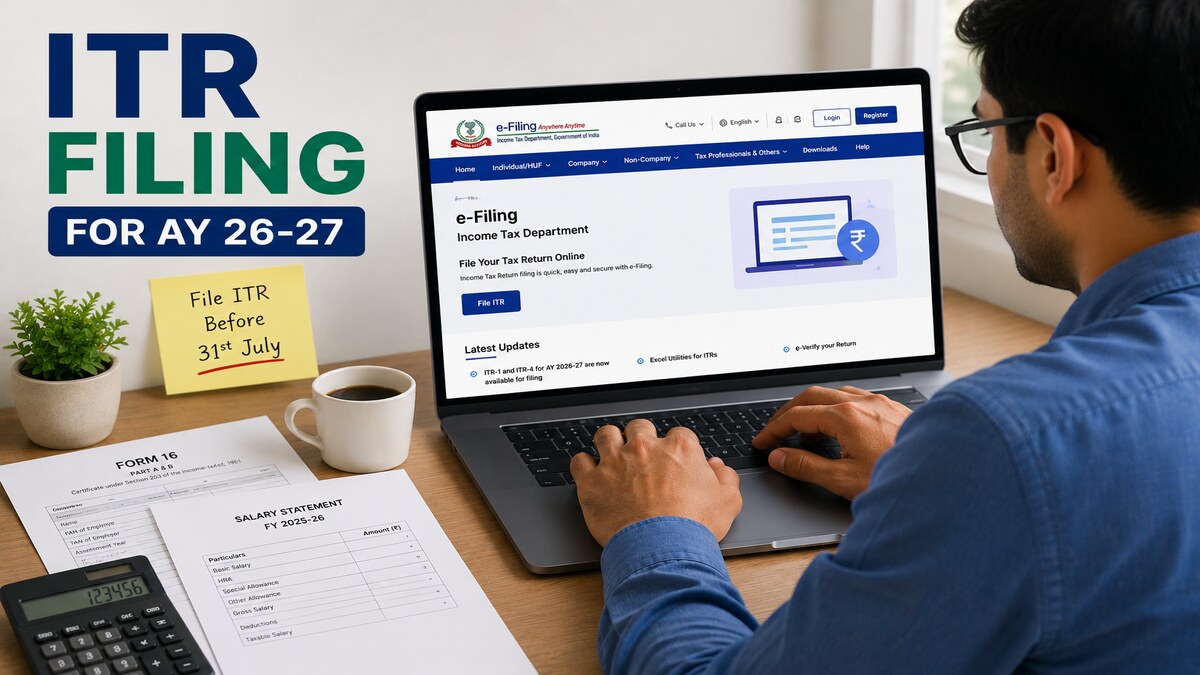
The rush to file Income Tax Returns is picking up, and so is the traffic on the income tax portal. As millions of taxpayers log in before the July 31 deadline, the government says it has upgraded the e-Filing portal to make it faster and more reliable. The changes were disclosed in Parliament by the Finance Ministry.
A member of Parliament named Shri Shyamkumar Daulat Barve has raised concerns over recurring technical glitches, data processing errors, and login failures on the portal, which he says have disrupted the filing process during the peak compliance season.
Questions have also been raised about whether the government is aware of these persistent issues and what technical or structural measures are being taken to address them.
Responding to these concerns in the Lok Sabha on July 20, Minister of State for Finance Pankaj Chaudhary said that the CBDT has implemented a series of technical and structural remediation measures to strengthen the e-Filing portal’s infrastructure and improve its performance during the peak ITR filing period.
The data of some significant activity on the Income-tax portal for the last week (8–14 July 2026) shows that the Income-tax portal has been seeing a steady surge in usage.
The biggest jump was seen in Income Tax Return (ITR) filing. On 8 July 2026, as many as 8,38,724 ITRs were filed, almost double the 4,26,961 returns filed on the same day in 2025. The momentum continued throughout the week, with filings crossing the 10 lakh mark on 10 July (10,41,223) and 11 July (10,87,871). The highest filing volume during the period was recorded on 14 July 2026, when 12,21,854 ITRs were filed, compared with 4,09,437 on the corresponding day last year.
The total daily activity reached 1,61,03,603 on 14 July 2026, compared with 95,33,552 on the corresponding day in 2025. On most days during the week, total portal activity remained well above 1.2 crore, whereas it stayed below 1 crore throughout the comparable period last year.
Overall, the figures indicate that taxpayer engagement with the Income Tax Department’s e-filing portal has increased significantly in 2026.
“Given the high scale of concurrent access in the peak filing period, some taxpayers may, at times, experience transient technical issues such as slower page response or intermittent delays during periods of peak concurrent load,” said the Finance Ministry.
“However, despite the substantial increase in load, e-Filing portal has been functioning in a largely stable and efficient manner during the ongoing peak filing period, with performance being monitored on a continuous basis through a dedicated Daily/Hourly Monitoring Dashboard tracking login, Income Tax Returns (ITRS) filed, Annual Information Statement (AIS)/Compliance Portal redirections, payment gateway status, error codes and other operational indicators. Any technical issue reported is taken up for time-bound identification, escalation and resolution,” the Ministry further clarified.
Key steps CBDT has taken
Higher filing capacity: The biggest upgrade is on the backend. CBDT said the portal has been performance-tested to process up to 1 crore returns in a single day, which is meant to reduce breakdowns and slowdowns during the July filing rush. This matters because the department saw sharply higher traffic this year, with logins and filings rising well above last year’s level.
More infrastructure and bandwidth: The portal has been strengthened with additional computing power, storage, memory, network capacity and internet bandwidth. In practical terms, that should help the site handle heavy peak-hour traffic better than before. The government also said earlier infrastructure issues have been fixed, which is a key reason for the current upgrade.
24×7 monitoring framework: A dedicated 24×7 monitoring framework has been set up, including a central War Room to track portal performance in real time. That means technical teams can respond faster if there is a slowdown, outage or login issue during peak filing days. For taxpayers, this should translate into quicker issue resolution and fewer prolonged outages.
Stronger cyber protection: CBDT has upgraded firewalls and stepped up protection against cyber and bot attacks. “This is important because filing season usually attracts heavy automated traffic and attempted abuse of the system. Better cybersecurity should improve stability and reduce the risk of malicious disruptions,” said CA Chandni Anandan, Tax Expert at ClearTax.
Coordination with ecosystem partners: The department has also coordinated with external agencies such as UIDAI, RBI, banks, CDSL, NSDL, ICAI and e-Return Intermediaries. That coordination is meant to keep PAN, Aadhaar, bank, depository and filing-linked services working smoothly together. For users, it should make identity verification, payments, and statement-linked filings more seamless, according to Anandan.
Portal remains largely stable despite surges: According to the Finance Ministry, the portal has mostly remained stable even when usage has spiked. On July 14, for example, filings crossed 12 lakh and total portal transactions touched around 1.61 crore. The message from CBDT is that the system has been upgraded to absorb this load without major disruption.
Penalties imposed on the managed service provider (MSP)
The Member of Parliament also sought details on whether any contractual accountability measures or financial penalties have been initiated against the Managed Service Provider (Infosys) for the prolonged non-functioning of the Income Tax e-filing portal and the recurring operational lapses that have affected its performance.
The Minister stated that, in accordance with the contractual provisions, the following penalties were imposed on the concerned Managed Service Provider (MSP):
As per the original project timeline, the Managed Service Provider (MSP) was required to deploy the IEC 2.0 project, under which the Income Tax Department’s e-Filing portal forms a key component of the Integrated e-Filing and Centralized Processing Centre (IEC) 2.0 project, by July 2020 for taxpayer use. However, the MSP failed to deliver the project within the stipulated timeframe. Consequently, the Government imposed liquidated damages on the MSP as a contractual penalty for the delay in project implementation.
The performance of the Managed Service Provider (MSP) responsible for the IEC 2.0 project is primarily assessed through Service Level Scores (SLS), which evaluate various performance parameters, including instances of prolonged system downtime and operational deficiencies. The Service Level Scores are reviewed on a quarterly basis, and based on these evaluations, the Government has imposed penalties on the MSP for 12 quarters due to its failure to meet the prescribed performance benchmarks.
Under the terms of the contract, the Managed Service Provider (MSP) is obligated to ensure that the Income Tax Department’s e-Filing portal consistently meets the prescribed application performance standards and to minimise service disruptions, particularly during the peak ITR filing season. However, due to application outages during the peak filing period in FY 2025–26, the Government imposed contractual penalties on the MSP in accordance with the applicable provisions of the agreement.
Under the terms of the contract, the Managed Service Provider (MSP) is liable to pay a penalty if the statutory due date for filing Income Tax Returns (ITRs), or any other pre-notified deadline, is extended due to reasons attributable to the MSP. Accordingly, a penalty was imposed on the MSP during FY 2025–26 for delays that resulted in the extension of the prescribed timelines.
Disclaimer: This article is for informational purposes only and does not constitute professional tax advice. Tax laws and regimes are subject to frequent changes by the government. Readers should verify details with official Income Tax Department notifications or consult a Chartered Accountant before making any financial decisions.
Every financial journey has a turning point. What’s yours?
Financial Express is launching a new series highlighting real experiences with money, investments, and the taxman. Did a sudden tax rule catch you off guard? Did a piece of financial advice change your life? Your story could provide invaluable, practical lessons for thousands of fellow taxpayers. Share your experience with us. We respect your privacy: no stories will be featured without a direct conversation and your full consent. Thank you.