
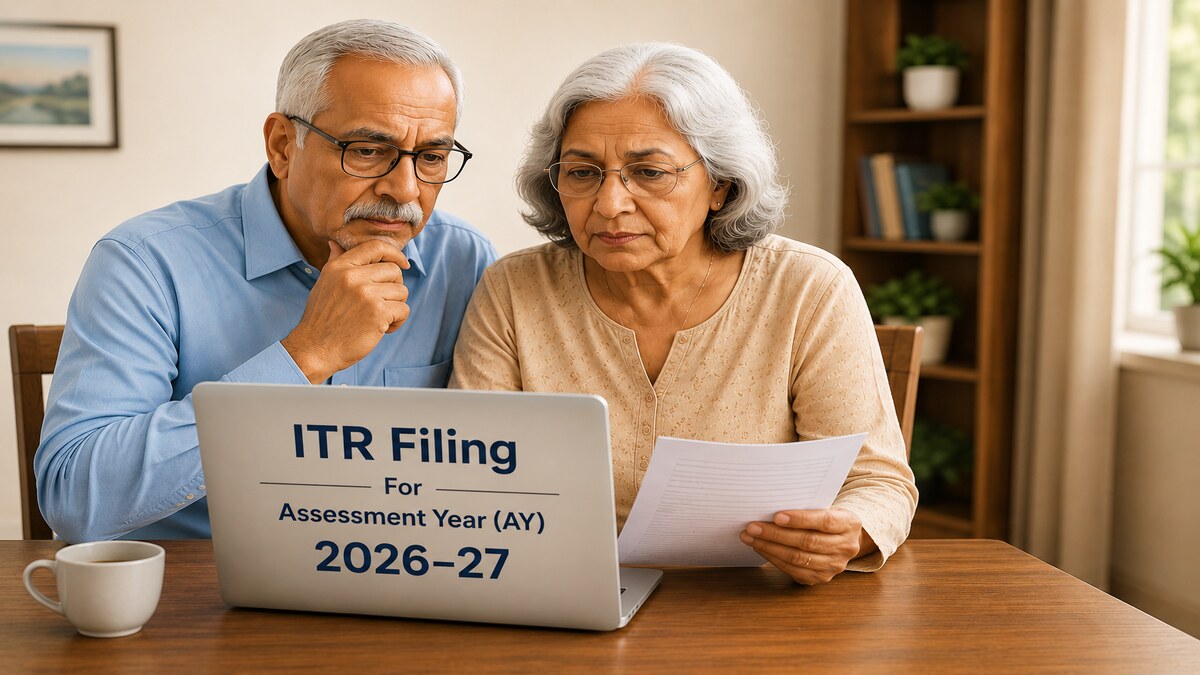
Many retirees stop filing their Income Tax Return (ITR) once their income falls below the taxable limit, assuming there is no longer any need to do so.
But that’s not always the right approach. Even if you don’t have to pay any tax, filing an ITR can still offer several financial and legal benefits.
Before deciding to skip your return for the Assessment Year (AY) 2026-27 (FY 2025-26), here’s why it may be worth filing one.
Old vs new tax regime: Income tax slabs for senior citizens
For senior citizens (aged 60–79 years)
| Income Tax Slab (Old regime) | Income Tax Rate |
| Up to Rs 3,00,000 | Nil |
| Rs 3,00,001 – Rs 5,00,000 | 5% above Rs 3,00,000 |
| Rs 5,00,001 – Rs 10,00,000 | Rs 10,000 + 20% above Rs 5,00,000 |
| Rs 10,00,000 | Rs 1,10,000 + 30% above Rs 10,00,000 |
| Income Tax Slab (New regime) | Income Tax Rate |
| Up to Rs 4,00,000 | NIL |
| Rs 4,00,001 – Rs 8,00,000 | 5% above Rs 4,00,000 |
| Rs 8,00,001 – Rs 12,00,000 | Rs 20,000 + 10% above Rs 8,00,000 |
| Rs 12,00,001 – Rs 16,00,000 | Rs 60,000 + 15% above Rs 12,00,000 |
| Rs 16,00,001 – Rs 20,00,000 | Rs 1,20,000 + 20% above Rs 16,00,000 |
| Rs 20,00,001 – Rs 24,00,000 | Rs 2,00,000 + 25% above Rs 20,00,000 |
| Above Rs 24,00,000 | Rs 3,00,000 + 30% above Rs 24,00,000 |
For super senior citizens:
| Income Tax Slab (Old regime) | Income Tax Rate |
| Up to Rs 5,00,000 | NIL |
| Rs 5,00,001 – Rs 10,00,000 | 20% above Rs 5,00,000 |
| Rs 10,00,001- Rs 50,00,000 | Rs 1,00,000 + 30% above Rs 10,00,000 |
| Income Tax Slab (New regime) | Income Tax Rate |
| Up to Rs 3,00,000 | NIL |
| Rs 3,00,001 – Rs 7,00,000 | 5% above Rs 3,00,000 |
| Rs 7,00,001 – Rs 10,00,000 | Rs 20,000 + 10% above Rs 7,00,000 |
| Rs 10,00,001 – Rs 12,00,000 | Rs 50,000 + 15% above Rs 10,00,000 |
| Rs 12,00,001 – Rs 15,00,000 | Rs 80,000 + 20% above Rs 12,00,000 |
| Rs 15,00,001- Rs 50,00,000 | Rs 1,40,000 + 30% above Rs 15,00,000 |
| Rs 50,00,001- Rs 100,00,000 | Rs 1,40,000 + 30% above Rs 15,00,000 |
| Rs 100,00,001- Rs 200,00,000 | Rs 1,40,000 + 30% above Rs 15,00,000 |
| Above Rs 200,00,001 | Rs 1,40,000 + 30% above Rs 15,00,000 |
Note: The tax-free limit under the default new regime is set at Rs 4 lakh, while Section 87A rebates of Rs 60,000 effectively make income up to Rs 12 lakh tax-free. In contrast, under the old tax regime, resident senior citizens could receive a tax rebate of up to Rs 12,500 provided their net taxable income was less than Rs 5 lakh.
No tax liability? Benefits of filing ITR for retirees
Even where the total income is below the taxable limit, filing an ITR helps recover any excess tax deducted by banks on interest income, preserves the right to carry forward capital losses from investments and creates a documented record of income that can be useful while applying for loans, visas or other financial products.
It also helps reconcile information appearing in the Annual Information Statement (AIS) and Form 26AS, thereby reducing the likelihood of future queries arising from reporting mismatches.
Equally important, filing a return ensures that retirees do not inadvertently forgo deductions or exemptions that they are otherwise entitled to claim.
Many senior citizens continue to earn interest income, incur significant medical expenses or receive a pension alongside investment income, and an annual return provides the opportunity to claim these benefits correctly while reviewing whether the old or new tax regime is more tax-efficient.
Consequently, many retirees with modest pension and interest income may not have a mandatory filing obligation if their gross total income remains within the applicable threshold and none of the specified filing conditions are triggered.
Another important distinction is the special relief under section 194P, which is often misunderstood. It does not exempt every taxpayer above the age of 75 from filing an ITR.
The exemption is available only where very specific conditions are satisfied, such as receiving only pension and interest from the same specified bank, furnishing the prescribed declaration and allowing the bank to compute and deduct the tax.
The moment a retiree has rental income, capital gains, multiple bank accounts or any additional source of income, this relaxation may cease to apply.
“Retirees should evaluate their filing obligation each year based on the composition of income rather than age alone. A regularly filed ITR also creates continuity in tax records, which becomes valuable when a property is sold, investments are redeemed or legal heirs need to establish the tax history of inherited assets,” said Akhil Chandna, Partner, Global People Solutions Leader, Grant Thornton Bharat.
Applicable ITR forms
The applicable return form depends entirely on the nature of income and investments rather than retirement status.
Retirees receiving only pension, interest income and income from a single eligible house property can generally file ITR-1, provided they satisfy the prescribed conditions.
However, once they have income from the sale of shares, mutual funds or immovable property, multiple house properties, foreign assets or foreign income, ITR-2 ordinarily becomes the appropriate form.
Those continuing with consultancy assignments, professional practice or business activities after retirement may have to file ITR-3 or ITR-4, depending upon the manner in which such income is taxed.
Equally important is maintaining proper documentation. In practice, retirees often underestimate the value of retaining tax records because they assume their affairs are simple. However, even a future property sale or scrutiny may require evidence relating to earlier years.
Some key records include:
* Pension payment statements or Form 16 issued by the pension disbursing authority.
* Interest certificates from banks and post offices.
* Form 26AS, AIS and TIS for reconciliation of income and taxes deducted.
* Capital gains statements issued by brokers, mutual funds or depositories.
* Medical insurance premium receipts and other deduction-related documents.
* Property purchase and sale documents wherever applicable.
* Copies of earlier ITRs and computation of income.
Maintaining these records ensures consistency in future tax filings and significantly reduces the effort involved in responding to departmental queries.
Mistakes to avoid
One of the biggest mistakes retirees make is missing the opportunity to claim refunds where banks have deducted tax at source on fixed deposit interest despite the final tax liability being nil. Unless an ITR is filed, recovering such excess tax becomes difficult.
Another practical issue arises with investments. Many retirees redeem mutual funds or sell shares to meet post-retirement expenses. Where such transactions result in capital losses, failure to file the return within the prescribed due date may permanently deprive them of the right to carry those losses forward for adjustment against future gains.
Perhaps the most overlooked advantage is continuity of financial records.
“Regular ITR filing creates a documented history of income, investments and tax positions, which proves valuable while applying for loans, obtaining visas, claiming inheritance-related tax benefits or explaining high-value transactions before the tax authorities,” says Chandna.
From a practical perspective, retirees should view ITR filing not merely as a statutory obligation but as an annual financial health statement. Even where filing is voluntary, the long-term compliance and documentation benefits often outweigh the minimal effort involved.
Disclaimer: This article is for informational purposes only and does not constitute professional tax advice. Tax laws and regimes are subject to frequent changes by the government. Readers should verify details with official Income Tax Department notifications or consult a Chartered Accountant before making any financial decisions.
Every financial journey has a turning point. What’s yours?
Financial Express is launching a new series highlighting real experiences with money, investments, and the taxman. Did a sudden tax rule catch you off guard? Did a piece of financial advice change your life? Your story could provide invaluable, practical lessons for thousands of fellow taxpayers. Share your experience with us. We respect your privacy: no stories will be featured without a direct conversation and your full consent. Thank you.


