



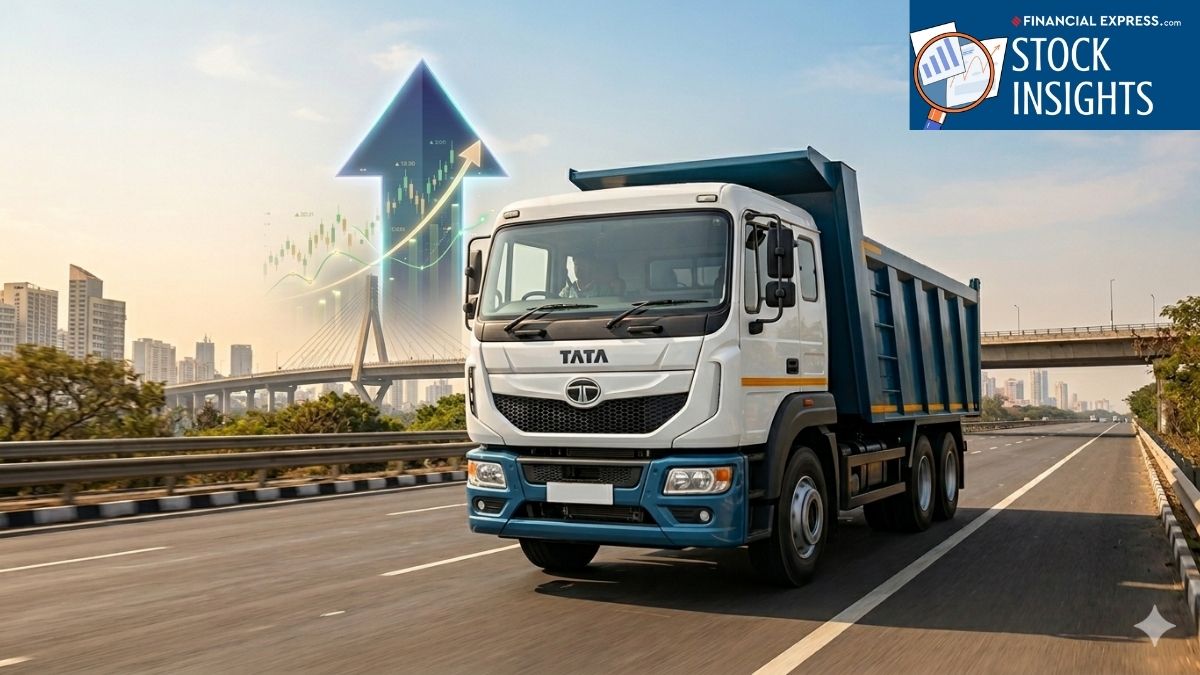
The March 2026 quarter results of Tata Motors were keenly awaited in a bid to understand the strength of the revival in the commercial vehicles segment. In addition, commercial vehicles sector, which transports daily essentials like fruits / vegetables along with materials needed for infrastructure development, like cement and steel, amongst other critical inputs, provides vital information on the broader trends in the Indian economy.
That’s because CV vehicle sales are often a ‘mirror’ to study the cyclical nature of infrastructure development and business activity in a country.
As a result, the sales trend in commercial vehicles is also often used by analysts and economists as one of the tools to measure the level of economic activity in the country, and specifically in Q4FY26 when the broader Indian economy has been reeling from the economic impact of the Middle East crisis.
Of equal importance, investors are keen to understand how Tata Motors dealt with surging input costs, especially steel and copper, amongst others, in the March 2026 quarter.
Q4 Review: Revenue Hits Rs 24,452 Cr as Margins Defy Metal Price Hikes
Tracking operational performance of Tata Motors in the March 2026 quarter
| Vehicle sales growth (% change y-o-y) | Standalone net sales growth (% change y-o-y) | Net profit growth (% change y-o-y) | |
| March 2026 quarter | 25% | 22.3% | 69.6% |
| December 2026 quarter | 20.7% | 19.7% | -60% |
Commercial vehicle segment has continued to benefit from the various measures taken by the RBI and the central government to boost economic activity in the country, and in the March 2026 quarter the sector did not face any headwinds from the Middle East crisis.
The GST Tailwinds: Why HCV Trucks Saw 29% Growth
For instance, there has been a reduction in loan / credit rates and the rehauling of GST rates, respectively. Specifically, the GST on trucks, buses and commercial vehicles was reduced to 18% from the earlier 28%, from 22 September, 2025.
The cumulative effects of these policy measures are visible in Q4FY26 – Tata Motors total CV sales grew 25% y-o-y to 1.32 lakh units in the quarter under review, and it was driven by a 29% y-o-y growth in heavy commercial vehicles (HCV trucks).
However, its domestic market share was at 35.7% in the commercial vehicles segment at the end of FY26 as against 37.1% a year earlier, as per its investor presentation.
The company benefited from strong demand for its recently launched models, Ace Pro and Winger 9S, and the new Azura range of commercial vehicles in Q4FY26.
The company also highlighted while declaring its sales volume for March 2026 quarter, that they were highest in the fourth quarter of a financial year over the past 5 years.
For perspective, the Mumbai-based player’s sales grew 20.7% y-o-y to 115,577 units in the December 2025 quarter.
Strong vehicle sales in the March 2026 quarter helped Tata Motors’ standalone revenue from operations rise 22.3% y-o-y to Rs 24,452 crore.
Nearest rival, Ashok Leyland, has not yet informed the bourses on the schedule of its board meeting for declaring its results for Q4FY26.
Managing a rising cost structure with cost cuts in Q4FY26
The broader auto industry has had to deal with higher input costs, especially surging metal prices in the March 2026 quarter.
The company benefited from employee expenses as a percentage of standalone revenue from operations declined nearly 110 basis points y-o-y to 4.5% in the March 2026 quarter. Also, other expenses as a percentage of standalone revenue fell nearly 160 basis points y-o-y to 12% in Q4FY26.
The above cost cutting measures helped Tata Motors offset higher metal input costs and its core standalone operating profit margin rose nearly 150 basis points y-o-y to 12.4% in Q4FY26.
Also, standalone net profit surged 69.6 % y-o-y to Rs 2,406 crore in the March 2026 quarter.
The company’s core auto business in India is reflected in the standalone quarterly results of Tata Motors.
In the December 2025 quarter, the company had offset higher input costs, and its operating profit margin grew 170 basis points y-o-y to 11.7% in Q3FY26.
The demerger of the erstwhile Tata Motors entity in two entities, had taken place with effect from July 1, 2025.
Growth plans – will the upturn in CV sector continue amidst Middle East crisis
Tata Motors had recently launched 17 trucks in different segments of commercial vehicles.
In April 2026, Tata Motors reported a buoyant 28% y-o-y growth in its monthly sales to 34,833 units, and still no impact of Middle East crisis was visible.
However, Prime Minister Modi, a few days earlier had called for moderation in usage of petroleum products in the country. And while no specific policy measures have been announced for the petroleum and broader auto sector, investors are keeping a close eye on government announcements and growth prospects of the broader auto sector, going forward.
Investors will also continue to monitor metal input costs, and the ability of Tata Motors and other leading players in the industry to manage rising input costs, going forward.
The company in July, 2025, had acquired Italy-based Iveco’s commercial vehicle business for nearly €3.8 billion (approximately Rs 38,200 crore), and it is currently in the process of obtaining all regulatory approvals. The above acquisition, once completed, will enable Tata Motors to significantly grow its presence in Europe, Middle East and Africa.
Valuation Gap: Tata Motors vs. Ashok Leyland
The recently listed Tata Motors has a negative return on equity (RoE), according to Screener.in, and it is expected to see a sharp improvement in its performance on this parameter as its operations stabilise
For Ashok Leyland, it had a RoE of 31.4 % for FY26, according to Screener.in.
The March 2026 quarter results of Tata Motors were declared after the close of Tuesday trade. Tata Motors ended Tuesday trade 0.9% lower at Rs 383.7.
The stock had hit a 52-week low of Rs 306 on 14 November, 2025.
Tata Motors trades at a standalone P/E of more than 75. An alternative way to value CV companies is on the valuation matrix – enterprise value (EV) to EBITDA.
For the newly listed Tata Motors it is about 15.9 times based on FY26 standalone results.
For Ashok Leyland, it trades on a standalone P/E of 24.6, according to Screener.in, and over the past 5 years it has traded in a range between 19.4 times and 111 times.
Ashok Leyland trades on the valuation matrix, – enterprise value (EV) to EBITDA, at nearly 24.6 times for the first 9 months of FY26.
Readers can put Tata Motors on their watchlist of stocks for 2026, and will also need to monitor the situation carefully in the Middle East, any possible government measures in response to the crisis and the resulting growth prospects for the broader commercial vehicles segment.
Disclaimer:
Amriteshwar Mathur is a financial journalist with over 20 years of experience.
The writer and his family have no shareholding in any of the stocks mentioned in the article.
Disclaimer: The website managers, its employee(s), and contributors/writers/authors of articles have or may have an outstanding buy or sell position or holding in the securities, options on securities or other related investments of issuers and/or companies discussed therein. The content of the articles and the interpretation of data are solely the personal views of the contributors/ writers/authors. Investors must make their own investment decisions based on their specific objectives, resources and only after consulting such independent advisors as may be necessary.