




Building a strong and successful stock portfolio involves several key steps. It starts with defining clear investment goals, choosing a strategy that suits your personal preferences, and staying actively engaged with both the market and your investments.
Drawing insights from experienced investors and adopting their proven strategies can also be immensely beneficial.
A prominent figure worth noting is Madhusudan Kela, a widely respected investor whose market choices often command considerable attention.
Who is Madhusudan Kela?
Known for his ability to identify quality companies with strong growth prospects, Madhusudan Kela is one of the most well-known and seasoned investors in the Indian stock market, with extensive experience of over 27 years.
He prefers a value investing style and has a long-term investment horizon.
Which Stock Did Madhusudan Kela Buy and Why?
Madhusudan Kela has picked stake in microcap stock Aptech.
According to the latest shareholding pattern for March 2026, investor Madhusudan Kela now holds a 1.1% stake in the company. His holding in the company is now valued at Rs 53 million (m).
He held no stake in the company earlier. While the reasons for his hike remain unclear, here a few a few points that can explain the decision.
#1 Good Financial Performance
The company has been reporting good numbers for the last few quarters. Revenues at the company for Q3 FY26 grew to Rs 1,371 m from Rs 1,102 m YoY.
The net profits of Aptech were placed at Rs 86 m vs Rs 36 m year-over-year. These good Q3 numbers may have led Madhusudan Kela to pick a stake in the stock.
#2 FIIs Stake Increases
FIIs have been gradually hiking stake in Aptech. Their shareholding has gone up from 0.39% in Sept 2025 to 0.66% in March 2026 quarter.
FII Holding
| Period | Sept 25 | Dec 25 | March 26 |
| % holdings | 0.39 | 0.58 | 0.66 |
This could also be one of the reasons for Madhusudan Kela to pick a stake in the company.
What Next?
India continues to face a significant skill gap, especially in areas like IT, animation, VFX, AI, and aviation services. With rising youth population and employability concerns, demand for job-oriented courses remains strong.
Aptech is well-positioned in this niche because it focuses on vocational, job-ready training, unlike traditional universities. Government initiatives like Skill India and increasing private sector demand for trained manpower could provide long-term tailwinds.
Additionally, Aptech’s presence in emerging sectors like media & entertainment and aviation gives it exposure to industries expected to grow structurally over the next decade.
Aptech has operated for decades and built brands like Arena Animation and MAAC, which still have recall in skill-based education.
However, traditional training faces disruption from online platforms. Growth will depend on scaling enterprise contracts and adapting to digital learning.
How Shares of Aptech Have Performed?
In the past five days, Aptech stock has gained from Rs 79.69 to Rs 88.69.
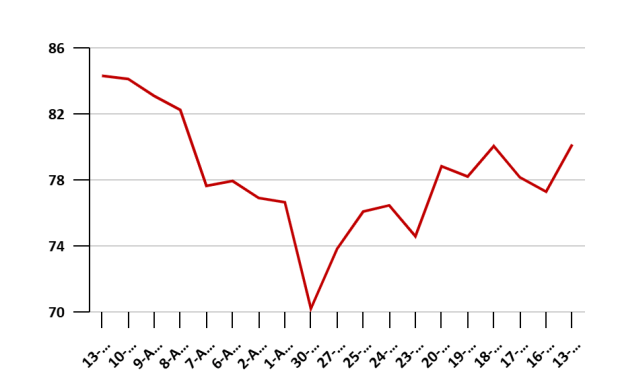
The stock touched its 52-week high of Rs 182.4 on 12 May 2025 and its 52-week low of Rs 69.5 on 30 March 2026.
Aptech Share Price 1 – Month
Date source: NSE
About Aptech
Aptech is an Indian vocational training company focused on skill development and career-oriented education. It offers courses in IT, animation, aviation, banking, and more through brands like Arena Animation and MAAC.
The company operates largely via a franchise model and also provides corporate training and testing services. With a global presence, Aptech benefits from rising demand for employability skills, though execution and regulatory risks remain important considerations for investors.
Happy investing.
Disclaimer: This article is for information purposes only. It is not a stock recommendation and should not be treated as such. Learn more about our recommendation services here…
The website managers, its employee(s), and contributors/writers/authors of articles have or may have an outstanding buy or sell position or holding in the securities, options on securities or other related investments of issuers and/or companies discussed therein. The content of the articles and the interpretation of data are solely the personal views of the contributors/ writers/authors. Investors must make their own investment decisions based on their specific objectives, resources and only after consulting such independent advisors as may be necessary