



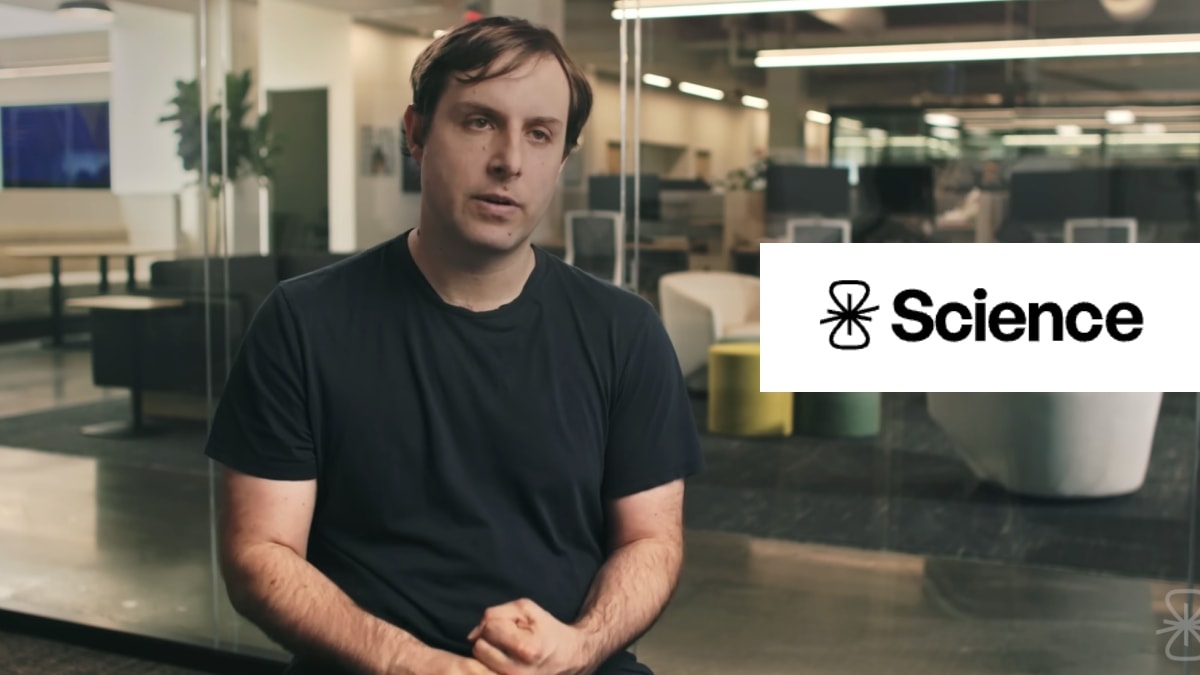
When it comes to Brain Computer Interface (BCI), Elon Musk’s Neuralink is the prominent name that comes up almost instantly. The firm has had success with human brain implants, promising to change the way humans interact with digital interfaces. Max Hodak was one of the many biomedical engineers in Neuralink working on the technology, but he had a different goal. For almost two decades, Hodak wanted to create reliable, high-bandwidth links between the human brain and machines, ones that felt natural.
An avid skydiver and licensed pilot, Hodak had an appetite for high-risk, high-reward innovative projects. Hence, he parted ways with Neuralink and went on to start a journey that’s now on the verge of giving him success.
Hodak, the CEO of the $1.5 billion neurotech startup, called Science Corporation, is preparing to implant its first biohybrid brain sensor in a human patient later this year.
‘The Matrix’ inspired his fascination
Hodak’s journey began in fifth grade after watching the iconic sci-fi thriller, ‘The Matrix’. “I didn’t know if we lived in a simulation,” he told TBPN on a podcast, adding, “but I was certain we were going to build one.” Born in 1990, Hodak graduated from Duke University’s Pratt School of Engineering in 2012 with a degree in biomedical engineering.
As a freshman, he found his way into the elite Nicolelis Lab – one of the world’s top brain-computer interface (BCI) research groups, despite it being reserved for graduate students. While finishing his degree, he commuted between North Carolina and Silicon Valley while working as a full-time software engineer. It is said that he flew on an average of 128,550 miles per year – such was his dedication.
Early career: From Transcriptic to Neuralink
Fresh out of college, Hodak co-founded Transcriptic (which later became Strateos) in 2012, a robotic cloud laboratory that automated life sciences experiments. He served as CEO for five years before stepping down in 2017 and co-founded Neuralink with Elon Musk.
As Neuralink’s President from its inception through early 2021, Hodak essentially ran day-to-day operations as the company raced to develop implantable BCIs for paralysis and beyond. He has called the experience “the ultimate PhD.”
However, Hodak’s exit is often termed as controversial, with many of his ex-colleagues hinting that his relations with Musk became tainted, as reported by Fortune. Hence, in 2021, he parted ways with Musk’s firm.
Although he didn’t publicise the reason, he stated later that he wanted to work on a biohybrid approach that avoids brain damage and associated risks. “Electrodes are a crude solution,” Hodak said in an interview with TechCrunch. He went on to add that inserting anything mechanically into the brain causes tissue damage.
While that trade-off may be justified for patients with severe conditions like spinal cord injury or blindness, he argues it ultimately prevents the system from scaling to millions or billions of channels, which could be the fundamental limit of approaches like Neuralink’s.
Founding Science Corp and the biohybrid bet
In 2021, Hodak launched Science Corporation in Alameda with backing from entrepreneur Jed McCaleb and others. The company’s thesis is simple yet radical – use lab-grown neurons as a biological bridge between electronics and the brain.
Science Corp acquired the PRIMA retinal implant from Pixium Vision in 2024 and has pushed it through clinical trials for restoring vision in patients with advanced macular degeneration. In March 2026, the startup closed a $230 million Series C funding, bringing total funding to roughly $490 million at a $1.5 billion valuation. It now employs about 150 people.
Today, Science is ready for its next milestone – placing its first brain sensor in a human under the guidance of Yale neurosurgery chair Dr Murat Günel. The pea-sized device contains 520 recording electrodes and sits on the surface of the cortex rather than penetrating tissue. Initial implants will go into patients already undergoing brain surgery (such as stroke victims).
Future versions will embed lab-grown neurons that integrate naturally with the patient’s brain, potentially halting the progression of diseases like Parkinson’s.
Günel, who joined as scientific adviser after two years of talks, called the biohybrid concept “genius.” Human trials could begin as early as 2027.
Building a future of choice
Hodak presents an optimistic vision for his take on BCI in the coming years. “By 2035, biohybrid neural interfaces will be broadly available for patients who need them. And that will begin to reshape the world in surprising ways,” he told TechCrunch.
He also expects the technology to keep improving, the procedures to become safer, and the benefits to become more dramatic. Over time, he believes that the patient base will grow, and by the late 2040s, the technology could be “quite ubiquitous.”
In Hodak’s view, the real inflection point comes around 2035, when he predicts, “patient number one gets the choice of: you can die of pancreatic cancer, or you can be inserted into the matrix, and then it accelerates from there.”