



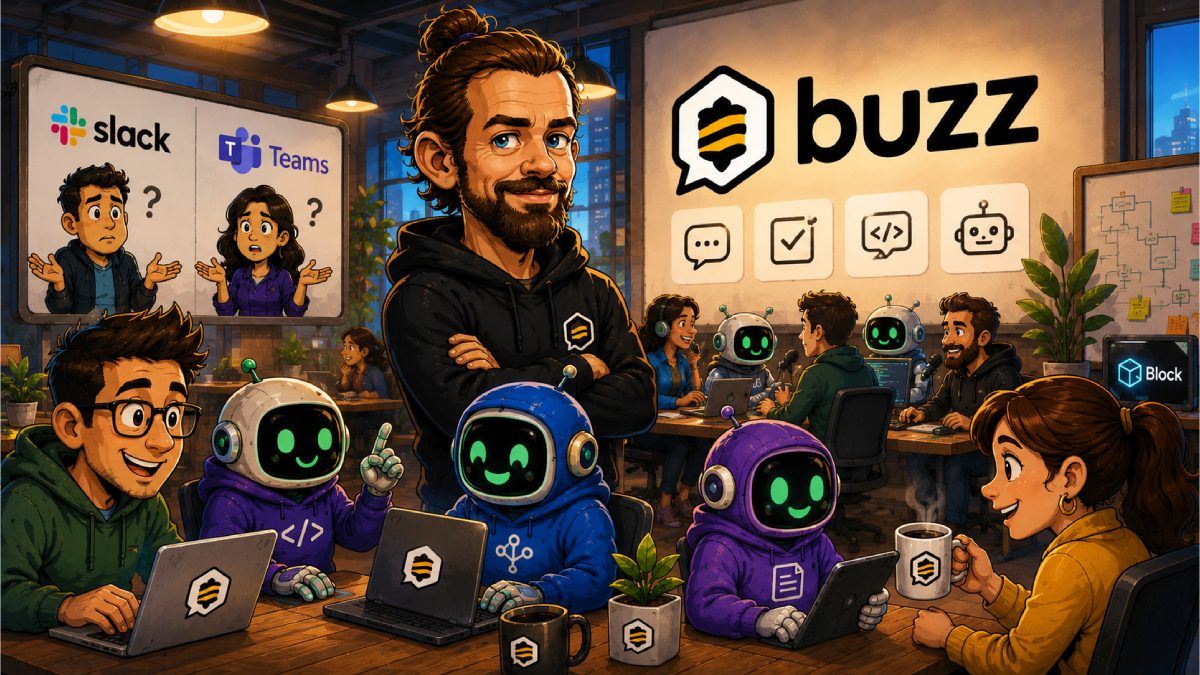
Jack Dorsey, the serial entrepreneur who was in charge of Twitter previously, is now challenging workplace collaboration giants Slack and GitHub with a new platform. Called Buzz, Dorsey presents it as a new open-source platform designed from the ground up for a world where AI agents work directly alongside human teams.
Developed by Jack Dorsey‘s Block (formerly Square), Buzz aims to eliminate fragmented agentic AI workflows by uniting team messaging, project management, code repositories, and AI orchestration into a single decentralised environment.
Think of it as an office space where you share your desk with human colleagues and AI agents, all working together in harmony.
Dorsey frames Buzz as a tool to “reduce our dependency on Slack and GitHub,” calling it a “model-agnostic, decentralised, self-sovereign, and open-source” group chat platform built for teams and AI bots of all sizes.
How Buzz differs from Slack, MS Teams
Platforms like Slack, Microsoft Teams, and Discord have spent the past two years adding AI bots and automated assistants as secondary integrations. Buzz, however, treats AI as a primary team member.
In Buzz, AI agents are not hidden behind slash commands or side panels, but operate as active, named participants in team channels. They can monitor ongoing discussions, maintain workspace context, surface documentation, generate pull requests, and automatically execute multi-step developer workflows.
Some of the key features driving the new platform include:
– Combined threaded group chat, direct messaging, voice channels, and Git-based code hosting into a single client.
– Teams can plug in specialised AI agents using any underlying model (open-weight or proprietary) to handle specific tasks like automated bug fixes, code reviews, or document summaries.
– Organisations can host Buzz on their own infrastructure, ensuring that proprietary conversations, codebases, and corporate data remain entirely under their control.
‘Slack’s real challenger’: How the internet reacts
Dorsey, who is no stranger to building communication platforms (he co-founded Twitter and stepped down as the CEO in 2011), shared his latest creation with the tech community on X. The response to the surprise launch was swift, with many developers and industry observers expressing excitement over a credible open-source challenger to Slack. Early adopters on X praised the platform for blending team communication with autonomous workflows. One user noted, “Humans and agents sharing the same rooms, workflows and signed audit trail, without being tied to one model or hosted platform, feels like a genuinely new primitive. Slack may finally have a real challenger. Testing this immediately.”
Another early tester highlighted how the platform changes the nature of software development. “I’ve been buzzing a lot lately, it’s unlocked 2 big changes in my agentic building workflow: 1/ it automates having agents of different kinds review & improve each others’ work 2/ it turns vibecoding into a social experience. This is how i want to build everything now,” he added.
Other prominent tech figures agreed, with builder Ben noting, “This might be the first project with a shot to take on Slack.”
Another user pointed out early issues with the UI, stating, “Looks cool, but too complicated to figure out for the average user. Tried messing around with this for a couple hours and the setup and UI is very confusing. How do you add other users to be an admin to a community? I saw a screen at one point that let me do this, then it disappears from the app.”
However, technical forums like Hacker News also saw robust debate regarding the operational hurdles of multiplayer AI agents. Users raised security and privacy considerations, pointing out that organisations will need to implement careful access controls to prevent multi-agent environments from inadvertently leaking sensitive data across shared channels.