



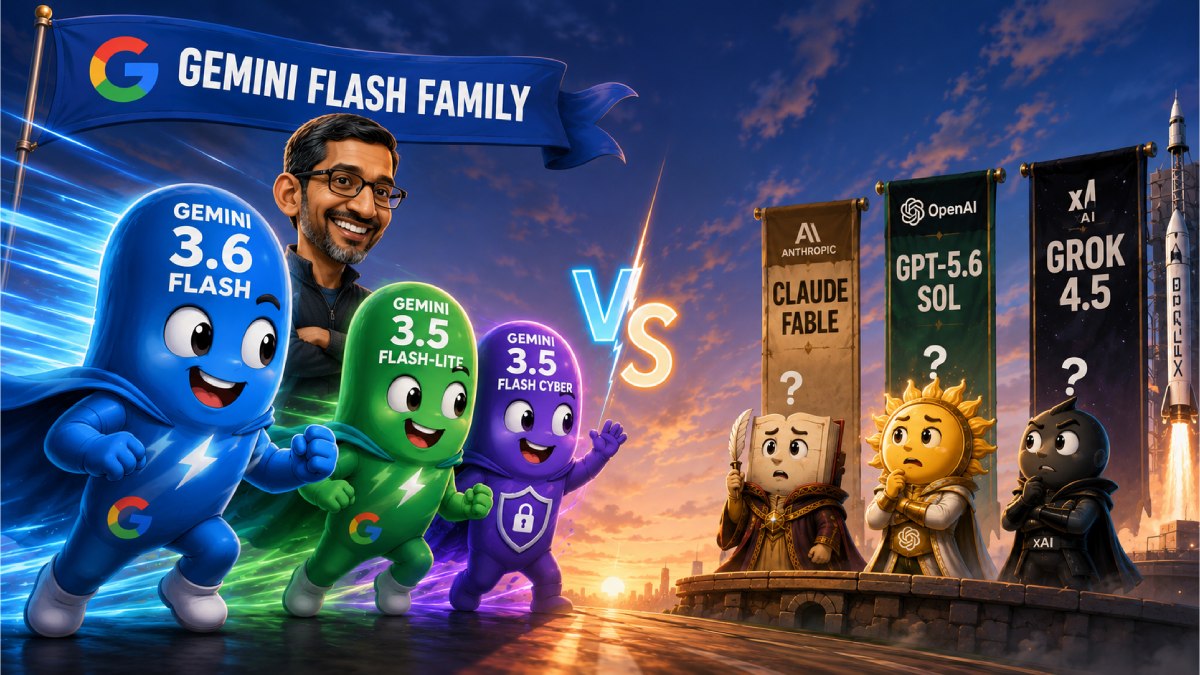
Google has responded to the latest salvo of AI releases with a lineup of ‘flashy’ new models. Rather than leading with a heavy, frontier-scale update to challenge competitors like OpenAI and Anthropic head-on, the latest upgrades to the Gemini Flash family target daily developer utility, cost-efficiency, and deployment speed. With Gemini 3.6 Flash, Gemini 3.5 Flash-Lite, and Gemini 3.5 Flash Cyber, Google is doubling down on fast, agentic workflows and domain-specific security.
The new Gemini Flash model suite prioritises production-ready tool integration and lower token overhead for enterprise applications rather than a frontier-class deeper integration. However, the announcement also skips any announcement on Google’s flagship Gemini 3.5 Pro – Google’s long-anticipated flagship model revealed at I/O 2026, which was expected to release in mid-2026.
New Google Gemini models released
Rather than rolling out a single heavyweight model, Google is standardising high-speed, highly optimised architectures designed to make running complex AI agents significantly cheaper and faster. Let’s start with Gemini 3.6 Flash:
Gemini 3.6 Flash: The efficient workhorse
Positioned as the flagship workhorse model for general-purpose developer tasks, Gemini 3.6 Flash brings upgrades to coding, multi-step planning, and visual/multimodal reasoning. Tests from Artificial Analysis show 3.6 Flash uses up to 17 per cent fewer output tokens compared to 3.5 Flash to accomplish identical tasks, with output reductions reaching up to 65 per cent on complex software engineering benchmarks like DeepSWE.
Google says the model requires fewer intermediate reasoning steps and tool calls, reducing execution loops and latency during long-horizon tasks. The model is priced at $1.50 per million input tokens and $7.50 per million output tokens, reducing total cost per task while delivering higher precision.
Gemini 3.5 Flash-Lite: Speed for high-volume processing
Designed specifically for high-throughput and latency-sensitive applications, like real-time agentic search and automated document processing, Gemini 3.5 Flash-Lite sets a new baseline for speed. Clocking in at up to 350 output tokens per second, Flash-Lite is presented as the fastest option in the 3.5 family.
The model is available at $0.30 per million input tokens and $2.50 per million output tokens, making it a good alternative for processing massive streams of data. Google says it outperforms its predecessor (Gemini 3.1 Flash-Lite) across agentic benchmarks, including SWE-Bench Pro and terminal-based coding tests.
Gemini 3.5 Flash Cyber: Claude Mythos on a smaller scale
Google also released Gemini 3.5 Flash Cyber as a custom-built model to detect and patch software vulnerabilities in real-time. It is embedded directly into CodeMender, Google’s autonomous code security agent, to automatically repair security flaws before they can be exploited. While Claude Mythos acts like a heavy-duty, elite security researcher performing deep-dive audits, Gemini 3.5 Flash Cyber behaves like a high-speed, lightweight defensive agent integrated directly into the daily software development lifecycle.
Due to the dual-use risks in vulnerability discovery models, Google is restricting Flash Cyber to a limited-access pilot for governments and verified security partners instead of offering it as a general API release.
But where is Gemini 3.5 Pro?
While the new Gemini Flash family of AI models promises to tackle the needs at a lower scale, the questions around Gemini 3.5 Pro, Google’s upcoming flagship AI model, still linger. Originally teased at Google I/O with an expected mid-year timeline, Gemini 3.5 Pro’s absence from the launch puts Google vulnerable to competitors like OpenAI and Anthropic, who have been pushing out frontier updates.
Google confirmed that Gemini 3.5 Pro is actively undergoing partner testing and will launch as soon as performance targets are met. On the other hand, the team has already kicked off initial pre-training for its next generation, Gemini 4.