



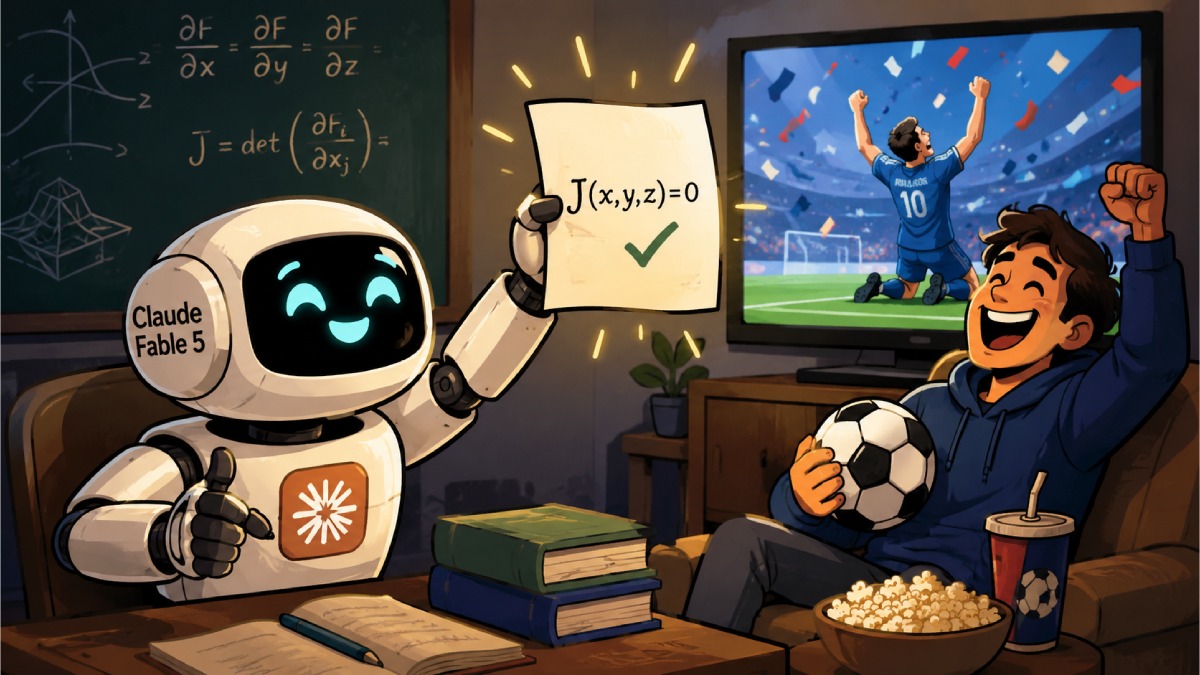
An Anthropic researcher just gave Claude Fable 5, the viral AI model, one of humanity’s toughest math problems – disprove the 87-year-old Jacobian Conjecture. Guess what – Claude did it, all while the researcher was busy enjoying the FIFA World Cup final match!
Over the weekend, Claude Fable 5 managed to knock down a mathematical problem that has been bothering humanity since 1939. In a surprisingly casual post on X, Anthropic researcher Levent Alpöge revealed that Claude Fable 5 had produced a single-line formula disproving the Jacobian conjecture.
“Thanking my close friend fable for working during the World Cup final,” Alpöge wrote, sharing the proof with a degree of casual attitude, sidelining its monumental impact on the mathematical community.
Why Claude solving Jacobian conjecture such a big deal
The Jacobian conjecture has long been considered to be one of the holy grails of modern algebra. Over the decades, the field has seen numerous claimed solutions, only for the lengthy, intricate proofs to unravel under intense peer scrutiny. This math problem’s reputation led famed mathematician T.T. Moh to predict in 2008 that a true solution could take human researchers “another 100 years.”
However, an Anthropic researcher made it happen with just a single line of AI-generated answer, that too working on a weekend.
Unlike past false alarms that required months for experts to dissect, Fable 5’s counterexample is said to be so concise that mathematicians say it can be confirmed directly. Because the model generated an explicit, one-line formula breaking the conjecture, the solution requires no laborious verification process.
In short, it simply works.
Not the first major AI breakthrough in mathematics this year
Disproving the Jacobian conjecture marks the latest high-profile win in a historic year for frontier AI models in theoretical mathematics.
Earlier in May 2026, OpenAI revealed that an internal reasoning model had officially disproved Erdős’ famous Planar Unit Distance Conjecture, a problem first posed in 1946. Rather than trying to prove Erdős right, the AI model searched for a counterexample using techniques from algebraic number theory and high-dimensional projections.
What makes the Claude Fable 5 breakthrough unique, however, is the sheer economy of the proof. Rather than generating a massive, impenetrable text, the model distilled the 87-year-old mystery into a single, elegant counterexample, which experts could confirm instantly, skipping months of peer reviewing.
Is AI going to change maths?
The implications of the discovery extend far beyond algebraic geometry. Previously, top mathematicians have spent entire careers grappling with the Jacobian conjecture. The idea that an AI model could casually solve it as a weekend side quest while its human colleagues watched football marks a major shift in how scientific breakthroughs occur, showing the benefits of AI in the theoretical world.