



The Employees’ Provident Fund Organisation (EPFO) has introduced the VISHWAS 2026 Scheme, a one-time settlement window available for six months from 29th June 2026 to help establishments resolve pending cases related to penal damages.
When employers fail to submit EPF contributions on time, they are penalised with these damages. If the dispute is still unresolved at any point, the employer may apply under VISHWAS 2026. This covers situations in which a final damages order has been issued, but recovery has not yet been completed, or in which a damages order has previously been passed and the case is still continuing before a court or tribunal.
Regardless of the circumstances, the scheme only covers disputes over damages under Section 128 of the Code on Social Security, 2020 or Section 14B of the EPF Act.
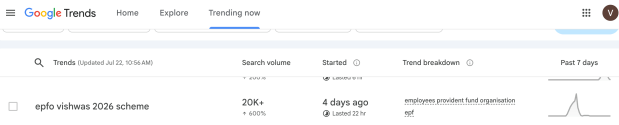
The scheme covers a wide range of cases involving Section 14B penal damages. Employers can opt for the scheme if they have ongoing litigation against Section 14B orders, penalties that have already been assessed but remain unpaid, or cases where only a Section 14B notice has been issued. It also extends to pre-adjudication cases where notices are yet to be issued.
“VISHWAS, 2026 has been introduced with the objective of promoting voluntary compliance, reducing litigation, and enabling speedy resolution of long-pending disputes relating to penalty/damages while safeguarding the interests of employees,” the labour ministry said in a release.
Employers are required to use the EPFO Employer Portal to submit an application and authenticate it using an e-sign or Digital Signature Certificate (DSC). Before submitting an application, employers must pay any interest due under either Section 127 of the Code on Social Security, 2020 or Section 7Q of the EPF Act.
After the application is granted, the amount payable under the scheme must be paid within 15 days from the date of approval.
Reduced penal damages under the scheme
A key feature of the VISHWAS 2026 Scheme is the substantial reduction in penal damages. Instead of the standard Section 14B penalty rates, damages will be recalculated using the following graded structure:
- 0.25% per month for payment defaults of less than two months.
- 0.50% per month for defaults of two months to less than four months.
- 1% per month for defaults of four months or more.
The EPFO says the scheme offers several advantages beyond lower penalties. Employers can settle litigation that has remained pending for years, resolve unpaid Section 14B dues, and complete compliance through a fully digital and transparent process.
The recalculation of damages is carried out using system-generated data, reducing manual intervention. Once payment is completed, EPFO issues a digitally signed VISHWAS certificate, which can be submitted before the court or the Central Government Industrial Tribunal (CGIT) to facilitate the withdrawal or closure of pending cases.
Key takeaway
Where an employer has previously paid some of the damages, EPFO will recalculate the damages at the concessional rates prescribed under the plan.
The recalculation of damages is carried out using system-generated data, reducing manual intervention. Once payment is completed, EPFO issues a digitally signed VISHWAS certificate, which can be submitted before the court or the Central Government Industrial Tribunal (CGIT) to facilitate the withdrawal or closure of pending cases.
Through this initiative, EPFO aims to promote voluntary compliance, reduce litigation, and strengthen trust between employers and the provident fund authorities.
Disclaimer: This article is for informational purposes only and should not be construed as investment advice. Investors should assess their financial goals, risk appetite and consult a qualified financial advisor before making investment decisions.
Every financial journey has a turning point. What’s yours?
Financial Express is launching a new series highlighting real experiences with money, investments, and the taxman. Did a sudden tax rule catch you off guard? Did a piece of financial advice change your life? Your story could provide invaluable, practical lessons for thousands of fellow taxpayers. Share your experience with us. We respect your privacy: no stories will be featured without a direct conversation and your full consent. Thank you.