



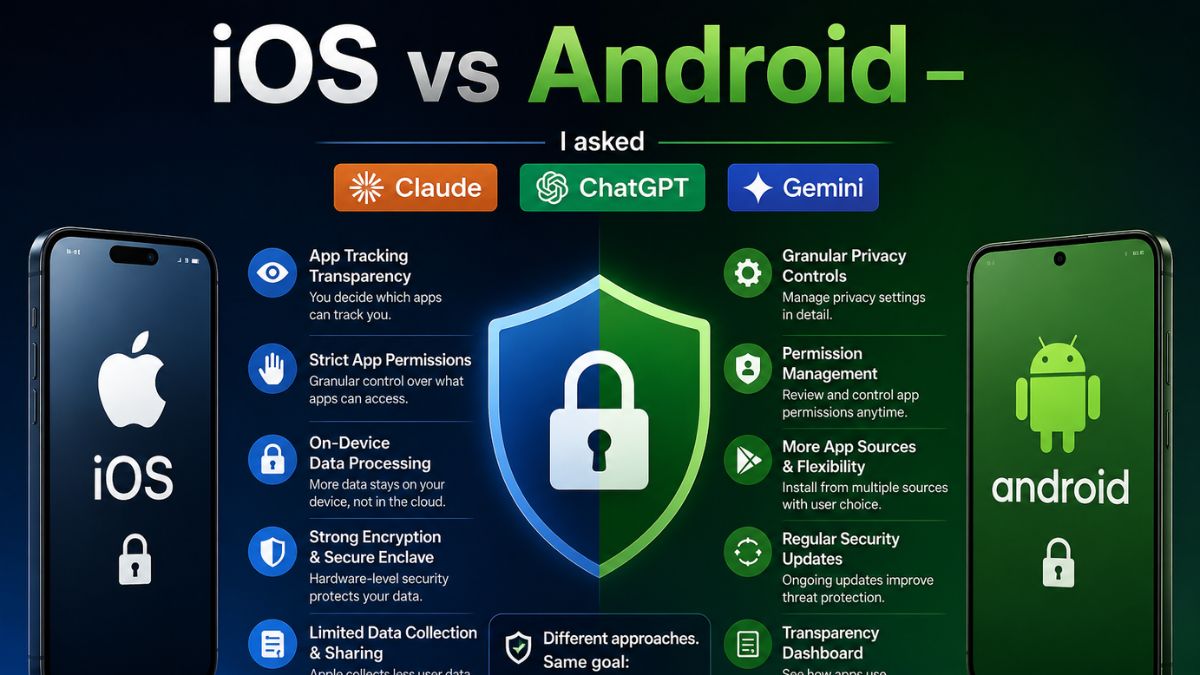
The debate over whether Android or iOS offers better data privacy has been raging for over a decade, and it ultimately comes down to a fundamental trade-off between convenience and control. To settle the debate on whether Android or iOS is better for your privacy, we decided to put the question to ChatGPT, Gemini and Claude. While the AI chatbots provided a neatly balanced breakdown of security patches and permission settings, the reality for everyday users is far more straightforward.
Choosing between these two operating systems isn’t just about picking a brand; it’s about choosing which corporate business model you trust with your personal life. If you want a device that locks down your data straight out of the box, one platform clearly takes the lead, but if you want the freedom to micromanage your own digital perimeter, the other might surprise you.
Here’s what ChatGPT had to say about privacy on Android and iOS:
iOS vs Android:
According to ChatGPT, control by users over their personal information is the main reason why iOS is considered to be a better option for users.
The operating system works without transferring personal information to the cloud and instead processes everything locally, which increases security. Moreover, there are such useful features as Mail Privacy Protection, iCloud Private Relay, and App Privacy Reports, which allow a person to get more information about how his or her data is processed.
“Since Apple derives most of its profits through hardware sales and subscriptions, the company does not depend as much on data collection as Google does. This means that privacy becomes an important selling feature for Apple and helps it maintain high-end consumer products and premium-priced software,” ChatGPT noted.
Meanwhile, data collection represents an integral part of Google’s business model since it derives considerable profits from advertisements. Although Google offers privacy settings and information about what data the company collects, some customers may find the whole process too complicated.
Security and privacy:
Privacy and security are related concepts, and both of the mentioned platforms fare well here. Updates that contain security updates are delivered to Apple devices directly.
The process may be a little different in the case of Android since manufacturers may have their own updates for the system. Google devices (Pixel), however, receive the updates rather fast, but delays on some Android devices might mean being open to certain threats for some time.
Those users who value privacy the most and want it without any trouble should choose iOS since it ensures maximum privacy at all times.
However, in terms of Android smartphone manufacturers take care of privacy a lot and with proper use of apps.
ChatGPT’s take:
Ultimately, the choice comes down to convenience versus control. iOS wins on pure privacy by making data protection a seamless, passive experience. Apple’s absolute control over its hardware and App Store keeps trackers away without requiring you to lift a finger. Android, conversely, offers privacy through personal sovereignty.
If you are willing to dive into deep settings menus and manually configure app permissions, Android gives you the exact tools needed to build a digital fortress tailored to your terms.
Here’s what Gemini had to say about privacy on Android and iOS:
Android vs iOS
Apple offers privacy as an added feature because revenue from premium devices and services drives its business model. Being independent of targeted marketing to stay in business, Apple is able to offer you an easy “Do Not Track” setting that blocks all third-party advertisements.
In essence, Google is an advertising company. Even though the Android system is a great innovation for free technology access, by default, it enables Google to track everything about you for better targeted advertising purposes.
Security and Privacy
However, people tend to use security and privacy interchangeably when talking about keeping their smartphones safe from any outside threats. Both these systems are highly secure. Nonetheless, when it comes to your privacy, they operate differently.
“Firstly, Apple uses a reactive strategy by implementing such features as App Tracking Transparency, which makes all applications prompt you before they collect information about you. Additionally, iOS stores any sensitive information on your device only, processing it on your phone’s local hardware. Such in-built solutions as Mail Privacy Protection and iCloud Private Relay make iOS seem like an attentive guard who locks up your house right upon your arrival,” Gemini noted.
“Secondly, Android uses a more proactive strategy since it allows you to control your privacy by yourself. Since it is open-source software, this system lets you do anything. At the same time, it makes privacy your own responsibility. Android provides a system-wide Privacy Sandbox along with the most intricate privacy permission menus that allow managing your settings precisely for a certain application. Although Android’s default configuration collects a lot of information about you automatically, it lets you maintain full privacy by yourself,” it added.
Gemini’s take:
In essence, the decision to use Android or iOS devices is not choosing a brand but rather a balance between ease of use and control.
If the need for seamless privacy is the main objective, then iOS is the winner. This is due to the total control that Apple maintains across its ecosystem, thus ensuring privacy through a protective system without the need for any additional effort from the end-user.
“However, when the ability to customize and control outweighs everything else, Android devices will be an option, provided you can manage some legal processes. If you are an advanced user who does not shy away from exploring the device and setting up everything on your own, there will be nothing stopping you from creating an impenetrable security fortress,” Gemini concluded.
Here’s what Claude had to say about privacy on Android and iOS:
iOS vs Android:
iOS is a closed ecosystem controlled entirely by Apple, which designs both the hardware and software. This gives Apple tight control over what runs on the device.
Android, by contrast, is open-source and fragmented — Google develops the core OS, but hundreds of manufacturers customize it, and update timelines vary widely. This fundamental difference shapes everything about how each platform handles privacy.
Security and Privacy:
The main difference between Apple and Google approaches is that Apple doesn’t rely on advertising as the primary source of revenue but sells hardware; therefore, your data is never the product. Apple uses a strict app review in App Store, blocks sideloading by default, and enforces ATT (App Tracking Transparency) for asking your permission to track activity in other apps and websites.
As per Claude, data stored in iCloud, especially for such sensitive information as Health data, messages, and Keychain, is fully end-to-end encrypted. Updates for operating systems are applied to all supported devices simultaneously. Apple uses more and more on-device technologies for Siri and photo processing, decreasing the amount of transmitted data.
Although Google has made some great changes to its operating system since Android 12–15, such as permissions auto-reset, a privacy dashboard, and approximate location sharing, Google still makes money through advertising; thus, collecting personal data is an integral part of its business model. Fragmentation of the system results in many Android devices using outdated OSes for years. Google’s Play Store is not as curated as Apple’s App Store, and there is pre-installed “bloatware” on many OEM phones harvesting your data.
Claude’s take:
For most people, iOS wins on privacy — and it’s not particularly close. Apple’s incentive structure genuinely aligns with privacy (hardware revenue, not ad revenue), ATT has measurably reduced third-party tracking, and the uniform update pipeline means security patches actually reach users.
“Android can match or beat iOS privacy, but only in the hands of a technically sophisticated user running a Pixel with a hardened ROM or carefully configured stock Android with Google services minimized. Out of the box, on a mid-range Samsung or similar device, the average user has less privacy protection meaningfully,” Claude concluded.
Final Verdict:
If you want immediate peace of mind without having to become an overnight IT expert, iOS is the undisputed winner. Apple treats privacy like a luxury utility; they build the fences, lock the gates, and keep data brokers out from the exact second you unbox the phone. You pay a premium for the hardware, and in return, you get a seamless, hands-off digital bodyguard that works entirely in the background.
On the flip side, Android is perfect for people who want complete control over their tech. When you first turn on an Android phone, it automatically tracks a lot of your data to help power Google’s massive advertising business.
However, if you are willing to spend a little time exploring the advanced settings, turning off default tracking, and deciding exactly what access your apps have, Android hands all the power over to you. It won’t automatically protect your data, but it gives you all the tools you need to build a highly secure phone exactly the way you want it.