



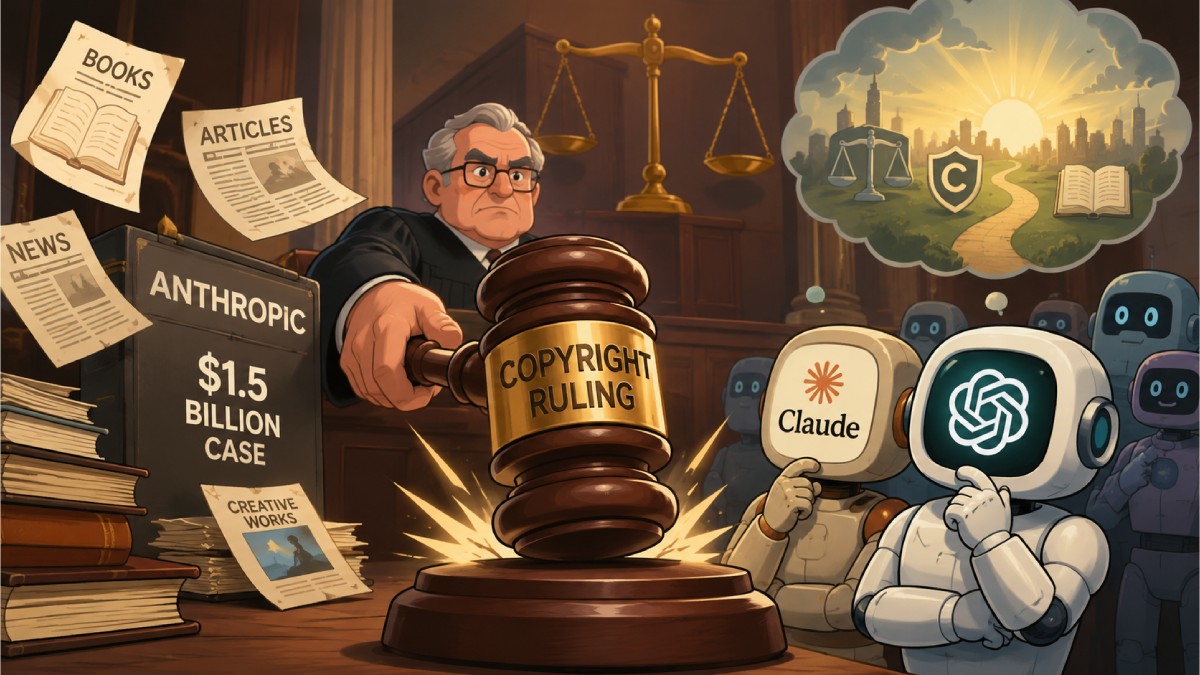
The US Court has finally issued a settlement in the landmark case involving Anthropic and a group of book authors, directing the maker of Claude Fable 5 to pay $1.5 billion in settlement (as per US Court filings published by Reuters). US District Judge Araceli Martínez-Olguín granted final approval to the class-action settlement between Anthropic and a group of book authors, resulting in the AI firm paying a hefty fine. The AI industry, however, celebrated the decision, marking how future AI models will be trained on copyrighted data.
Let’s understand the settlement first:
What Anthropic did wrong: To make its Claude AI chatbot smarter, Anthropic downloaded around 480,000 digital books (as per US Court filings published by Reuters). The problem arose when the trainers downloaded these books from illegal “pirate” sites on the internet instead of buying them or licensing them legally.
The court’s decision: The judge ruled that downloading pirated books is illegal piracy, which is why Anthropic is paying $1.5 billion. However, the judge also ruled that having an AI read books to learn grammar, vocabulary, and human concepts is totally legal under ‘fair use’, just like a human student reading books at a library to learn how to write.
The fine: Anthropic is paying about $3,000 for every book it illegally downloaded (as per US Court filings published by Reuters). That money gets split between the authors and publishers who owned those books.
Why Anthropic is happy about the decision: While Anthropic had to pay a massive fine for the illegal downloads, it won a bigger battle that will fetch it a fortune in the long run – courts officially agreed that AI models reading text to learn isn’t illegal. As long as AI companies buy or license their data properly from owners now on, their models are safe.
The judgement separated ‘training’ from ‘piracy’
Plaintiffs, led by authors Andrea Bartz, Charles Graeber, and Kirk Wallace Johnson, argued that Anthropic infringed on hundreds of thousands of copyrighted works by feeding them into Claude. Crucially, the books had been sourced from illegal online shadow libraries like Library Genesis (LibGen) and Pirate Library Mirror.
The case, however, swung dramatically in Anthropic’s favour when the court established a groundbreaking legal ruling:
Training AI is ‘fair use’: Feeding written text into a model to make the neural network learn underlying linguistic structures, grammar, and concepts is transformative, qualifying as ‘fair use’ under US copyright law.
Pirating the source material is infringement: Acquiring those books by downloading illegal torrents from pirate repositories violates copyright protection.
By separating the method of ‘data acquisition’ from the ‘act of model training’, the court dismissed the biggest legal threat facing generative AI companies.
Hence, AI models do not violate copyright simply by learning from text. The law cares about how you obtained the text, not that your AI read it.
Major outcomes from the $1.5 bn resolution
A record-breaking $1.5 billion figure
Anthropic will pay $1.5 billion—marking the largest copyright class-action recovery in legal history—to resolve all pending claims in a single stroke.
Almost 5 million works covered
The agreement contains approximately 482,000 registered book titles that were allegedly scraped and ingested into Anthropic’s early training runs.
A $3,000 payout per work
Those holding rights and authors are set to receive between $3,000 and $3,100 per affected title, delivering an unusually high direct cash distribution for a class-action settlement.
Complete destruction of illicit files
Anthropic is legally mandated to purge and destroy all original pirated source files obtained from shadow libraries within 30 days.
Strict independent compliance auditing
The company must submit to independent third-party verification to guarantee that future iterations of Claude are trained exclusively on clean and verified datasets.
What this means for the future of AI
The resolution of the case creates a clear playbook for how the multi-trillion-dollar AI industry will operate going forward.
1. ‘Fair Use’ for AI training
With ‘fair use’ upheld, the fundamental engine driving modern Large Language Models (LLMs) remains legally sound. AI companies can continue training their model on publicly available work, provided they pay the licensing fee.
2. No unchecked scraping
The $1.5 billion fine for Anthropic signals to the rest of the industry that harvesting data from unverified or illegal internet repositories carries devastating financial liability. Data hygiene and provenance tracking are now core engineering requirements for AI.
3. Data licensing boom begins
With the legal boundaries clearly defined now, tech leaders are expected to double down on formal licensing deals. Media organisations, book publishers, and stock photography platforms will see an influx of high-value licensing contracts as AI companies seek “audit-proof” training data.
4. A benchmark for pending AI lawsuits
The Anthropic settlement sets a benchmark for similar pending copyright litigation cases targeting OpenAI, Meta, Microsoft, and Midjourney. Competitors now have a clear price tag for resolving legacy data liabilities without risking their underlying technology.