



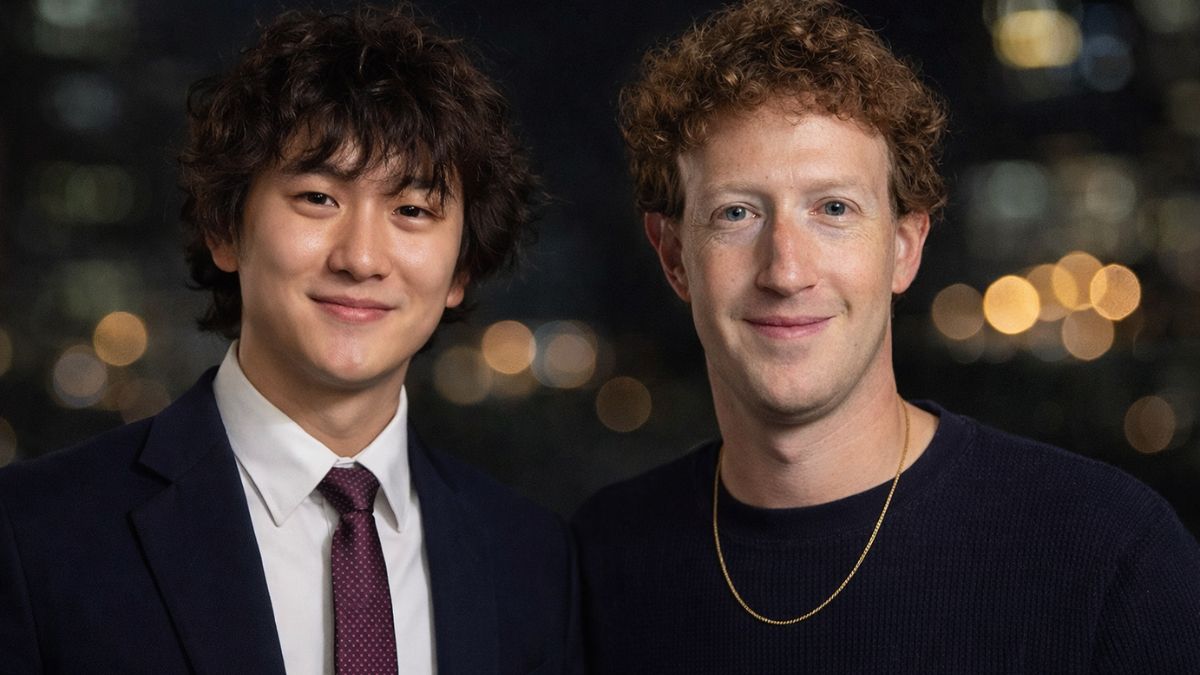
Meta’s aggressive push into artificial intelligence has been facing questions as reports suggest friction inside the company. The focus is on CEO Mark Zuckerberg and Alexandr Wang, who was recruited to help lead Meta’s next phase of AI development.
The move drew widespread attention in 2025 when Zuckerberg hired Wang, best known for building Scale AI, and paired the appointment with a $14.3 billion investment in the company. The deal underscored Meta’s push to beef up its AI capabilities and compete more aggressively in a fast-moving industry.
At just 28, Wang stepped into one of the most high-profile roles in technology. He was given responsibility for guiding Meta’s AI strategy and leading Meta Superintelligence Labs, a division created to advance the company’s long-term artificial intelligence goals. His arrival was widely seen as a signal that Meta was betting on fresh leadership and new ideas to accelerate innovation across its AI efforts.
Wang’s achievements:
Wang oversaw the creation and launch of Muse Spark, a model developed under the internal project name Avocado. By choosing not to release it as open-source software, Meta signaled a new direction focused on building revenue-generating products and expanding its commercial technology offerings.
After Meta completed its investment in Scale AI, Wang directed the integration and execution efforts tied to the partnership. He also introduced a new team structure, dividing research operations into focused groups with specific objectives to streamline decision-making and accelerate product development.
Wang took on a leading public-facing role for Meta, representing the company at major global forums and technology conferences. During these appearances, he discussed topics such as computing infrastructure, large-scale data management, and strategies for advancing national technology ecosystems.
He was also responsible for creating MSL and shaping its organizational framework. The division was structured to attract experienced researchers, support ambitious long-term projects, and strengthen collaboration between foundational research teams and product-focused groups.
The Tussle between Zuckerberg and Wang:
Reports from the Financial Times hint that the relationship has not been entirely smooth. Wang privately expressed concern that Zuckerberg’s hands-on approach to running the company was too restrictive, according to people familiar with the matter. The reports said he felt the level of executive involvement was preventing teams from moving quickly and experimenting freely.
The reported friction comes after a period of significant changes within Meta’s AI organisation. Some employees also questioned whether Wang’s experience running a fast-growing startup fully prepared him for managing large-scale research and engineering teams inside a global technology giant.
Meta sharpens its focus on advanced AI:
Meta’s restructuring efforts have continued as the company sharpens its focus on advanced artificial intelligence. According to reports from The New York Times and Business Insider, several engineering teams that previously fell under Wang’s oversight are being reassigned as part of a broader organisational overhaul.
The changes affect groups responsible for infrastructure, training data systems, and strategic internal projects, including initiatives known as Avocado and Mango. Sources familiar with the matter say the restructuring is tied to the creation of a new applied engineering division that will concentrate on converting AI breakthroughs into products and features used across Meta’s platforms.
The newly established unit will reportedly be led by Maher Saba, a senior executive from Reality Labs, the division responsible for Meta’s virtual reality hardware and smart-glasses projects.
Behind the restructuring are differing views about Meta’s future priorities. People close to the discussions say Wang has pushed for stronger investment in foundational AI capabilities to help Meta compete more directly with industry leaders such as Google and OpenAI. Other senior executives, including Chris Cox and Andrew Bosworth, have reportedly emphasized bringing AI-powered features to products that already reach billions of users, including Facebook and Instagram.
The debate reflects a broader strategic question facing many technology companies: to spend resources on long-term breakthroughs in core AI technology or to focus on building consumer products that can deliver immediate impact.
Is Wang leaving Meta?
There is no evidence that Wang is leaving the company despite the internal changes. The changes are intended to strengthen Meta’s long-term AI strategy and collaboration between teams, not reduce Wang’s role, according to people familiar with the matter.
Wang joined Meta in June 2025 as the company’s first Chief AI Officer to lead Meta Superintelligence Labs and remains responsible for shaping the company’s AI vision, guiding major initiatives, and helping translate research efforts into future products and technologies.
Wang’s journey reads like a classic Silicon Valley success story. He was born in New Mexico to Chinese immigrant physicists, and he displayed an early talent for math and computer science. He enrolled at the Massachusetts Institute of Technology (MIT), but dropped out in 2016 to found Scale AI by betting on the rising demand for quality annotated data to train machine-learning models.
Scale AI quickly became important for major technology companies since it supplied labeled data to clients such as NVIDIA, Amazon, and even Meta itself. By 2024, the startup had reached a valuation of nearly US$ 14 billion, establishing Wang as one of the youngest self-made billionaires in the AI industry.