



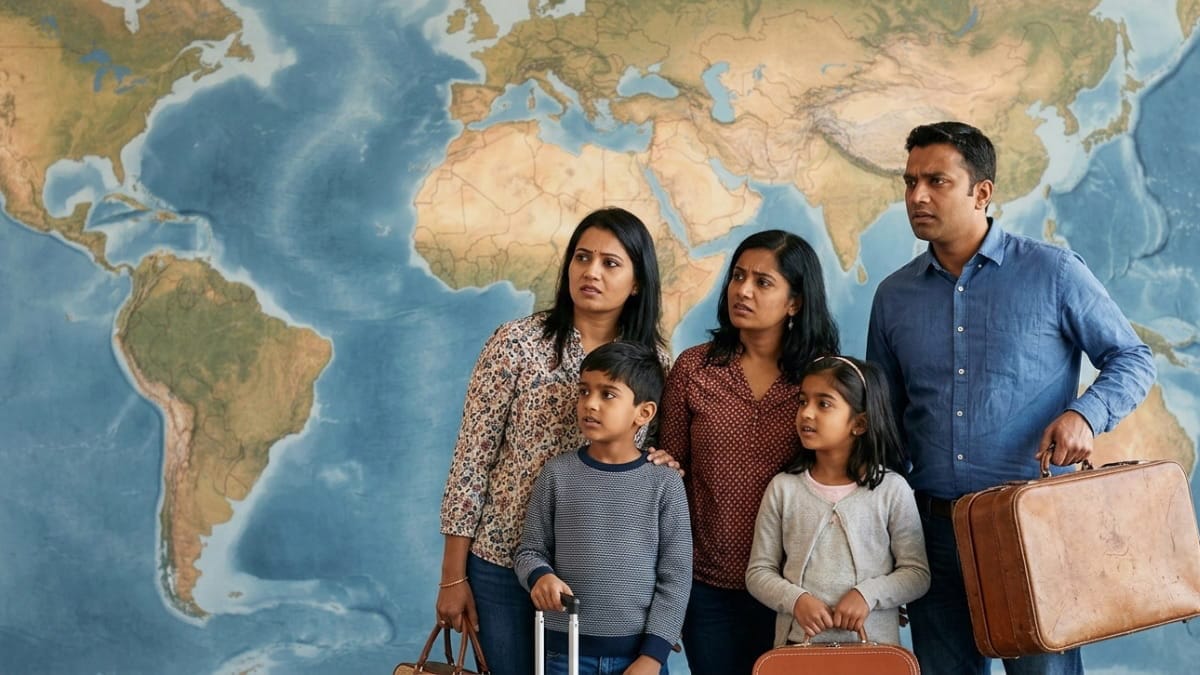
Travel trends 2026: As the summer travel season returns amid an ongoing global crisis, choosing the perfect destination is no longer just about the itinerary. With rising airfares and turbulent conditions in West Asia, caught in the crossfire of the US-Iran war, Indian travellers are rethinking their plans, shifting to domestic hotspots, Asian destinations, and offbeat alternatives.
FinancialExpress.com spoke to EaseMyTrip, Thomas Cook, SOTC Travel, and Travel Lounge Leisure & Tours about the trends shaping summer 2026.
Domestic travel surges as global uncertainty mounts
As geopolitical tensions disrupted westbound travel, one sector in India saw a sharp surge — domestic tourism. Travellers are flocking to hill stations in Himachal Pradesh, Uttarakhand, and Ladakh, while a growing segment is actively seeking offbeat destinations.
Rikant Pittie, CEO and Co-Founder of EaseMyTrip, told FinancialExpress.com, “There is a noticeable shift towards exploring a wider mix of destinations, including emerging and offbeat locations. Travellers today are more open to discovering new experiences beyond traditional hotspots.”
However, as uncertainty mounts, Hari Ganapathy, Co-founder, Pickyourtrail revealed, “The immediate impact is largely operational rather than a structural drop in travel demand. We’re seeing fare increases of 10–25% on domestic and short-haul routes, 12–17% on Europe packages, and up to 50–60% spikes for Dubai due to disruptions.”
If not West, then where?
Among the less conventional spots gaining traction with Indian travellers are Garo Hills in Meghalaya, Mandvi in Gujarat, and Gokarna in Karnataka on the domestic front, and Phu Quoc in Vietnam and Tashkent in Uzbekistan internationally, according to EaseMyTrip.
Meanwhile, SD Nandakumar, President and Country Head, Holidays & Corporate Tours at SOTC Travel, said, “We continue to see consistent travel interest from Indian travellers, with a preference for Eastbound and Far East destinations such as Japan, South Korea, Thailand, Singapore, Malaysia, Vietnam, Philippines and Indonesia, along with Australia and New Zealand.”
Pittie added that EaseMyTrip is seeing “strong traction towards high demand short-haul and medium-haul destinations such as Japan, South Korea, Vietnam, Thailand, Sri Lanka, and Bali,” with double-digit growth in interest for Asian hotspots. Hari Ganapathy also revealed that these spots, especially in Southeast Asia, South Korea, and Japan, have displayed a 16-20% year-on-year uptick in demand, hinting at a redistribution rather than a demand.
Flexibility over adventure
The shift is not just in where people are going but in how they plan. Travellers are prioritising flexible booking options — rescheduling, refunds in case of emergencies — and choosing convenience and connectivity over adventure.
“We are seeing a more thoughtful and adaptive approach to travel,” Pittie said, adding that while the inclination to travel remains strong, travellers have become more “mindful and strategic.”
“The travel landscape is evolving rather than slowing down,” he said. “This has resulted in a redistribution of demand across destinations, with both domestic and international travel continuing to see steady momentum.”
Multi-city trips gain ground
Rajeev Kale, President and Country Head, Holidays, MICE, Visa at Thomas Cook (India), said travellers are increasingly combining destinations into a single trip. “This is also giving rise to multi-city trips where customers combine a Southeast Asia holiday with their long-haul itinerary onward, enabling them to maximise their travel experience within a single trip,” he told FinancialExpress.com.
Several travel agencies are now offering flexible options, including rescheduling and refunds, to accommodate this evolving demand. Interestingly, the price surge for such packages, from India to Bali, Thailand, or Vietnam, has been nearly 6-8%, as compared to other destinations, revealed Pickyourtrail’s Ganapathy.
Experiential and spiritual tourism on the rise
SOTC Travel’s Nandakumar noted that while Indians are travelling to close-to-home destinations like Nepal, Sri Lanka, and Bhutan, spiritual tourism has seen a comeback. “Spiritual tourism, in particular, is gaining momentum… travellers are seeking meaningful and faith-led experiences pan-India,” he said.
Experiential travel is also gaining ground among younger travellers. Rather than ticking off tourist hotspots, Gen Z travellers are increasingly planning trips around concerts and music festivals, hopping from one city to another to catch their favourite artists.
Nandakumar also pointed to cruising as a growing experiential segment, noting interest in Asian sailings “including the Disney Adventure cruise from Singapore, which is driving demand among Indian multi-generational families seeking immersive cruise holidays.”
The human touch in travel planning
Leena Jhugroo, Managing Director of Travel Lounge Leisure & Tours, told FinancialExpress.com that as travellers seek more personalisation, demand for human involvement in the planning process is likely to grow. “There is also expected continuing demand for expert planning services, particularly for international travel, given that travellers increasingly desire convenience and reliability in the travel planning process,” she said.
From the point of view of travel agencies, Pickyoutrail also added, “The immediate impact is largely operational rather than a structural drop in travel demand. We’re seeing fare increases of 10–25% on domestic and short-haul routes, 12–17% on Europe packages, and up to 50–60% spikes for Dubai due to disruptions,” commenting on the effect of the US-Iran conflict.
Jhugroo framed the broader shift not as a disruption but as an evolution. “This change represents an evolution toward a more mature, discerning traveler who places significant importance on quality, planning, and purpose throughout their travels.”