



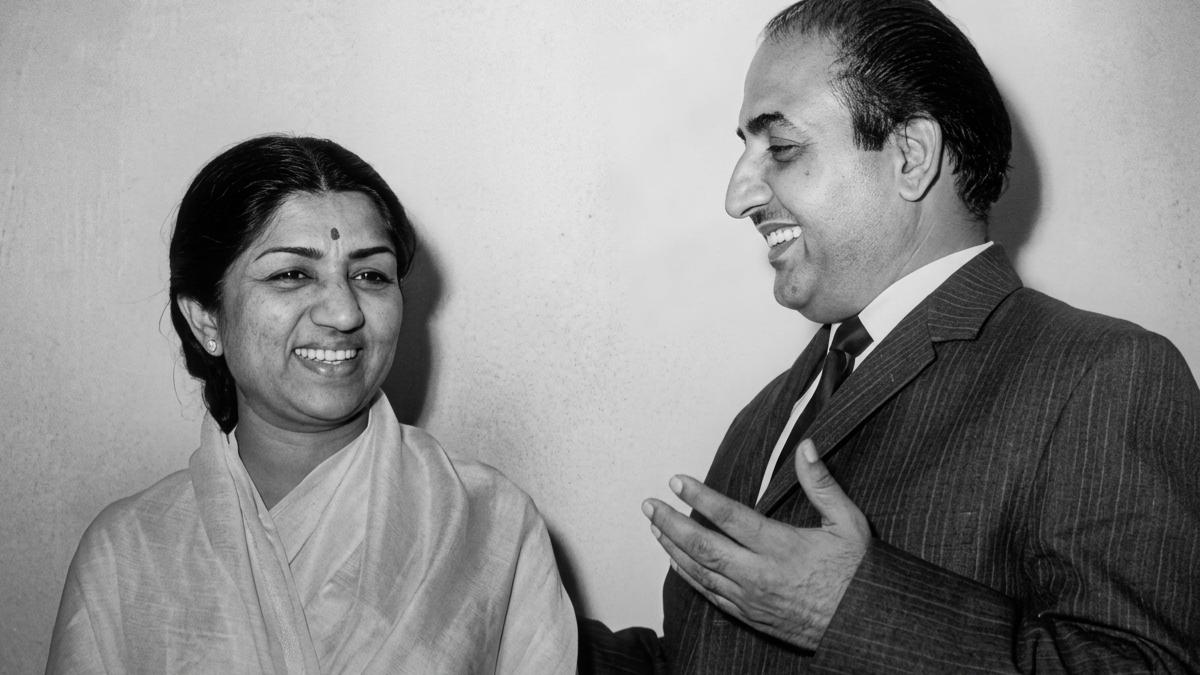
In the early 1960s, Lata Mangeshkar did something that no playback singer in Hindi cinema had dared to do: she picked a fight over money. Not just any money. The kind of money that kept flowing long after the microphone was switched off.
Playback singers at the time were paid a flat one-time fee per song. Music companies, meanwhile, split a 5% royalty from record sales with producers and select composers.
According to the book Lata Mangeshkar…in Her Own Voice by Nasreen Munni Kabir, she wanted friend and collaborator Mohammed Rafi to back her in demanding a half-share from the meagre 5%. This was a fair demand as the singer in the scenario got nothing further, no matter how many copies sold.
Lata’s argument was straightforward: records sold on the strength of voices, and voices deserved a share.
The split that silenced duets
Despite her expectation that Rafi – the era’s dominant male voice – would stand beside her in support. He didn’t, unfortunately. Mangeshkar’s hopes were shattered as Rafi maintained that the playback singer was only re-creating a song and that the credit belonged to the lyricist and the composer. According to him, once the fee was settled, the claim ended.
The disagreement then turned personal. According to The Print, from 1963 to 1967, Lata Mangeshkar and Mohammed Rafi – the undisputed queen and king of playback singing – did not feature together in a single duet.
The fallout rippled across the industry. Composers were forced to take sides and the two long-time collaborators turned to other creative partners. As per the same report, the most prominent replacement for the female voice was Suman Kalyanpur, who had a striking resemblance to Lata Mangeshkar’s sweet tenor. Rafi, meanwhile, was so indispensable to Hindi film music that there was simply no equivalent on the male side. Though Mahendra Kapoor tried to fill in for him, he still couldn’t match up
And if that wasn’t enough, tensions ran deep within the family as well, as Asha Bhosle, her younger sister also sided with Rafi. According to Lata Mangeshkar…in Her Own Voice, Asha Bhosle’s stance created and deepened a rift between the two. The two had a distinctly cool relationship after the fallout of the dispute. Though they made up in various ways over the years and also collaborated on various projects.
Who really won
In the end it was the Nightingale of India who had the final word, though the victory proved to not be as satisfactory as expected. It came in stages – and for most of her contemporaries, it was already too late.
According to Radioandmusic.com, citing a 2000 interview with music journalist VK Doobey, Lata herself managed to secure a personal royalty arrangement – drawing 2.5 percent from a producer’s share – but this was an individual deal, not an industry-wide change.
The broader legal battle took decades longer. According to the British Film Institute’s account of Lata’s life, the Indian Copyright Act of 1957 was amended in 2012, making it a legal requirement to pay royalties to singers for the first time. The Indian Singers’ Rights Association was formed in 2013, chaired by Mangeshkar, and after a lengthy campaign, Indian singers began receiving royalties in 2018.
More than fifty years after Lata first raised the issue in a recording studio, the argument she started was still being fought in courts and government offices.
A truce finally brokered
The truce came through music and the intervention of music director Jaikishen (of Shankar-Jaikishan). In Lata’s own words, as quoted in Lata Mangeshkar…in Her Own Voice:
“An S.D. Burman night was held at Shanmukhananda Hall in 1967 and Rafi Sahib and I met on the stage. We were both very pleased to be singing together again and sang the Jewel Thief duet Dil Pukaare.” They continued recording together until Rafi’s death.
The dispute is, in many ways, the 1960s version of a conversation the music industry is still having: of artists vs platforms, singers vs the industry. Yes, she fought for her cause and emerged victorious but the catalogues recorded before that – thousands of songs by hundreds of singers – continued to earn for labels and producers alone.
Lata Mangeshkar died in 2022. Mohammed Rafi had died in 1980. This fight for proper compensation of one’s talent outlasted almost everyone who experienced it.