



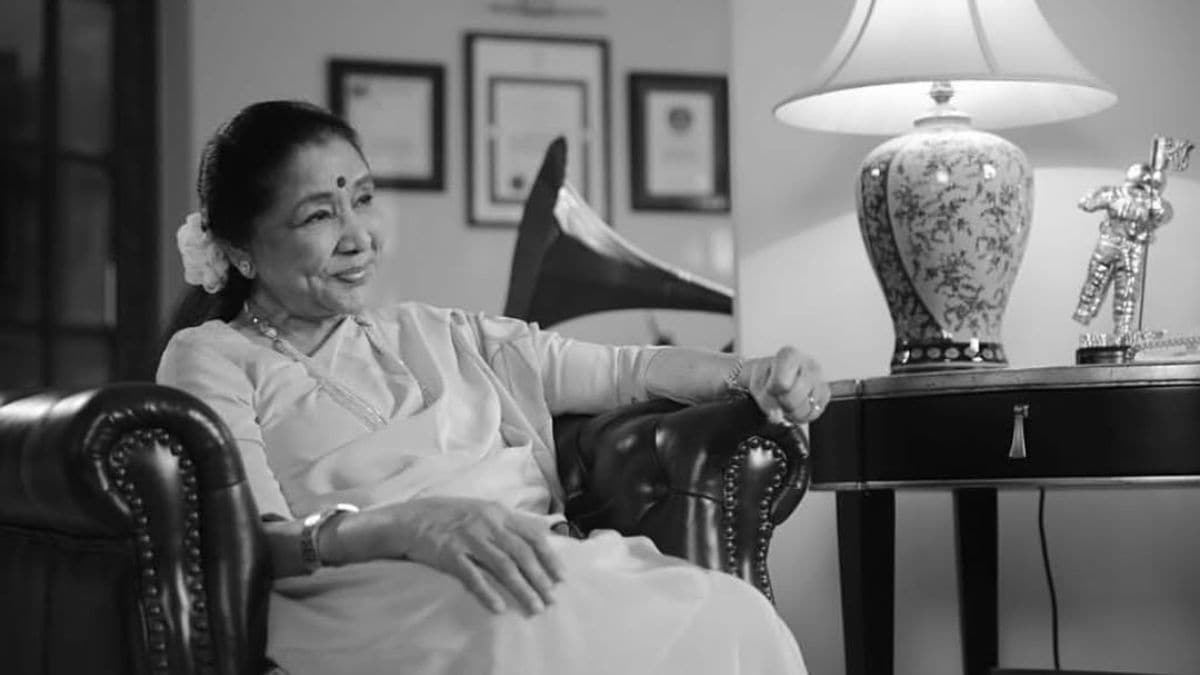
Asha Bhosle, one of India’s most versatile and beloved singers, passed away in Mumbai on Sunday at the age of 92. Her family confirmed that she breathed her last at Breach Candy Hospital, marking the end of a remarkable career that spanned over seven decades. For millions, her voice wasn’t just music; it was something that stayed with them through different phases of life.
For years, Asha quietly worked to step out of the shadow of her elder sister, Lata Mangeshkar. She didn’t just want to be known as someone’s younger sibling; she wanted to be recognised on her own terms. And over time, she built a name that came to represent versatility, resilience, and a fresh, modern sound that reshaped Indian music.
How did Asha Bhosle make her own identity?
Along with her elder sister, Lata Mangeshkar, Asha helped define the golden era of Indian cinema. Yet, there was a time when a young Asha feared she would always remain in her sister’s shadow.
In an interview with India Today, she once recalled when a production man once mistook Lata’s voice for hers. “I come from a family of musicians… my voice was very much similar to Didi (Lata Mangeshkar). Initially, when I sang, my voice would come out the same as Didi’s. Once a man called me… He mistook Didi’s voice for mine. He said, ‘Yeh Asha ka gaana hai.’ I clarified right then, ‘No, it’s not me. It’s my sister’s song.’ Then he apologised.”
That incident was a turning point. Asha began questioning her artistic identity. She realised that if she continued to sound like the “Nightingale of India,” there would be no room for her. “I thought to myself, if I continue to sing in a similar voice to Didi, then I will never get work as long as Didi is in the business. I won’t have a name and fame of my own,” she then said in an India Today interview.
Bringing the West to the East
To create her own unique sound, Asha Bhosle looked beyond India for inspiration. At a time when most playback singing followed a straight and simple style, she began watching English films and listening closely to Western music.
She noticed how Western singers used more variation in their voices; there was movement, softness, and a kind of ‘quiver’ that added emotion. This was very different from the more direct style commonly heard in Indian songs back then.
Asha didn’t just observe; she practised for hours to stand out. She trained herself to understand these techniques and slowly began adding them to her own singing. This helped her bring a fresh, modern feel to her songs, making her voice stand out and giving Indian film music a new dimension.
“I had the habit of watching English films and listening to English songs. They sing very operatically. But there’s no quivering in our voices when we sing here in India. Indian songs are sung straight. I wanted to be able to sing all kinds of songs. So I brought the Western singing style to India. I trained myself accordingly,” Asha shared with India Today.
This evolution allowed her to become the voice of the ‘modern’ Indian woman. While Lata was often the voice of the heroine’s soul, Asha became the voice of her spirit, her rebellion, and her sass.
The ‘quiet’ competition
The relationship between the two sisters was one of deep love mixed with a “healthy competition.” Asha admitted that recording alongside Lata was a high-pressure environment. Speaking to India Today, she noted that she always had to be on her toes, wondering what “extra touch” Lata would add to a track.
“Whenever I used to record with Didi, I had to be extremely conscious. I had to be prepared for what different thing she would add this time. We had a thing for adding our own touch to songs, so I used to be worried. There was a pressure to give an equal attempt at adding something new… to leave my mark,” she said.
She wasn’t afraid to take risks that others shied away from. She famously recalled the recording of the iconic “Piya Tu Ab To Aaja,” where the lyricist Majrooh Sultanpuri actually walked out of the studio. He told her, “Beti, maine ganda gana likha hai” (Daughter, I have written a bad song), worried about what his own children would think. Asha, however, saw the musical genius in the track and stayed true to her commitment. It became a massive hit, cementing her as the queen of the cabaret.
How did Asha Bhosle become a voice for every generation
Asha’s greatest strength was her ability to stay young. She once said that while young boys loved her energetic tracks, they would shift to classical styles as they aged. To counter this, she simply moved with the next generation.
“Young boys used to really like my songs. When they get old, they prefer the classical style of singing. So, I’ve been moving along with the upcoming generations,” she once said in a media interaction. This adaptability is why she could effortlessly transition from the soulful “Chura Liya Hai Tumne Jo Dil Ko” in the 70s to grooving to ‘Kaala Chashma’ in her later years.
Over an extraordinary career, Asha Bhosle recorded over 12,000 songs, earning a place in the Guinness World Records. She was honoured with the Padma Vibhushan in 2008 and the Dadasaheb Phalke Award in 2001.